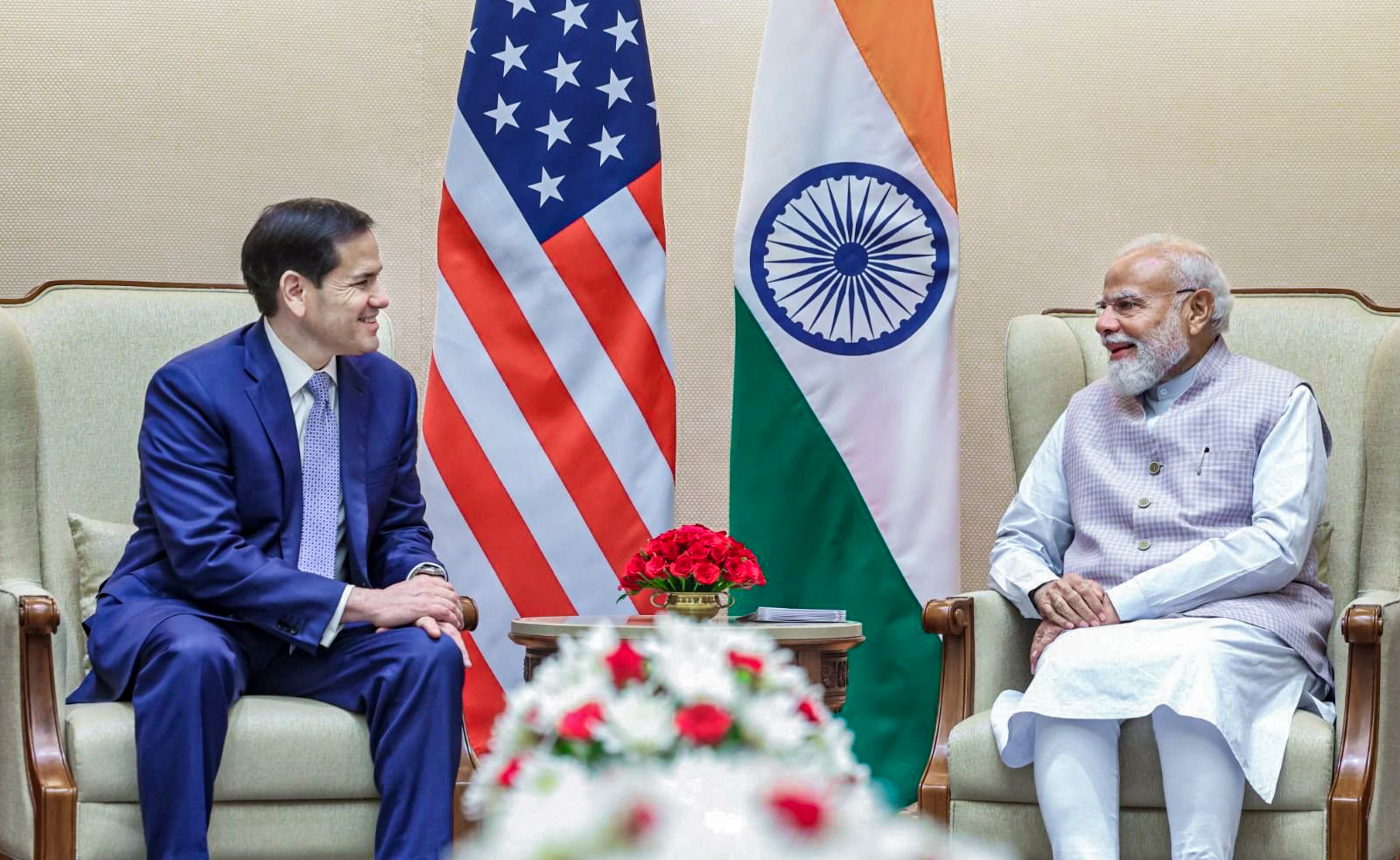
Describing ties with India as a “strategic alliance”, visiting US Secretary of State Marco Rubio Sunday underlined that India is one of the handful of countries that have “global influence” and the “ability to influence global events”.
Addressing a press conference along with External Affairs Minister S Jaishankar, Rubio sought to address concerns of legal migration from India, racist comments against Indians and Indian Americans, and the US’s close ties with Pakistan’s military leadership, while reassuring that the bilateral relationship with India has not lost any momentum.
Rubio said, “There are only a handful of countries in the world that have both the economic and diplomatic power to be influential on strategic issues from a global perspective, and India is one of them, which is what adds the finishing touches on the importance of the strategic alliance… we have a strategic alliance between the United States and India, it’s a strategic alliance between two countries that have global influence and the ability to influence global events, and that distinguishes it from other relationships.”
The two ministers held their bilateral meeting on Sunday, a day after Rubio met Prime Minister Narendra Modi. The US Secretary of State arrived in India on Saturday.
Jaishankar, who was calibrated in his comments, stuck to the “strategic partnership” line and did not mention “alliance”, as he said, “We have a strategic partnership which emanates from a convergence of national interests in many areas.” He outlined issues of defence, energy, nuclear energy, critical minerals, and the trade negotiations as part of the bilateral talks, apart from geopolitical issues in West Asia and Indo-Pacific, among others.
“We discussed the importance of taking into account the Make in India approach and lessons drawn from recent conflicts, while going forward in the defence domain. On the economic front, we spoke about the value of concluding at an early date the final text of the interim agreement regarding reciprocal and mutually beneficial trade,” Jaishankar said.
Both ministers discussed strengthening their strategic partnership, with a focus on defence, security, and economic cooperation. Key points from the bilateral talks include the renewal of the 10-year major defense partnership framework and the signing of a comprehensive underwater domain awareness roadmap.
Story continues below this ad
Asked about the impact of the recent curbs on Indians travelling to the US, Rubio acknowledged the contribution that Indians have made to the US economy. “(T)he changes that are happening now, or the modernisation of our migration system into the United States, is not India-focused. It’s not India-specific. It is global. It’s being applied across the world. We are in a period of modernisation.”
Explaining the context about illegal migration into the US, he said, “We’ve had a migratory crisis in the United States. This is not because of India, but broadly, we had over 20 million people illegally enter the United States over the last few years, and we’ve had to address that challenge.”
“We are modernising the US immigration system for the 21st century, so that it is an immigration system that’s not just good for America, but it’s also good for the people that are coming.”
Responding to questions on racist comments against Indians and Indian Americans, he said that these are “some stupid people” who make “dumb comments” and the US is a very welcoming country.
Story continues below this ad
“I don’t know how to address that, but I’ll take that very seriously about the comments. Look, I’m sure that there are people that have made comments online and in other places, because every country in the world has stupid people. I’m sure there’s stupid people here. There’s stupid people in the United States that make dumb comments all the time. I don’t know what else to tell you, other than the United States is a very welcoming country,” Rubio added.
Repairing ties
With Rubio visiting after a challenging year and efforts to repair ties, he also noted that there has not been any loss of momentum in India-US bilateral ties.
Responding to questions, he said, “The US-India relationship has not lost any momentum. I understand why some people might say that. I mean, I don’t understand, but I understand some people say that, but I don’t see it or view that in any way, shape, or form. The reality of it is, this is not about India, this is about the United States, in terms of trade. The president did not say, ‘Let’s figure out a way to create friction with India over trade.’ The president came in and said, ‘We have a trade situation involving the US economy that doesn’t work moving forward. There’s a huge imbalance that’s built up, and it needs to be addressed.’ And he pursued it from a global perspective. And so I can tell you, as Secretary of State, there virtually is no country in the world that I could travel to that isn’t going to raise the issue of trade, because we did this from a global perspective.”
The Secretary of State listed areas of cooperation, including on Pax Silica, an initiative on critical minerals. “This is an area of strategic concern for both sides, and we are partnering with it on it, and it’s an example of what we wanted to continue to build on. So, you know, in just the last few months, as I said, there’s $20 billion of Indian investment in the US economy, and that number continues to grow, so I think the relationship continues to be strong, and in fact I believe by the end of this administration it will be stronger than it’s ever been. That’s certainly our goal, and that’s certainly what we’re building towards,” he said.
Story continues below this ad
On the Trump administration’s close ties with Pakistan’s military leadership, Rubio also sought to assuage the concerns. He said, “As far as our relations with other countries. Yeah, we have relations, and we work at the tactical level, for example, and in many other ways with countries all over the world, so does India. That’s what responsible nation-states do. But I don’t view our relation with any country in the world as coming at the expense of our strategic alliance with India.”
On the blockade of the Strait of Hormuz and its impact, he said that “this is an international waterway… they don’t own it. It’s an international waterway, and what they are doing now is basically threatening to destroy commercial vessels using an international waterway. That is illegal under any concept of international law that governs us… if we allowed that to become normal, we would be normalising an unacceptable status quo and setting a dangerous precedent that could be replicated here in this region and in multiple places around the world.”