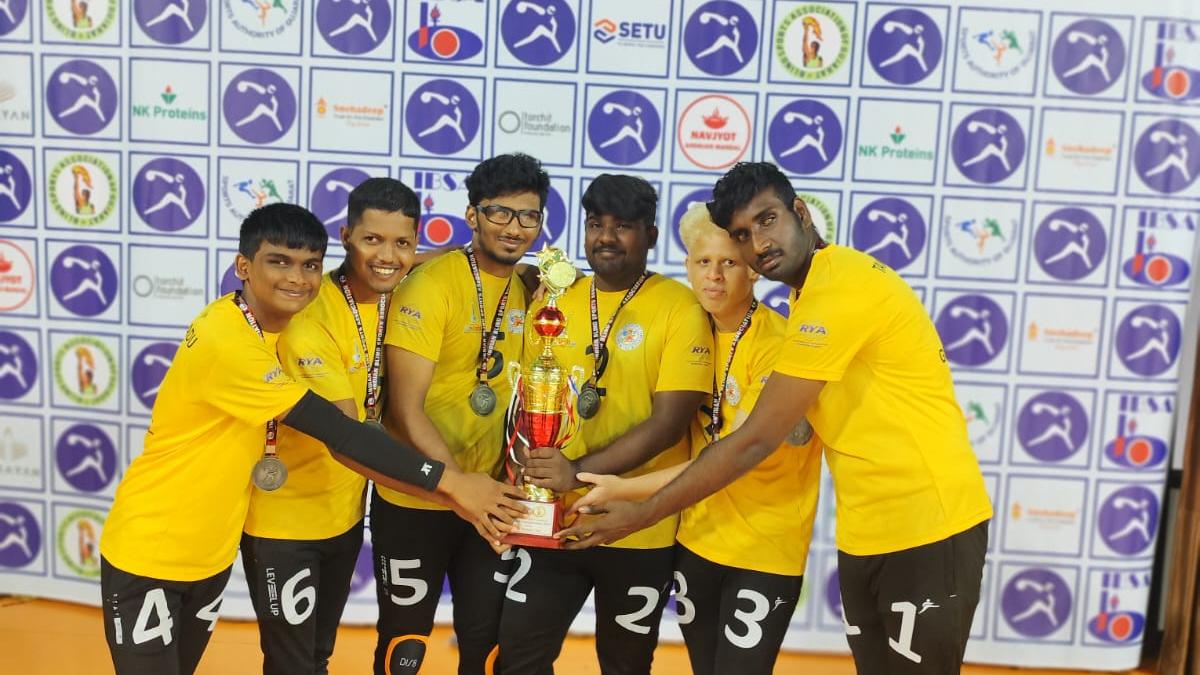

Viewed at a surface level, the Tamil Nadu team’s great showing in the Indian Blind Sports Association’s “Second Youth National Goalball Championship 2026”, where it took the second place, is just another victory in a sporting arena. At a deeper level, this victory signals other victories.
For one, it is a victory for the Goalball Association of Tamil Nadu, a registered body just a year old, for its successful efforts to stitch together a team comprising visually impaired students from small towns and difficult economic backgrounds. Many of them look at sports as a ticket to a stable government job.
R. Barath, a final year student of Presidency College, grew up in a joint family in Erode. His single father and uncle are visually challenged. Just three months ago, he learnt about the sport from a friend and got selected to the state team. “There are many blind students like me at Presidency College, Queen Mary’s College and Nandanam Arts College. Conducting awareness sessions about this sport will encourage many more to join it and benefit they way I have,” he says
A short put and javelin thrower, Ahilendiran D from Madurai got to know about goalball from his coach. An orphan, Ahilendiran supports his family taking up part-time jobs. After this victory, he hopes they get to compete in recognised competitions and more people and organisations come forward to sponsor them as well. Rajasthan Youth Association Foundation sponsored them for the just-concluded event.
A judo coach for the blind, V. Maheswaran from Salem was roped in to coach the boys team noticing the interest he showed in the para sport. He picked up the sport watching videos online and with the help of his son. “We all are learning and getting better with every competition. When we had the selection camp in Chennai, we sought help from members of Telangana team,” says Maheswaran. Proud that three of his judo students have landed government jobs, he says, sports is not a level-playing field especially for those with disabilities and more organisations should come to empower students to take up sports.

A team effort
For the national tournament, participants have to wear an eye patch but each costs more than ₹ 3,000, so we just tied a black cloth and played, he says.
Finding new talent
Visually challenged G.R. Bharathi Raja, who started the Tamil Nadu Blind Football Association in 2019, is also coaching students in goalball. He says goalball is specially designed for those with vision problems and teaches players life skills, builds physical strength and helps with coordination.
The Association is looking at conducting more awareness workshops in schools and colleges about goalball. Their first workshop had 45 students participating in it. “We are happy to visit institutions with visually challenged students to conduct more sessions and groom a new generation of players,” says Bharathi Raja, who works with Indian Bank.
Besides accessible facilities to play and practise, the sport needs support on many other fronts.
Vidyashankar B, chairperson, Goalball Association of Tamil Nadu, wants the State Government to reward players who win national and international tournaments with cash awards.
Bringing players together at one space is a challenge. “If every district allots a space in a stadium for goalball then it saves the travel time, cost incurred for food and accommodation for many of these players who come from humble backgrounds,” says Vidyashankar, who works with an IT company and is grateful to the support from Lit the Light Trust where he was a volunteer.
Finally, for players with visual disabilities it is not just about winning medals but to show to the world they can compete in a para sport.
The history of it
Invented in 1946 as a rehabilitation sport for visually impaired World War II veterans, the sport evolved into a competitive discipline and gained international recognition. In 1976, Goalball was officially introduced as a Paralympic sport at the Toronto Paralympic Games.
Played by two teams of three players each in an indoor court that roughly measures the size of a volleyball court (18mx9m), goalball relies on auditory skills, teamwork and tactical awareness. A bell inside the ball allows players to track movement through sound. All players wear opaque eye masks to allow players with varying degree of blindness to compete on an equal footing. Players roll or throw the ball hard along the floor to get it past the opposing team’s defence and into a 9-metre-wide goal.
For details, visit https://tngoalball.in/ or call 93449 87893