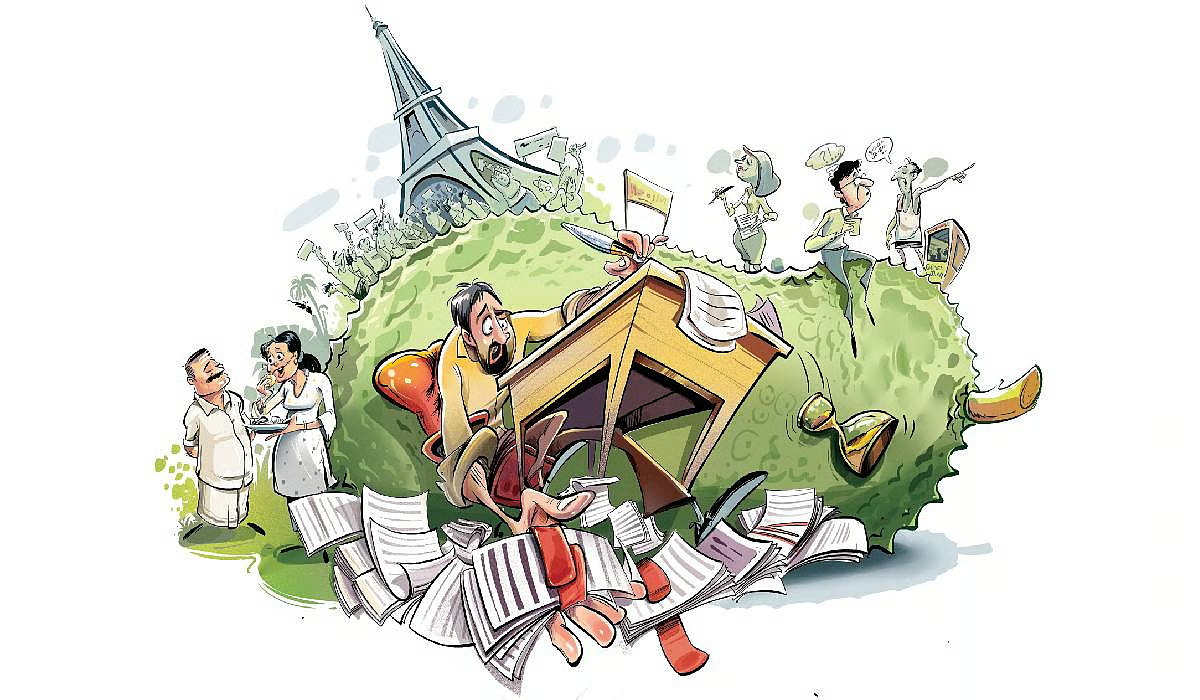
Look, an investor
A recent startup event in Kochi had young entrepreneurs, some right out of college, putting up stalls detailing their ambitious projects. It so happened that this correspondent was accorded a warm welcome to the venue, with the organisers and the top Kerala Startup Mission officials going out of their way to extend greetings. People, especially those manning the stalls, took note.
Unaware of the ‘buzz’ around my entry, I walked up to the stall of a startup that developed games. The enthusiastic founders started explaining their product and their business idea. ‘Good story,’ I thought, and took the discussion forward. Soon, with a flourish, the youngsters took out their visiting cards and requested a meet-up to discuss their product further. Suddenly, the realisation dawned: ‘They are after funding and I am their prospective investor!’
“Oh no, I’m a journalist,” I corrected, setting off loud laughter. The founders, however, were quick to clarify that a story on them would be just as important.
Anu Kuruvilla
Jackfruit for lunch, in the wild
On an assignment to the Chinnar Wildlife Sanctuary, I set off from Kottayam at dawn, armed with a notebook and on the strength of a cup of coffee. En route from Marayur, I hoped to find some shop. Instead, the road slipped quietly into reserve forest stretches—no shops, no tea stalls… only trees and wildlife warnings.
Past the checkpost and a five-kilometre drive through the sanctuary, I was at my destination – a tribal settlement — around 2 pm. By then, I was so hungry I felt capable of devouring an elephant! As is their custom, the Muthuvan community welcomed me warmly. An elderly woman offered coffee, and on learning I had missed lunch, the tribal chief promptly plucked out an ‘elephant-sized’ treat — a ripe jackfruit. He sliced it open, served as fresh as any.
Perhaps it was the hunger, or the kindness, but that was the sweetest jackfruit ever! Talk of hospitality.
Nejma Sulaiman
Deja vu in Paris
A week-long stay for a climate conference in Paris, the fashion capital of the world, enabled this reporter to see up close its impressive civic sense, love for arts, polite behaviour, and the way Parisians valued privacy. But on September 18, as I walked around the streets, a sense of shared culture hit me. There it was, playing out in front of my eyes… a massive protest march… in Paris! The metro system and the suburban rail service were disrupted, not to speak of traffic snarl-ups, as thousands of workers led by 10 trade unions marched down the streets protesting President Emmanuel Macron’s proposal for budget cuts. Placards, slogans, and dancing on the streets… as if I was back witnessing one of the routine protests on the Palayam-Secretariat stretch in Thiruvananthapuram. My journalist friend quipped: “A cultural connect!”
Manoj Viswanathan
Fritters? No, politics
Covering local body elections entails travelling to the remote corners of a district, Kasaragod in this reporter’s case. Having reached the border town of Muligadde, hardly a kilometre from Karnataka, after a long day, my friend and I sought refuge at a roadside shack for some refreshment.
We attempted to strike a conversation on politics, in chaste Malayalam. The shop owner returned a blank look and called in his cook. The elderly man began explaining the fritters on offer, in Tulu! It was our turn to return that blank look.
I racked my brain to brush up on some Kannada. The conversation then turned into an interesting mixture of Tulu, Malayalam and broken Kannada. But none of us understood what the other was saying! Finally, two other customers came to our rescue. ‘It’s about politics, chetta!’
Well, the awkward smiles said it all: There’s plenty to learn in a district that speaks seven languages.
Arockiaraj J
Location live, assault invited
Amid the political uproar over a sexual assault complaint, this correspondent rang up a police officer in Malappuram to verify certain facts. Instead of offering the usual grim response, the officer jumped straight into describing a critical turn of events, in all seriousness: “An IUML worker abused that particular survivor while chatting in a local WhatsApp group. He then picked a fight with CPM workers, dragged their wives into it, shared his live location daringly, and went home and slept. The CPM workers took the location pin seriously, followed Google Maps, reached his house, and attacked him while he was snoring!”
The moment he finished the account, we burst out laughing, simultaneously.
That, the officer said, was the first instance in his career of a victim sending an ‘invitation’ to the attackers.
(The IUML worker suffered minor injuries and the CPM workers were caught.)
Lakshmi Athira
Love in the time of AI
Out of nowhere, the ‘Rahul–Ashwathi Chechi’ romance flooded Kerala’s social media timelines. Emotions ran wild and shares multiplied before questions could even arise. The story felt so real — a childhood rescue, a life-altering sacrifice, and a love wrapped in pure Malayali sentiment — that thousands admired it without blinking. But the deeper I dug, the ‘touching love story’ turned into a reporter’s nightmare. As the cinematic fog cleared, a ‘digital’ villain came to the fore: artificial intelligence! No real Rahul, no heroic lorry scene, just an expertly crafted AI narrative that hijacked human empathy and went viral.
By the time the truth surfaced, the damage — or rather the ‘business’ — was done, proving yet again that in the age of scrolling thumbs and soft hearts, feelings trend faster than facts.
Pooja Nair
Looming deadline and a deep dive
More than eight years after the traumatic night, and nearly five years after the trial began, the long-awaited verdict in the 2017 actor abduction and sexual assault case was pronounced on December 8. Actor Dileep was acquitted, while Pulsar Suni and five others were convicted. For the public, it was a verdict. For this correspondent, it was the culmination of years of reporting marked by shock, exhaustion, and quiet pain. Four days after the verdict, on December 12, I reached the court at 9 am. The courtroom was jam-packed, heavy with anticipation. By 11 am, the sentence was announced. A familiar ritual followed, of reporters waiting for the verdict copy. Hours passed.
Afternoon slipped into evening. At 9 pm, I was still on the court premises, empty-handed, deadline looming. With no copy of the verdit in sight, I headed to the office to file the main story and allied reports. Even after finishing those, the hunt for the all important document continued. At 10.30 pm, news broke that the verdict copy was out. Immediately, I called my source, a lawyer representing two of the accused persons. He received the copy at 11 pm and I rushed to collect it. The day’s final edition was drawing close.
Back in the office, I opened the massive order — 1,709 pages! I couldn’t help but stare at it for a few seconds. Quickly, the ‘deadline bell’ rang in my head, and I dived into the details. Thankfully, almost immediately, my eyes caught a crucial section: the court posing questions on the person behind the alleged quotation. I read that portion at breakneck speed, focused only on what mattered most for the story. Somehow, through fatigue and adrenaline rush, I finished writing in time. I felt a rare happiness, more relief than joy, having filed a story based directly on the verdict the very same day.
P Ramdas