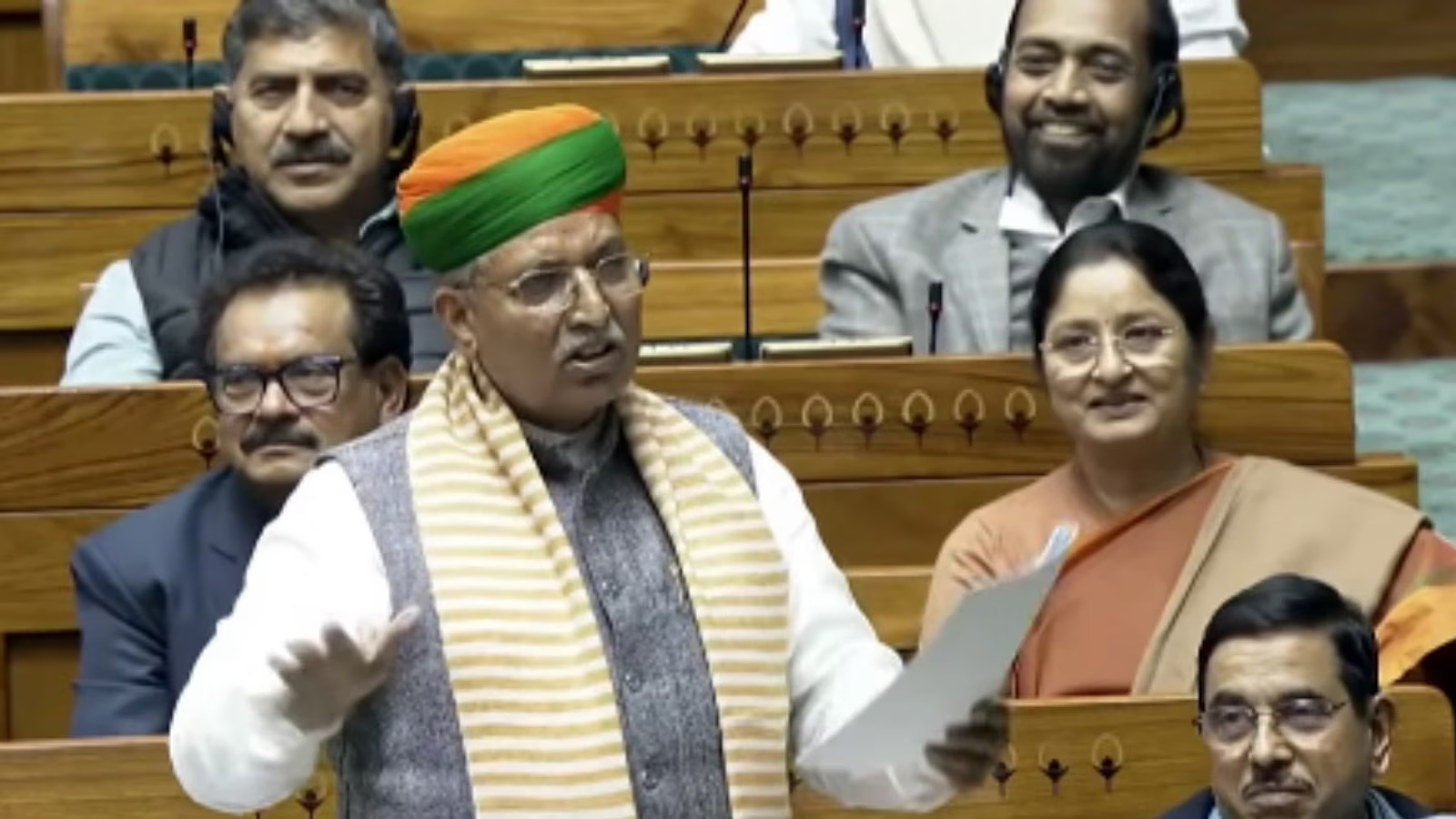
The BJP and its allies on Tuesday mounted a defence of the Special Intensive Revision (SIR) of electoral rolls during a discussion in the Lok Sabha on electoral reforms, even as they avoided directly shielding the Election Commission (EC) that is currently facing sustained Opposition criticism. Instead, the Treasury benches turned the debate into a political indictment of the Congress, accusing it of “undermining institutions”, “corrupting electoral practices”, and crying foul because of its “inability to win elections”.
While Law and Justice Minister Arjun Ram Meghwal set the tone, framing the SIR as a Constitutional necessity rather than a political exercise, the ruling NDA alliance also fielded senior leaders from Bihar, where the SIR exercise before the recent Assembly polls had kicked up a storm.

Invoking B R Ambedkar’s 1949 speech on “one man, one vote and one vote, one value”, Meghwal said the principle was at the heart of the revision drive. “One person should have only one vote… no eligible person should be denied… and no ineligible person should be enrolled,” he said, adding that SIRs had been carried out “from time to time” during Congress rule as well.
“If they do it, it’s fine; if we do it, it’s wrong. What kind of contradiction is this?” he asked, a line that framed much of the Treasury’s pushback: that the Congress was objecting not to the process but to its political consequences.
Meghwal even turned Rahul Gandhi’s “vote chori (theft)” slogan around, alleging that the Congress had indulged in “electoral wrongdoing” from the very first general election. Citing the 1951 Mumbai North contest that Ambedkar lost after “74,333 votes were declared invalid”, he said, “This was the first example of electoral corruption.”
The line of attack was meant to place the Congress on the defensive by tying its complaints about the EC to a historical pattern that the BJP claims is rooted in the Opposition party’s legacy, rather than an institutional decline as alleged.
The Law Minister alleged that Congress Parliamentary Party chairperson Sonia Gandhi had been enrolled as an elector before becoming a citizen, and was later removed. Pointing out that the latest SIR exercises were being conducted after two decades, Meghwal said, “In this time frame, rapid urbanisation, migration for education and employment and other socio-economic changes have led to citizens shifting residences repeatedly.”
Story continues below this ad
As the debate progressed, BJP MPs dialled up both the historical sweep and the political temperature. Nishikant Dubey, who represents Godda in Jharkhand, said the Congress’s tradition of politicising institutions was behind the current accusations against the EC. From the Swaran Singh Committee in 1975 that “finished all institutions” to Congress-linked officials later appointed as governors, ministers or candidates, Dubey argued that Congress manipulated every pillar of the Republic but now positioned itself “as a guardian of electoral integrity”. “What honesty and transparency are you talking about?” he asked.
Part of the Treasury’s strategy appeared to be to show that SIR had not, in fact, benefited the BJP electorally. In an attempt to blunt the charge that SIR was partisan, Dubey pointed to examples in Bihar and Maharashtra where deletions and additions had not prevented Opposition victories. But woven into his argument was the BJP’s long-running charge that demographic shifts in eastern states were fuelled by “illegal immigration” and were being protected by Opposition parties. He cited figures from Santhal Pargana and West Bengal to ask rhetorically, “Who are these 15%? They are all Bangladeshis on whose votes JMM and Congress win elections. And that is why they oppose the SIR.” The claim served the BJP’s political framing: that SIR threatens “vote-bank politics” rather than legitimate voters.
From Bihar, the BJP’s political messaging sharpened further. Former state BJP president and Paschim Champaran MP Sanjay Jaiswal accused the Congress of repeatedly crying “vote chori” without introspection. Claiming that Booth Level Officers (BLOs) had reached over “99% of houses” and that “1.5 lakh BLAs (Booth Level Agents) of parties, including the Congress” assisted them, Jaiswal suggested the Opposition was attacking its own workers’ efforts. “These people… will blame EVM, SIR, but will not introspect. This is a good situation for us,” he said.
His comments signalled the BJP’s confidence that the Opposition’s narrative lacks credibility outside its own ranks and its belief that the Congress’s defeat in Bihar had undercut its political footing in this debate.
Story continues below this ad
BJP ally JD(U) pointed out that the SIR was the EC’s decision, not the government’s. “We don’t have the right to discuss SIR in this House … it is not the government’s decision and is of the EC,” said JD(U) leader and Union Minister Rajiv Ranjan Singh, popularly known as Lalan Singh.
He questioned why anyone should object to furnishing one of 11 documents to prove citizenship if they were genuine voters. Targeting the Congress’s long-standing grievance with EVMs, Singh said, “If you are given power for 10 years, then EVM is fine. But despite efforts, if you are not accepted by the people, then EVM is the problem.”
Broader criticism
Others in the NDA expanded the debate into a larger critique of the Congress’s historical conduct, weaving familiar BJP-era arguments into the present moment. LJP (Ram Vilas) MP Arun Bharti said the Opposition party had “established booth capturing as a system” between 1960 and 1990 and had imposed Emergency when the court found Indira Gandhi’s election invalid. He claimed the Opposition’s real problem was that “SIR has uprooted the pillars of vote bank politics”, adding that the process had unfolded over three months, not in haste. “The problem is not in the machine or the process, rather in the thought process of the Opposition,” he said.
Shiv Sena MP Shrikant Shinde struck a similar note, contrasting the Opposition’s current rhetoric about “saving democracy” with what he called its own historical abuses. He pointed to the court ruling on Indira Gandhi’s electoral malpractice, alleged that nitric acid was once poured into ballot boxes in the Nehru era, and revived the charge that Ambedkar’s votes were deliberately invalidated. “Those who smothered democracy are today masquerading as its protectors,” he said, echoing the BJP’s broader argument that Congress’s challenge to SIR was less about democratic principle and more about political convenience.