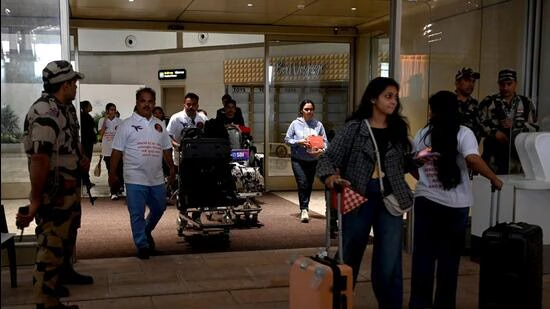
Navi Mumbai: Less than a fortnight after its much-hyped launch, the Navi Mumbai International Airport (NMIA) is facing turbulence on the ground. Passengers flying through the new terminal have flagged serious gaps in mobile connectivity, last-mile transportation, lighting, and signage, which is denting the promise of the Mumbai metropolitan region’s long-awaited second international airport.
Total digital blackout
The most immediate and disruptive problem, passengers say, is the near-total absence of mobile network coverage inside the terminal. Calls drop, mobile data is unavailable, and app-based payments frequently fail, forcing travellers to rely almost entirely on the free airport Wi-Fi for basic tasks, such as contacting family and booking onward transportation.
This lack of connectivity quickly cascades into other problems, most visibly the inability to coordinate pickups. “There was no network the moment I entered. I couldn’t book a cab or even call home. Outside, passengers were standing around, asking each other how to get a taxi,” said Vijay Desai, a business traveller.
Similar frustration was echoed on social media. X user @abadjate cautioned travellers against flying into NMIA in the coming months. “Zero network, no proper arrangements for taxis. Passengers struggling to get cabs,” he wrote, recounting scenes of confusion outside the terminal.
“International passengers face additional hardship as foreign numbers cannot connect to the Wi-Fi, forcing them to take someone else’s phone to make a call or book a cab,” said an airport employee, requesting anonymity.
Privacy concerns and infrastructure gaps
The mandatory reliance on airport Wi-Fi has raised concerns about data security. “Why should I be forced to give my personal number just to get connectivity? This is an infringement of privacy,” said passenger Mukesh Dalvi, pointing to the risks associated with VoIP-based networks.
Beyond connectivity, flyers have raised concerns about the terminal’s interiors. “The airport looks shabby and already feels old. There is no character, and the lighting inside is horrible. There are absolutely no passenger services,” said @abadjate in his X post, which has since gone viral.
The criticism was sharpened by questions over user development fees. “After paying top dollar, ‘something is better than nothing’ cannot be the standard,” wrote @abadjate, questioning how senior citizens and families with heavy luggage are expected to cope.
Transport: a mixed bag
With app-based taxis difficult to access, many have turned to Navi Mumbai Municipal Transport (NMMT) buses. While NMMT has deployed 14 buses across routes to Belapur, Nerul, Taloja, Kharkopar, and Khandeshwar (running every 17-22 minutes), the experience has drawn mixed reviews.
“I took the bus because there was no other option. The ride was tough, and the stepwell was extremely high for people with luggage,” said senior citizen Kalpesh Soni. However, travel vlogger Arindam Mahapatra offered a more measured view, noting that while nine-metre buses have steep steps, larger 12-metre JBM or Volvo buses are being deployed on routes like A-4 to Nerul station.
An airport employee acknowledged that while buses are currently the most reliable option, overall last-mile connectivity remains weak. “There are bus services every 15 minutes to and fro from Nerul Station to the terminal; bus A-4 goes directly, but passengers are largely unaware of this and end up waiting for Ola and Uber. Apart from this bus route, there are very limited travel options—autos drop passengers only at Gate 1, from where one must take an internal terminal bus,” the employee said.
Connectivity isn’t the only pressure point. Motorists have complained about confusing approach roads near the Atal Setu, with some inadvertently driving into cargo areas or construction zones due to unclear signage. Furthermore, only a handful of food and beverage outlets are currently operational, despite the airport’s ambitious retail plans, they said.
NMIAL against ‘cartelisation’
Responding to the backlash, a spokesperson for the Adani Group-led Navi Mumbai International Airport Ltd (NMIAL) said it was a “conscious decision” to install a shared, unified network—known as an In-Building Solution or IBS—to ensure total coverage across the terminal, rather than allowing individual telecom companies to build separate systems.
“Learnings show that certain important areas, such as baggage belts, utility buildings, and ATC (Air Traffic Control) get neglected by TSPs (telecom service providers) in favour of passenger-heavy areas, leading to overall airport inefficiency,” the spokesperson said.
NMIAL also rejected allegations by the Cellular Operators Association of India that telecom firms were denied Right of Way—the legal permission to lay cables and install infrastructure inside the airport premises.
“We have regularly communicated with TSPs and offered IBS services at charges in line with industry standards, to which they are yet to revert. We will not give in to any cartelisation,” the spokesperson said, noting that BSNL is already in an advanced testing phase. In the interim, NMIAL is providing free high-speed Wi-Fi to passengers to mitigate the delay, the spokesperson added.
NMIAL did not respond to a detailed questionnaire regarding other issues mentioned by passengers, such as transportation and road signage, till the time of going to press.
HT did not receive a response from ride-hailing platforms Uber, Ola and Rapido regarding setting up services at the new airport.
With inputs from Osama Rawal