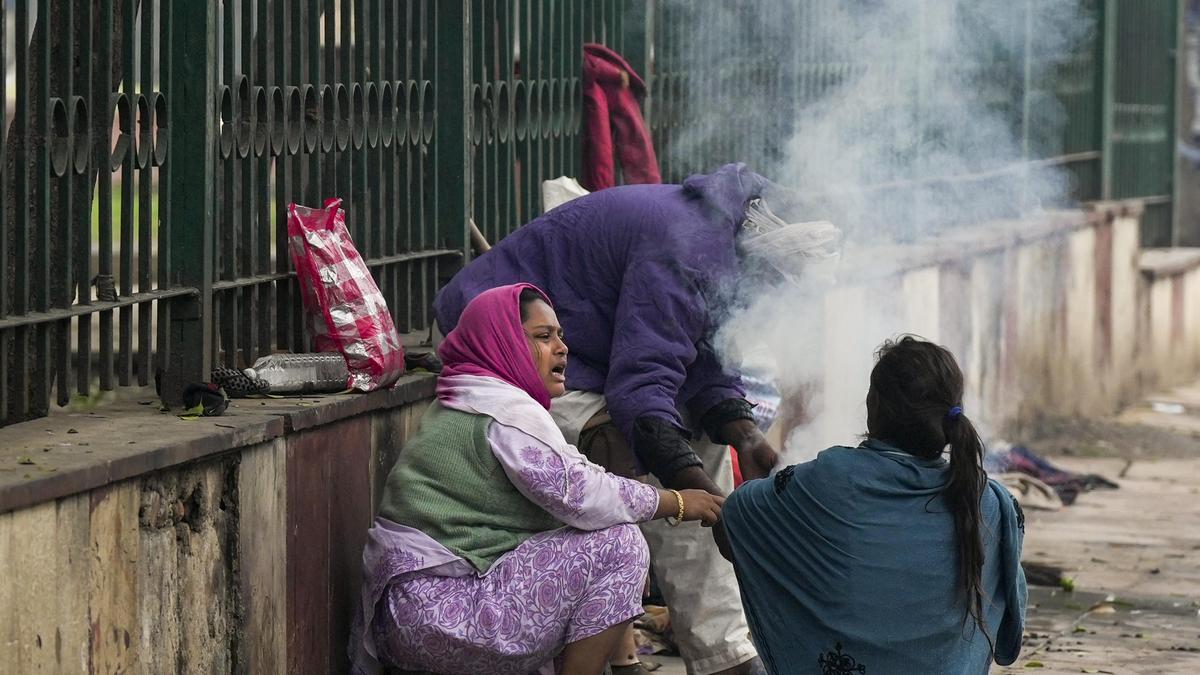
Delhi saw a colder start to February, compared to last year, with the maximum temperature settling at 24.6 degrees Celsius on Sunday, according to the Indian Meteorological Department.
The maximum temperature on Sunday (February 1, 2026) is lower than last year’s 26.2 degrees Celsius while 2.3 notches above the seasonal average, according to official data.
According to the weather department, the minimum temperature settled at 12.1 degrees Celsius, about 3.7 degrees above the season’s average.
At Safdarjung, the city’s principal observatory, the minimum temperature settled at 12.1 degrees Celsius, while Palam recorded 10.6 degrees Celsius.
Lodhi Road logged 11.8 degrees Celsius, the Ridge 12.1 degrees Celsius and Ayanagar 11.6 degrees Celsius.
Maximum temperatures in the city ranged from 22.6 to 24.6 degrees Celsius.
Among the stations, Safdarjung recorded the highest maximum temperature at 24.6 degrees Celsius, followed by Ayanagar at 23.6 degrees Celsius and the Ridge at 23.6 degrees Celsius, while Lodhi Road logged a high of 23.7 degrees Celsius, and Palam recorded 22.6 degrees Celsius.
The relative humidity stood at 82% at 5:30 p.m.
According to the IMD, rainfall over northwest India, including Delhi, Haryana and Chandigarh, is likely to remain below the Long Period Average in February.
Long Period Average refers to the average rainfall or temperature for a region, calculated using weather data from around thirty years, and is used as a benchmark for normal climatic conditions for a given period.
The weather department has forecast above-normal minimum and maximum temperatures during the month, indicating fewer cold nights and warmer afternoons as winter conditions recede earlier than usual.
Meanwhile, air quality in the national capital slipped in the “poor” category, with the average Air Quality Index (AQI) recorded at 265, which was about 315, indicating “very poor” during the day.
According to the Central Pollution Control Board, an AQI between 0 and 50 is considered ‘good’, 51 to 100 ‘satisfactory’, 101 to 200 ‘moderate’, 201 to 300 ‘poor’, 301 to 400 ‘very poor’, and 401 to 500 ‘severe’.
The Air Quality Early Warning System for Delhi has forecast that the AQI is likely to remain in the ‘very poor’ range from February 1 to 3.
The weather department has predicted moderate fog for Monday (February 2, 2026), with maximum and minimum temperatures expected to hover around 21 degrees Celsius and 11 degrees Celsius, respectively.
Kashmir, Himachal Pradesh see fresh snowfall, rains; night temperatures rise across North
Parts of Kashmir and Himachal Pradesh received fresh snowfall and rains on Sunday (February 1, 2026), even as night temperatures rose across the northern States.
Snowfall was witnessed in the higher reaches of Pahalgam in Anantnag district and Qazigund area of Kulgam district, while many areas in south Kashmir, including Srinagar city, were hit by rains.
The minimum temperature in Srinagar city settled at 2 degrees Celsius on Saturday (January 31, 2026) night, up from 0.1 degrees Celsius the night before, according to the India Meteorological Department (IMD).
The ski resort of Gulmarg in Baramulla district, which recorded a low of minus 7 degrees Celsius, was the coldest in the Union Territory.
Pahalgam tourist resort in south Kashmir recorded a low of minus 1.4 degrees Celsius, up from minus 2.6 degrees the previous night.
In Qazigund, the minimum temperature settled at 0.4 degrees, while Kokernag recorded zero degree Celsius and Kupwara minus 1.7 degrees Celsius.
A 20-day Chillai Khurd (small cold) began on Saturday, after the culmination of the 40-day harshest winter period, or Chillai-Kalan. Chillai Khurd will be followed by the 10-day Chillai Bachha (baby cold), officials said.
The IMD has forecast light rain and snow in the higher reaches at many places of Kashmir on February 2-3, they said.
Himachal Pradesh, where a yellow alert has been issued, witnessed light snowfall along with rain on Sunday.
Shillaroo in Shimla district and Kothi in Kullu district witnessed 5 cm snow, while Kufri received 4 cm, Gondhla village in Lahaul and Spiti 3 cm, Khadrala in Shimla 2.5 cm, Sangla in Kinnaur 2.1 cm and Kalpa 0.8 cm.
Manali received the highest rainfall in the state at 10 mm, followed by Sujanpur Tira in Hamirpur district at 7.8 mm. Shimla received 4.2 mm rain, Solan 3.4 mm, Nadaun 2.6 mm and Nahan 2.4 mm.
The lowest temperature in Himachal Pradesh was minus 3.6 degrees Celsius in Lahaul and Spiti’s Tabo village.
The weather office said snowfall and rainfall are very likely to continue in the middle and higher hills of the State on February 2 and 3, while weather will remain dry in plains and lower hills.
Meanwhile, the cold eased in other northern States such as Rajasthan, Punjab and Haryana.
The night temperatures in several parts of Rajasthan stayed above 7 degrees Celsius.
Alwar recorded a minimum temperature of 7.2 degrees Celsius on Saturday (January 31, 2026) night, Lunkaransar (7.7), Pali (8.3), Jawai Dam in Pali district (9.6) and Sri Ganganagar (9.7).
Ajmer witnessed light rainfall at 1.1 mm in the last 24 hours due to impact of a western disturbance. The weather conditions would remain the same in the next 24 hours, officials said.
Minimum temperatures in most places in Haryana and Punjab went up on Sunday (February 1, 2026) and hovered above normal levels.
In Haryana, Ambala recorded a minimum temperature of 12.4 degrees Celsius and Hisar 11 degrees.
According to the IMD, in Bhiwani and Narnaul, temperatures dropped to 6 degrees and 6.5 degrees Celsius, respectively.
Karnal recorded a low of 9.9 degrees, Rohtak (11.8), Sirsa (9.6), Faridabad (11.6), Gurugram (11.2) and Nuh (12.7).
Chandigarh, the common capital of the two States, recorded a low of 11 degrees Celsius.
In Punjab, Amritsar and Gurdaspur experienced a cold night, with temperatures dipping to 5.9 degrees and 6 degrees Celsius, respectively. Patiala recorded a minimum temperature of 10.2 degrees Celsius, Ludhiana (7.6), Bathinda (8.2), Faridkot (7.4) and Hoshiarpur (10.1).