Agra is known for its petha. Ajmer for its sohan halwa. Gurugram for its doda barfi. Indore for its poha. Kakori for its kebabs. Mathura for its rabri. Nagina for its gulab jamun. Nainital for its bal mithai. Orai for its rasgulla. Sandila for its peda. Ghaziabad for its… oh, here’s news!

The Government of Uttar Pradesh has assigned each zila, or district, a signature dish that is acknowledged to be its culinary speciality. Ghaziabad, across the Delhi-UP border, has been paired with soya chaap and pickled chillies. In the coming days, this reporter will try to investigate the city’s soya chaap culture more closely, though the street food scene currently visible across Ghaziabad appears to be dominated by momos, Maggi noodles, samosas, parathas, tikki, tikki-burger Moradabadi biryani, Vegetable biryani, Calcutta egg roll, and increasingly litti-chokha.
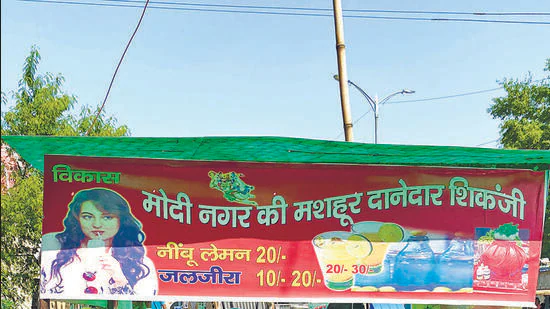
That said, there is a town in Ghaziabad district that has given its name to the particular version of a refreshing drink. The drink is the humble shikanji, a simple mix of lemon and water. The town is Modinagar. And the particular version is Modinagar ki danedar shikanji.
The town lies 50 kilometres from Delhi, but its unique lemon drink has spread across the Delhi region. It is encountered from the lanes of Ghaziabad’s Sita Ram Bazar (aka Turab Nagar) to the localities of old Gurugram. Its presence extends beyond the roadside stalls. Sealed bottles of “Modinagar Wale Famous Shikanji” have popped up on shopping websites. One Instagram reel filmed inside a shikanji place in Modinagar, that claims to have invented the drink, credits its in-house spice mix for the shikanji’s appeal, claiming that the drink “keeps the stomach cool” during the brutal summer months.
Whatever the claims, in Gurugram, one danedar shikanji cart stands in Sadar Bazar, near the Civil Hospital—see photo. The cart hosts a giant brass vessel filled with the lemon drink.
A typical shikanji is simply lemon water seasoned with spices and sugar. So what exactly gives danedar shikanji its granular, or danedar, texture? Is it the bhuna zeera floating on top? Is it the fried boondi sometimes added to the drink? No, and no. One afternoon, during a long-ago conversation, the young vendor of the afforementioned Gurugram cart offered a different explanation. The danedar texture, per him, comes from, believe it or not, ice.
The dandedar shikanji’s basic recipe is much like any other shikanji: lemon, water, zeera, and black salt. But the vessel is filled with a great amount of finely crushed ice. As the vendor churns the drink inside the vessel with a handle fixed to the lid, the jugalbandi between the ice and the masala creates a grainy texture. This peculiar coarseness gives danedar shikanji its name, and also its distinctive granular sensation on the tongue.
That said, the danedar shikanji dunked down in Gurugram did not offer much of the promised graininess. It did, however, bring quick relief to the heat-opressed senses.