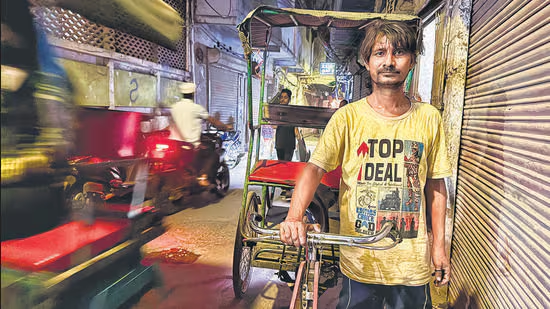
Over the past few years, Old Delhi’s cramped streets have begun to feel even more congested. Much of this is due to the arrival of the so-called battery rickshaw, which has almost entirely replaced the old-fashioned manually driven rickshaw. Battery rickshaws are broader and take up more space in the already narrow lanes. For the rickshaw man, of course, they have arrived as a life-changing relief. Unlike the traditional rickshaw puller, he does not have to squeeze out the last ounce of energy from his exhausted body to drag passengers through crowded streets—sometimes clambering down to haul the vehicle by hand on steep slopes. A good part of the labour now being done by the rickshaw’s motor, equipped with a rechargeable battery.

And yet, some of those old rickshaws and their rickshaw pullers exist. One of them is Gulab. This evening, after dropping off a customer in one of the Walled City’s innermost lanes, he explains why he continues to pedal a manual rickshaw. “My maalik is very poor and can’t afford a battery rickshaw.”
Gulab has been pulling a rickshaw in Delhi for 25 years. All this time, he has used the vehicle lent to him by his “maalik,” the rickshaw owner. The arrangement is simple: half of Gulab’s daily earnings go to the owner. But those earnings have shrunk. Gulab says his income has halved since battery rickshaws began appearing about a decade ago. “Public these days prefer the battery wali rickshaw,” he says. “They are quicker and have more comfortable seat.”
Still, Gulab says, he cannot simply leave his current owner and work for someone with a battery rickshaw. “Can’t betray a person who has supported me for so long.” The reason, he says, is also financial. A battery rickshaw costs at least 1 lakh rupees, while a manual rickshaw can be bought for 10,000 rupees.
Gulab’s family—his wife and two children—live back home in Bihar. “I’m from Janpad Darbhanga, Thana Singwara, Gaon Bhudiyaban Sanapur,” he says, carefully listing all the specifics of the homeland’s address. Gulab himself has no permanent place to stay in the city. At night he sleeps inside a shuttered shop on Fasil Road, thanks to an understanding with a sympathetic shopkeeper. In return, the shopkeeper knows someone is watching over the premises.
All that said, Gulab insists he still prefers the manual rickshaw. “The energy used in pulling it keeps my blood moving,” he says. “Keeps me young.” Responding to a query, he admits that pulling a rickshaw “is very hard work, especially in the summer, but people don’t think of that, they haggle over the money with me as they would with a battery rickshaw driver.”
Gulab now graciously agrees to pose for a portrait with his rickshaw. As the camera button is pressed, a battery rickshaw passes by. See photo.