As global markets grapple with trade wars, geopolitical uncertainty and shifting capital flows, India enters Budget season from a position of relative strength.
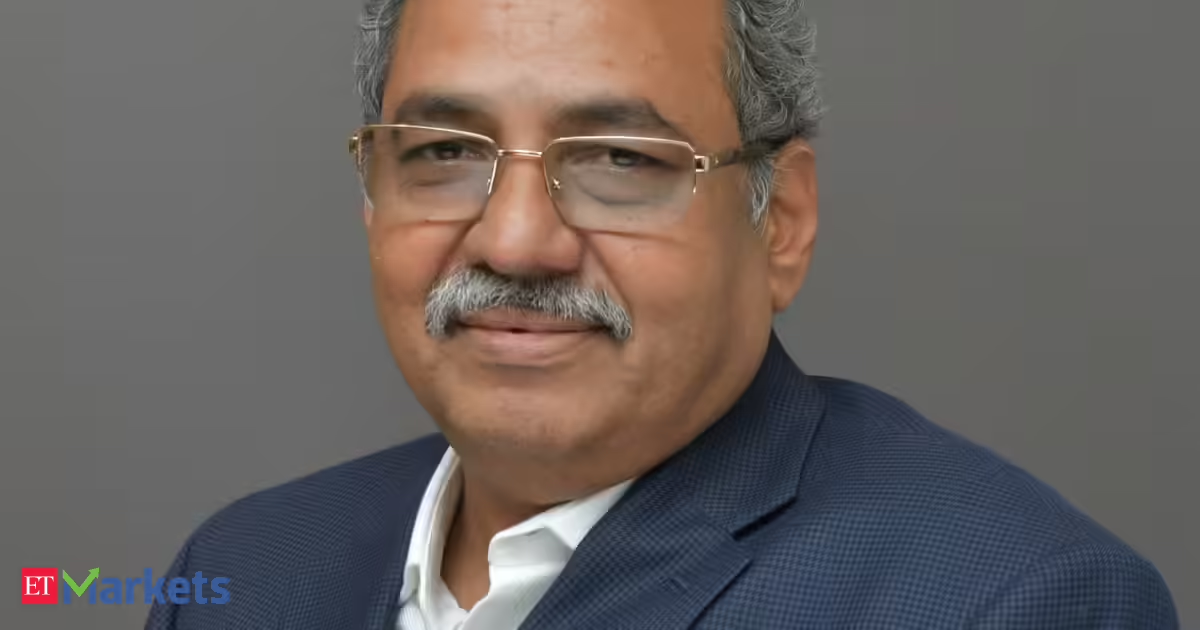
In an exclusive interaction with ET Budget Boardroom, A Balasubramanian, MD & CEO of Aditya Birla Sun Life AMC, outlines why policy continuity, deeper bond market development and stronger domestic funding mechanisms should be the core priorities for the upcoming Budget.
He argues that India’s quiet achievements in fiscal consolidation, real asset creation and capital market maturity have laid a strong foundation for sustained growth, even as global economies face mounting challenges. Edited Excerpts –
Kshitij Anand: Let me come to you, especially at a time when there is talk of sanctions, tariff wars, and supply chains getting affected. How will the Make in India theme shore up in this Budget?
A Balasubramanian: The way I see it, India has always emerged as a winner, especially during times of crisis. Historically, if I look at the last three decades, whenever we have been pushed into a corner or challenged by the global environment—whether due to sanctions, economic activity, trade wars, or even geopolitical risks—India has always come out stronger. In my view, India is in a sweet spot in that sense.

Second, the Make in India theme was started in 2017. I still remember when Raghuram Rajan was the RBI Governor; that was the time when it was being widely discussed whether we should make in India for India or make in India for the world.
That debate gained significant momentum. Today, we can take pride in the fact that India is producing a large number of goods domestically, both for local consumption and for exports.
On the fiscal front, we are also in a sweet spot. Globally, including large economies with whom we are currently discussing trade wars, many countries have their own problems of fiscal slippages.
Most countries, including developing nations, face fiscal challenges—except perhaps Europe. India is one of the few countries where fiscal achievement has been noteworthy. The biggest achievement, I would say—very quietly accomplished by our Honourable Finance Minister, Nirmala Sitharaman—is fiscal consolidation.
At the same time, while we talk about fiscal consolidation, we also retain the ability to provide fiscal stimulus if the country needs it. In that sense, we are well-positioned. Whatever steps were taken in the past have now started playing out quite nicely.
Another important point is policy adaptability. Despite having seen reforms over the last several years, the government is now talking about a third round of reforms. This essentially means we are thinking far ahead and planning how India should stand out as a winner amid the current global challenges. While trade wars and other issues dominate headlines, India has been quietly working in the background to ensure that we remain the fastest-growing economy.
Policies are continuously reviewed, tweaked, and amended to ensure sustainability and long-term growth. I believe we are moving in the right direction.
One specific point worth noting is that today, India is a country where the cost of capital is among the lowest. Anyone looking to build a business in India benefits from low capital costs, whether through equity or debt.
In fact, even US home loan rates are higher than those in India. This progress in reducing the cost of capital will make India far more attractive in the years ahead compared to global markets.
Kshitij Anand: You also made an interesting point about AI taking centre stage. Bala sir, many themes that have caught investors’ attention include AI, clean energy, and hospitality. Many of these themes are accessible through US markets as well, though some activity is happening in India too. For new-age sectors, are there any prominent areas you expect to get more attention in this Budget—defence, AI, or perhaps boosting manufacturing? Which sectors are on your radar?
A Balasubramanian: I think India is one of the few countries focused on creating real hard assets. If you look at capex over the last few years, nearly ₹11 lakh crore has been allocated towards building India’s manufacturing capability, incentivising manufacturing companies on one side, and improving self-sufficiency in areas such as defence, renewable energy, roads, ports, and airports on the other.
We still have a long way to go. Even in rural India, there is significant scope for further investment. We need to look at where capital can be effectively absorbed. India still has several sectors where initiatives have already begun—defence being one that you mentioned—but these sectors can absorb much more capital to become not only self-sustainable but also strong suppliers to global markets.
Another area is waterways. This has been one of the government’s oldest pet projects and among the longest-discussed ideas, yet we have not done enough.
Inland water transport, especially from a logistics perspective, can absorb a huge amount of capital. India’s focus on real asset creation remains strong, and there is still significant room for expansion in this space.
In contrast, when we look at the US, capex there largely revolves around AI, which is considered capital expenditure. Compared to that, India is creating tangible assets. Of course, AI cannot be ignored, given that we do not yet know how it will fully evolve.
Right now, debates revolve around valuations and whether they are bubbly. Nevertheless, AI as an asset class cannot be ignored as the world transitions to a new order. Having said that, India’s real assets will definitely start delivering benefits.
From a government perspective, over the last few years, the narrative around infrastructure creation has shifted. Public sector investment has increased significantly across various asset classes. This enhances the ability to monetise these assets and raise resources for the next phase of growth. Since most of the assets being created are earning assets in some form, monetisation should become relatively easier. As we move forward, these assets are likely to be monetised, enabling stronger funding for future growth.
On foreign institutional investors, while there has been some outflow, it is important to remember that many exits have occurred through FDI and portfolio investments.
Private equity investors who invested in India have exited with substantial profits. Having experienced successful returns, there is a strong possibility they will return.
With the rupee-dollar rate around 93 and interest rates expected to come down, India is likely to become more attractive among emerging markets.
As long as we stay aligned with the Viksit Bharat vision—maintaining growth visibility of 7.5% to 8%, strong corporate earnings visibility, and a robust investment environment—FIIs will naturally return.
I do not believe India needs further taxation-led initiatives. As long as earnings growth remains visible, FIIs will come back.
Kshitij Anand: From a valuation standpoint, how is India placed as we enter, let us say, 2026 or Budget 2026, compared to EMs and others?
A Balasubramanian: One good thing about equity market valuations is that over the last two years, Indian equity markets have delivered relatively flat returns. If you look at the Nifty or Sensex, they have generated single-digit returns. We have also seen the rest of the market—small and midcaps—deliver significant underperformance. This essentially means that whatever excess valuation existed about a year to a year and a half ago has corrected.
Since then, various steps have been taken to bring economic growth back to normal, which for India means a fast-growing economy at about 7.5% to 8%. Measures such as interest rate cuts and the GST cut announced last year now need time to play out and reflect in corporate earnings. My belief is that this will start showing up in earnings over the next few years.
Valuations will remain a point of discussion, but they may not become a stumbling block, given that the market has already gone through a phase of consolidation—what one could call a time-value correction. Therefore, it is reasonable to expect momentum to return to equity markets, driven first by earnings recovery and then by government-led reforms in the next phase, which should open up more opportunities over time. These two factors, in my view, are likely to drive the next round of growth momentum in equities.
That said, we must also acknowledge that India is a market where equity funding has played a critical role in supporting the growth needs of companies by enabling them to raise capital. The demand–supply balance so far has been such that if there had been less supply in terms of equity issuance, markets would probably have performed better. However, this is a good problem to have. It helps companies clean up their balance sheets, improves their borrowing capacity, and enhances their ability to invest. The multiplier effect of this is likely to be significantly higher.
My belief is that over the next three years, this leverage benefit will start becoming visible across companies. As a result, future growth plans are likely to materialise, leading to the next phase of growth momentum.
Kshitij Anand: So, your three expectations from the Budget?
A Balasubramanian: As always, I expect the Budget to demonstrate continuity in tax provisions that have contributed to making India’s growth story a reality. Tax incentives that are currently in place should continue.
Second, fixed income as an asset class also needs attention. India needs a vibrant bond market, just as it has a vibrant equity market. If our economy is to grow larger, both capital market asset classes—bonds and equities—must work together to fund future growth. Therefore, I would expect some measures to support the fixed income market, including through mutual funds. This would help make India more self-sufficient in funding its growth needs as we move forward.
(Disclaimer: Recommendations, suggestions, views, and opinions given by experts are their own. These do not represent the views of the Economic Times)