As India and the European Union (EU) aim to conclude their trade negotiations during the visit of European Commission President Ursula von der Leyen and European Council President Antonio Costa, Prime Minister Narendra Modi on Saturday underlined that trade and mobility agreements being signed with many countries would bring “new opportunities” for India’s youth.
Besides the focus on the India-EU Free Trade Agreement (FTA), the EU-India Summit, hosted by Modi on January 27, is also expected to launch a new cooperation framework on mobility covering students, researchers, seasonal workers and highly skilled professionals to support Indian talent going to Europe.
Von der Leyen, a former German Defence Minister, will meet External Affairs Minister S Jaishankar on Sunday as they chart out the next course of the India-EU partnership.
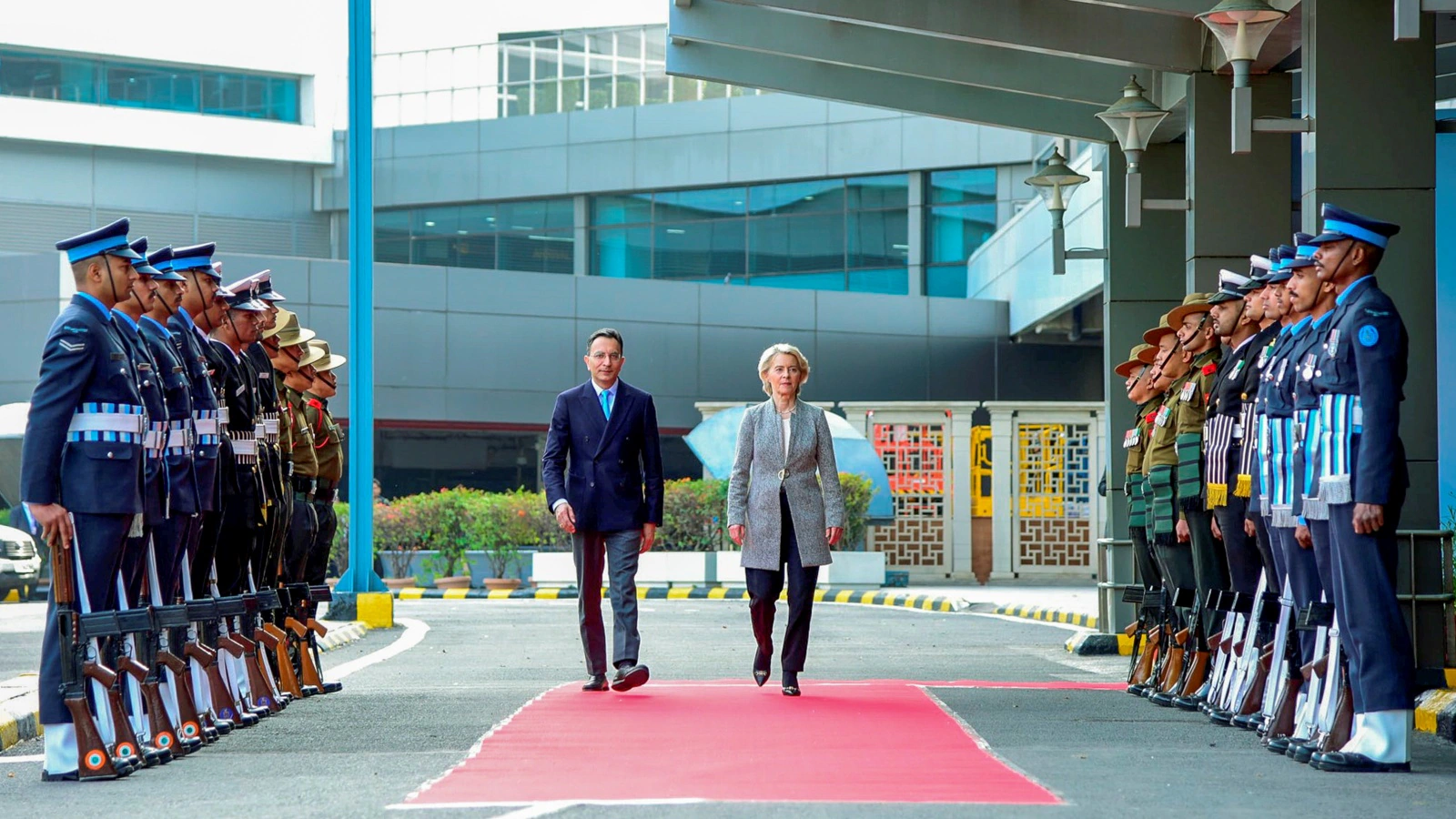
On Saturday, Jitin Prasada, Union Minister of State for Commerce and Industry, welcomed von der Leyen at the airport. Prasada will also receive Costa, former Prime Minister of Portugal, at the airport on Sunday. The fact that the Union Minister of State for Commerce was picked for receiving the EU leaders is emblematic of the focus of the visit — the economic relationship and the FTA between India and the EU that is expected as an outcome.
Earlier in the day, in a post on X, von der Leyen said: “‘The mother of all trade deals’. We are closing in on the (EU-India) Free Trade Agreement. See you soon in Delhi.”
The two leaders of the European Union will be accorded the guard of honour on Sunday.
Story continues below this ad
“Charting the next phase of the India-EU strategic partnership. A warm welcome to the President of the European Commission Ursula von der Leyen @vonderleyen, on her State Visit to India,” Ministry of External Affairs’ official spokesperson Randhir Jaiswal said in a post on X. “As the world’s two largest democracies, India and the EU share a partnership rooted in mutual trust and shared values,” he said.
The EU-India Summit will focus on deepening cooperation across trade, security, defence, clean energy, and people-to-people contacts. The two sides are expected to advance and aim to conclude the EU-India FTA negotiations as a high-profile deliverable at the summit to improve market access and diversify supply chains. They are also expected to sign the EU-India security and defence partnership.
The summit will also endorse a comprehensive strategic agenda for the next five years, covering economic relations, sustainability, technology and global challenges. India and the EU aim to enhance mutual security, economic resilience and multilateral cooperation, emphasising the importance of their strategic partnership in a shifting global landscape.
The two sides are expected to publish a joint statement at the end of the summit to communicate outcomes. They are also expected to issue the joint EU-India comprehensive strategic agenda — a five-year roadmap — to outline cooperation across key sectors.
Story continues below this ad
The EU, as a bloc, is India’s largest trading partner in goods. For the financial year 2024-25, India’s total trade in goods with the EU was worth about US$ 136 billion, with exports around US$ 76 billion and imports at US$ 60 billion.
Meanwhile, addressing the government’s 18th Rozgar Mela online, Modi said on Saturday: “Today, India is one of the youngest countries in the world. It is the continuous effort of our government that new opportunities are created for India’s youth power within the country and across the world. Today, the Government of India is signing trade and mobility agreements with many countries. These trade agreements are bringing numerous new opportunities for the youth of India”.
Modi also highlighted the impact of foreign direct investment (FDI) into the country. “The way the world’s trust in India is increasing today is also creating many new possibilities for the youth. India is the only large economy in the world that has doubled its GDP in a decade. Today, more than a hundred countries are investing in India through FDI. Compared to the 10 years before 2014, more than two-and-a-half times the FDI has come into India. More foreign investment means countless opportunities for employment for the youth of India,” he said.
A total of 61,000 new government employees received their appointment letters at 45 locations across the country. The PM encouraged them to carry out small reforms at their level. He said the government’s work of improving ease of living and ease of doing business was not only a matter of policy, but the intentions of the government employees at the local level mattered too.
Story continues below this ad
“You must remember one more thing. In this era of rapidly changing technology, the needs and priorities of the country are also changing rapidly. You also have to keep upgrading yourself along with this fast change…Whether it is the Prime Minister or a small servant of the government, we are all servants and we all have one common mantra; in that, no one is above, nor is anyone to the right or left, and for all of us, for me as well as for you, that mantra is ‘nagrik devo bhava’ (The citizen is God),” he said.