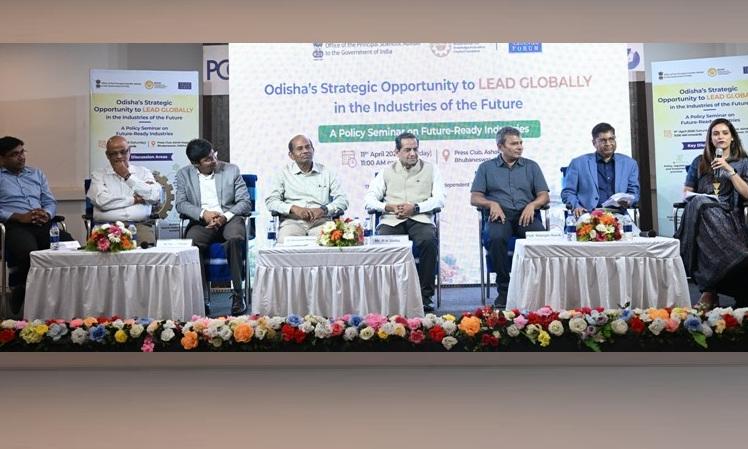
Bhubaneswar: Experts across policy, industry and academia have called for an aluminium-led industrial strategy to drive Odisha’s next phase of economic growth, warning that underutilisation of the state’s vast bauxite reserves is resulting in significant economic losses.
The call was made at a policy seminar titled “Odisha’s Strategic Opportunity to Lead Globally in the Industries of the Future,” organised by Think Change Forum in partnership with Bhubaneswar City Knowledge Innovation Cluster Foundation under the Office of the Principal Scientific Adviser to the Government of India.
Participants highlighted a structural imbalance in Odisha’s industrial development. While the state has made rapid progress in steel, aluminium remains underdeveloped despite Odisha holding 51 per cent of India’s bauxite reserves and the world’s fifth-largest deposits. India imported 3.6 million tonnes of bauxite in FY23 and an estimated 4.5 million tonnes in FY25, incurring a foreign exchange outgo of Rs 4,000–5,000 crore. Finished aluminium imports crossed Rs 70,000 crore in FY26.
Experts said this reflected a missed opportunity for industrial expansion, job creation and regional development, particularly in mineral-rich districts such as Kalahandi and Rayagada.
“There is an urgent need to operationalise bauxite resources and link them to downstream value chains,” said R.K. Sinha, former Controller General of the Indian Bureau of Mines, stressing that aluminium is emerging as a strategic material for sectors such as electric mobility, renewable energy, aerospace and advanced manufacturing.
The seminar focused on the importance of faster project execution, policy implementation and value chain integration. Speakers pointed to projects like the Lanjigarh refinery as critical to building downstream industries and local livelihoods.
Kalyan Charan Mohanty of Industrial Promotion and Investment Corporation of Odisha Limited said the state government is focused on attracting investment and strengthening value addition in aluminium over the next five to six years.
Economist Nilanjan Banik noted that delays between project approvals and operationalisation continue to dilute economic outcomes, calling for stronger coordination among stakeholders.
Estimates presented at the seminar suggested that operationalising three bauxite mining clusters could add Rs 18,000 crore annually to Odisha’s GSDP, generate 15,000 direct jobs and over 50,000 indirect jobs, and attract around $2.5 billion in downstream investment.
Experts also stressed the need for sustainable mining practices, community participation and environmental safeguards, warning that long-term gains will depend on balancing industrial growth with ecological responsibility.
The seminar concluded that Odisha’s ability to build an integrated aluminium ecosystem—linking mining, refining, manufacturing and innovation—will determine its competitiveness in future industries.