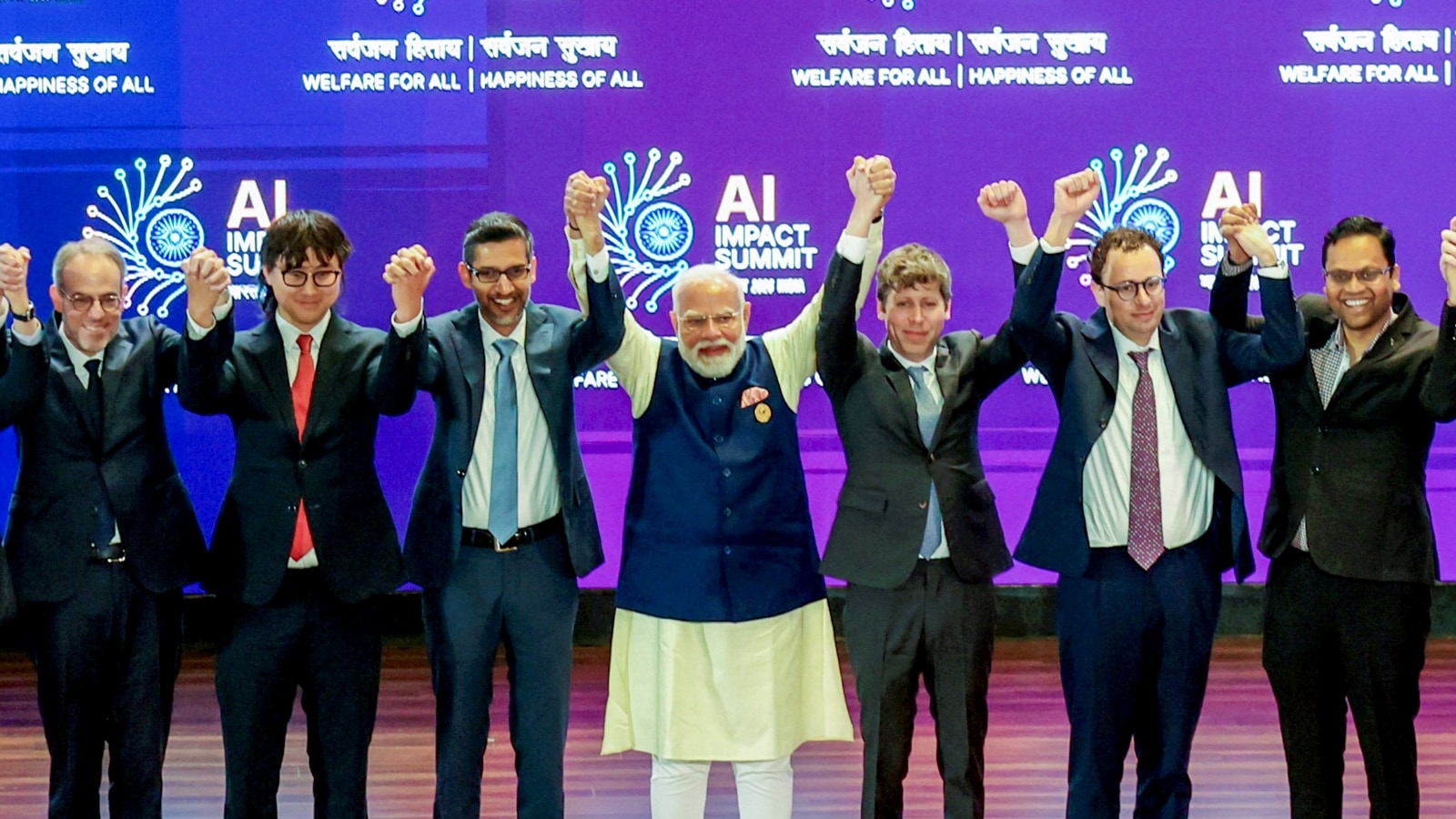
Underlining that India does not “fear” AI but sees both “fortune” and “the future” in it, Prime Minister Narendra Modi Thursday called for developing AI as a “global common good”, one which “will benefit the world only when it is shared”.
Addressing the India AI Impact Summit in New Delhi with global leaders and founders and CEOs of tech giants listening, Modi said “India thinks differently” from “some countries and companies” who “believe AI is a ‘strategic asset’ and must be developed confidentially”.
“I present India’s vision for AI: MANAV, meaning human. The MANAV vision stands for: M – Moral and ethical systems means AI must be built on ethical guidelines; A – Accountable governance means transparent rules and robust oversight. N – National sovereignty means data belongs to those who generate it. A – Accessible and inclusive means AI must not be a monopoly, but a multiplier. V – Valid and legitimate means AI must be lawful and verifiable. India’s MANAV vision will be a vital link for human welfare in the AI-driven world of the 21st century,” he said.
“We believe AI will benefit the world only when it is shared. When codes are open and shared, millions of young minds can make them safer and better,” he said.
His remarks came a day after Sriram Krishnan, White House Senior Policy Advisor on AI, said the US expects that its allies, including India, should build their AI solutions on top of America’s AI stack.
Also Thursday, leading international and domestic AI companies signed the New Delhi Frontier AI Impact Commitments at the summit, a guiding, voluntary framework, under which they have agreed to work on evaluating Al systems for global contexts, recognising that cross-lingual support is helpful for “democratising Al” – in line with India’s pitch on AI development to counter concentration of the technology in the hands of a few.
The companies have agreed on two broad commitments, focusing around advance analysis of real-world AI usage, and strengthening multi-lingual and use-case evaluations. Companies that have signed the commitments include Google, OpenAI, Meta, Anthropic, Microsoft, Sarvam, Gnani, Bharatgen and Soket AI.
Story continues below this ad
In his address, the Prime Minister, while highlighting the urgent need for global standards, pointed out that deepfakes and fabricated content were “destabilising” open societies. Drawing a parallel with nutrition labels on food, he said digital content too must carry authenticity labels so people can distinguish between real and AI-generated material. He underlined the growing need for watermarking and clear source standards.
Modi said AI will also open higher-value, creative, and meaningful roles for more people, creating opportunities for innovation, entrepreneurship, and new industries. He stressed the importance of skilling, reskilling, and upskilling as crucial pillars.
India, he said, is building a resilient ecosystem ranging from semiconductors to quantum computing. He highlighted that secure data centres, a strong IT backbone, and a dynamic startup ecosystem made India a natural hub for affordable, scalable, and secure AI solutions. “Any AI model that succeeds in India can be deployed globally,” he said.
Highlighting the importance of child safety, Modi said that just as school syllabi are curated, the AI space must also be child-safe and family-guided. He said today there are two kinds of people: those who see fear in AI and those who see fortune, adding that India sees fortune and the future in AI, backed by talent, energy capacity, and policy clarity.
Story continues below this ad
Union IT Minister Ashwini Vaishnaw, while announcing the signing of the New Delhi Frontier AI Impact Commitments, said, “Leading frontier AI companies, along with India’s innovators, have pledged voluntary commitments for inclusive and responsible AI. These focus on advancing real-world AI insights to support evidence-based policymaking on jobs, skills, and economic transformation, and on strengthening multilingual, contextual AI evaluations to ensure effectiveness across languages, cultures, and real-world use cases, especially in the Global South. This marks a major step toward AI that is powerful, inclusive, and globally relevant, positioning India at the forefront of a Global South perspective on AI governance.”
Under the commitments, participating companies will evaluate multilingual capabilities on a subset of languages and cultural contexts while preserving flexibility on the choice of tools, benchmarks, as well as Al systems prioritised for this work. They will also collaborate with local ecosystems for the development and application of evaluations for under-represented languages and cultural contexts.
“Participating organisations recognise that cross-lingual support is helpful for democratising Al and aspire to improve Al performance and high-quality experiences for users across the globe. Furthermore, they recognize the value of partnerships with governments and local ecosystems that have or may develop datasets and expertise that support the evaluation of Al systems for local cultural contexts and use cases,” the commitments state.
Signatory companies also recognise that building rich measures of where and how Al is diffusing across the global economy helps to shed light on the future of work and human-Al collaboration; support the development of evidence-based policymaking in areas such as workforce development and education; enable meaningful comparison over time; and help advance adoption and opportunity.
Story continues below this ad
Participating organisations will work to enhance analysis regarding global Al adoption for economic purposes. By the next AI Summit, they have pledged to publish statistical insights derived from anonymised, aggregated and taxonomised usage data, either directly or (where relevant) through contributions to international efforts.