On the rare occasions I sit down to watch a movie, I invariably choose a black-and-white film of sound vintage, preferably set in Madras. That way, I get some gems by way of buildings and streets of the past. Sadly, the print is often execrable in quality and even worse, very rarely was a film shot on location, and so the finds are not many. But occasionally, something unusual comes up, and that is worth it.
Last week, I was watching Gemini Ganesan’s 1953-release Avvaiyar. This was not with any idea of finding something of Madras in it, for it is a period film, with what little location shooting there being deep in some forests. I was watching it mainly to delight in K.B. Sundarambal’s singing. But I was to be rewarded, and in no small measure. Madras did come up, and most unexpectedly.
A surprise find
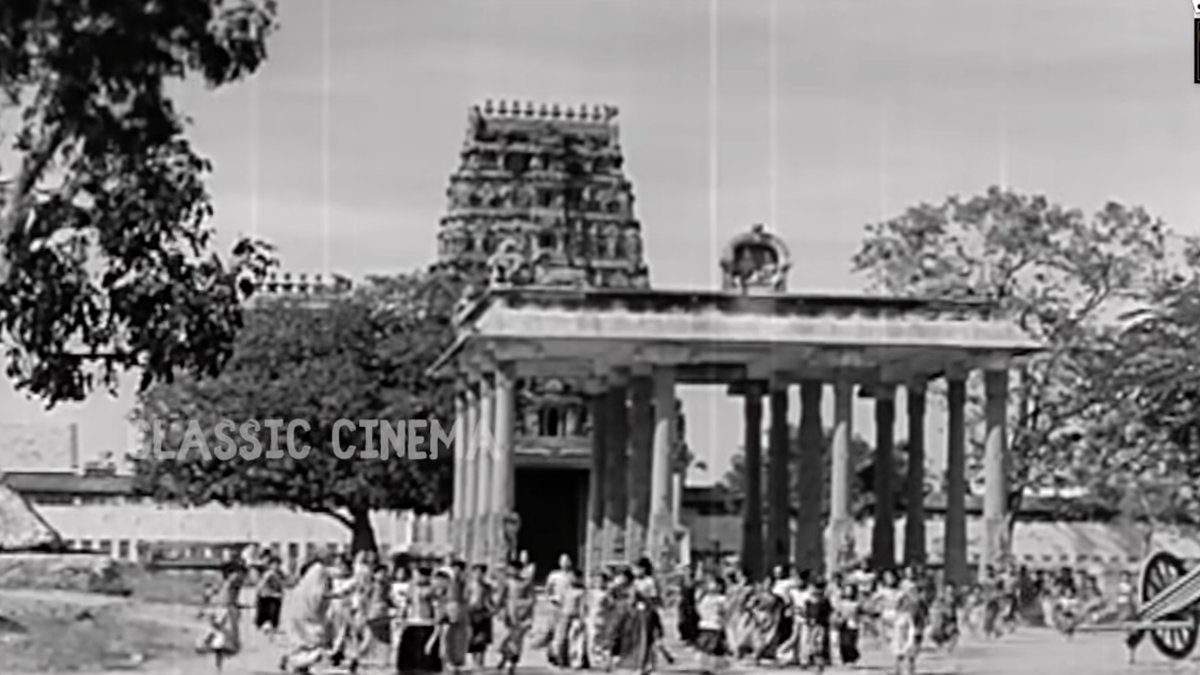
Towards the end, Avvai, with most of her action-filled life behind her, comes to a village. And I sat up. For this was a real hamlet, with tiled houses and a small temple at the far end. I have not been able to identify what that shrine is, but what followed was of interest. Avvai, now singing her famed Athichudi to a group of young children, passes a processional mount – a magnificent rishabam or bull, placed on a four-wheeled cart. And then, she comes to a lovely 16-pillared stone pavilion, with a temple behind. This was a shrine different to the small one seen earlier.

That this was a Shiva temple was clear from the bull mount, and this was reinforced by a frieze of Shiva and Parvati on the pediment of the pavilion. Behind this structure was a tall rajagopuram. The camera then moved to a corner and from there was revealed what was the outline of a Gajaprshta Vimana – the classic Chola elephant-back canopy over the sanctum. I halted the film at this point and gazed at it for long, as I had the feeling I had seen the same temple a couple of months ago.
There followed a frenzied search in my photograph collection (which is not the most organised), and finally I zeroed in on it. It was the Thirumullaivoyal temple. Dedicated to Masilamaniswarar and Kodiyidaiammai, this is a Padal Petra Sthalam for it is revered in the Tevaram, with 10 verses by Sundaramurthy Nayanar whose time period is the 8th century CE. His verses describe the place as surrounded by groves of flowering shrubs and trees with bees hovering, and the mighty Pali River running closeby. In the 15th century, Arunagirinathar, too, came here and dedicated three of his Tirupugazh verses to the Murugan sanctum on the northern side of the shrine. In these too, the greenery of Thirumullaivoyal gets due mention.
It is interesting that much of the sylvan surroundings seem to have existed even in the 1950s when Avvaiyar was filmed here. There is a certain pastoral peace in the shots that makes your heart ache. What happened to Pali River we don’t know, but it certainly does not exist now.

K.V. Raman, in his Early History of the Madras Region writes that the oldest inscriptions from this shrine date to the reign of Parthivendravarman of the 10th century CE. There follows another of Rajendra Chola in the 11th century, and it was very likely at his orders that the sanctum with its Gajaprshta Vimanawas constructed. We do know for sure that the larger and more magnificent sanctum of similar design at Thiruvottriyur was by him. The rajagopuram that is on the southern side, fronted by the 16-pillared pavilion that features in the film, was endowed by a Muniyappa Mudaliar, sometime in the 19th century.
Vanishing landscape
I could not help reflecting on how much of a valuable record cinema is when it comes to capturing heritage for posterity. And at the same time, it also highlights what we have lost. Standing outside the Thirumullaivoyal temple, the immediate surroundings seem completely unchanged from the 1950s. The temple still has vacant land all around and affords a vista for looking at it from afar. But just a short distance away is complete chaos by way of streets that have been filled with buildings they were not meant for, traffic at its worst, and congestion beyond imagination.

It makes you wonder at where urban planning failed. It is very well to say that the core city is beyond repair as it has historically developed in haphazard fashion. But what excuse do we have for places like Thirumullaivoyal that even till the 1970s were untouched? If Sundaramurthy, Arunagiri, S.S. Vasan, and K.B. Sundarambal were to return today, they will find it difficult to identify the village with what they saw. The temple thankfully remains the same.
(Sriram V. is a writer and historian.)