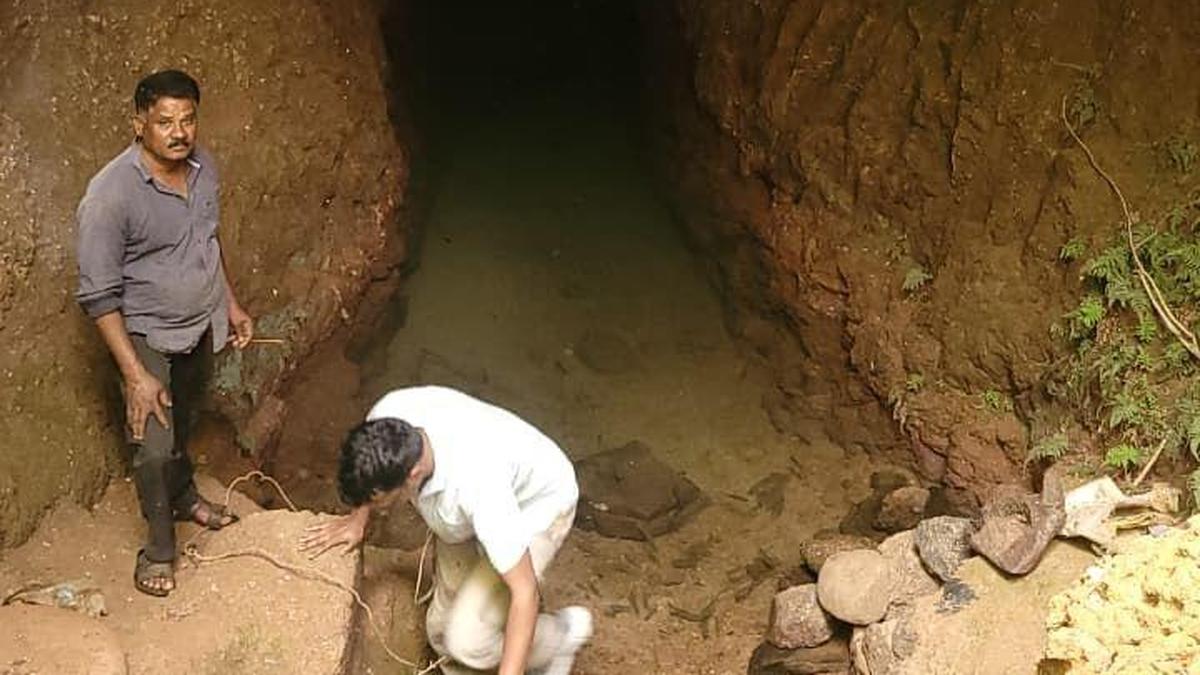

Fresh concerns have surfaced over alleged damage to the centuries-old Naubad–Aliyabad karez (qanat) water system in Bidar, following unauthorised digging and alteration near its outlet, raising alarm among conservationists and prompting intervention by the district administration.
Deputy Commissioner Shilpa Sharma visited the site after receiving complaints about the damage and directed officials to immediately halt any unauthorised activity, initiate action against those responsible and ensure that conservation measures are undertaken in consultation with experts familiar with the karez system, sources in the district administration said.
Letter to DC
The issue came to the fore after environmental activist and State Board for Wildlife member Vinay Malge submitted a representation to the Deputy Commissioner, warning that the alterations could threaten both the structural integrity and hydrological functioning of the historic underground water system. In his letter, Mr. Malge flagged concerns over changes to the outlet channel, stating that such interventions could disrupt groundwater recharge and the long-term sustainability of the karez.
A karez, also known as a qanat, is an ancient underground water-harvesting system in which a gently sloping horizontal tunnel is excavated beneath the earth to tap groundwater from higher elevations and convey it by gravity to the surface. Vertical shafts are constructed at regular intervals for ventilation, maintenance and access. Designed to minimise evaporation and contamination, karez systems are regarded as outstanding examples of traditional hydrological engineering, particularly in arid and semi-arid regions.

Deputy Commissioner Shilpa Sharma on a recent visited to the Naubad–Aliyabad karez (qanat) water system in Bidar.
| Photo Credit:
SPECIAL ARRANGEMENT
During Bahmani period
The Naubad–Aliyabad karez is believed to have been constructed during the Bahmani Sultanate in the 15th century and is among the earliest known qanat systems in India. Conservationists note that it is particularly rare as it is carved through laterite rock, unlike most karez systems elsewhere, which are typically built in alluvial or limestone formations.
“The karez in Bidar is not merely a historic water harvesting structure but a living groundwater recharge and storage system of exceptional scientific, ecological and heritage value. Any alteration that reduces groundwater retention time risks permanently damaging the revived karez line,” Mr. Malge told The Hindu.
Heritage site
He also pointed out that the system holds strong potential for nomination as a UNESCO World Heritage site if conserved scientifically. “This is one of the earliest adaptations of Persian–Central Asian qanat technology in the Indian subcontinent, and the only known karez constructed in laterite. Losing it to unscientific interventions would be irreversible,” Mr. Malge said.
“The karez should not be viewed merely as a tourism asset. It must be preserved as a long-term, sustainable solution to Bidar’s chronic water scarcity,” he added.
To consult experts
Officials said the district administration was examining the concerns raised and would consult experts before allowing any further work in the area. Conservationists have urged that the karez and its recharge zone be treated as a protected heritage-hydrological landscape.
Revived after decades of neglect, the Bidar karez system has often been cited as a model of traditional water wisdom suited to the Deccan plateau. Activists and experts alike say its protection is crucial not only for preserving heritage but also for ensuring sustainable groundwater management in the region.