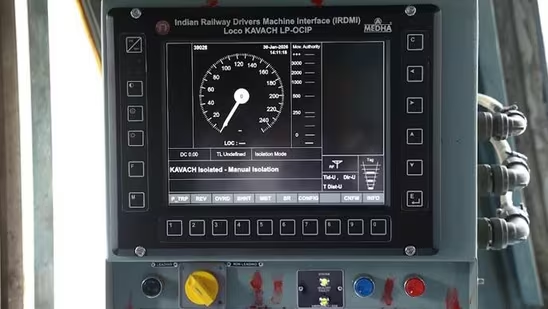
India’s indigenous train collision avoidance system, Kavach 4.0, is now operational on a key stretch of the Delhi-Mathura route, marking another step in the Railways’ push to improve safety on high-density corridors. The Indian Railways has commissioned Kavach 4.0 on the Delhi-Palwal section of Northern Railway, with the latest installation completed on the New Delhi Junction Cabin section. With this, the entire stretch between Tughlakabad and Palwal has come under Kavach protection.

Spread across 21.6 route kilometres and four major station yards, the upgraded system runs on a newly laid optical fibre backbone network and allows real-time monitoring from the New Delhi control room, Northern Railway said, Northern Railway said in a statement.
What is Kavach?
Kavach is an automatic train protection system designed to prevent collisions by automatically applying brakes if the train misses a signal or loco pilot fails to respond in time.
It has been developed by the Research Design and Standards Organisation (RDSO) in collaboration with Indian Railways.
The system is designed to prevent train collisions and reduce accidents.
Why India needed Kavach
India has one of the world’s largest railway networks, with heavy traffic on key routes. Train operations depend heavily on human control and signalling systems.
Before systems like Kavach, accidents could occur due to human error, misreading of signals, poor visibility during fog or rain, and communication gaps between stations and trains.
Indian Railways sees Kavach as a major safety upgrade aimed at reducing human error and moving closer to its goal of “zero accidents” on the network.
Causes of train accidents in India
Signal Passing at Danger (SPAD) – Signal Passing at Danger (SPAD) occurs when a train crosses a red signal without permission. This is one of the most common causes of serious railway accidents.
In the 2023 Odisha three-train collision, investigators said a signalling and routing error led trains into the wrong track section, causing a major collision. The accident was India’s worst-ever train accident and led to 296 deaths.
Human error by loco pilots or staff – Human error includes mistakes by loco pilots or railway staff, such as missing signals, delayed braking, overspeeding, or misjudging track conditions.
Wrong track entry collisions – This happens when a train enters the wrong line and collides with another train. In the 2014 Gorakhdham Express accident, the train entered a loop line and collided with a stationary goods train.
Brake failure or delayed braking – Mechanical faults or late braking can prevent trains from stopping in time. In some derailment and collision cases, delayed brake response has been identified as a key factor.
Poor visibility (fog, rain) – Dense fog and heavy rain reduce visibility, especially in north India during winter. This often leads to missed signals and speed restrictions to avoid accidents.
Communication failure – Breakdowns in signalling or communication between stations and trains can lead to wrong routing.
How Kavach prevents train collisions
Kavach works through continuous communication between track equipment, station systems, and locomotives. It uses sensors, radio communication, and trackside devices to monitor train movement and signal status in real time.
It helps prevent collisions by automatically applying brakes if a train misses a signal. It also prevents two trains from entering the same block section and controls speed limits across different track sections. The system gives advance warnings to the driver about signals and speed restrictions.
If the driver does not respond in time, the system takes control and slows down or stops the train.
Per Indian Railways, Kavach:
- Stops trains from crossing red signals.
- Shows signal updates directly to the loco pilot inside the cabin.
- Automatically applies brakes if the train is overspeeding.
- Automatically blows the horn near railway crossings.
- Prevents collisions between two Kavach-equipped trains.
- Sends emergency alerts during dangerous situations.
- Allows railway control rooms to monitor train movement live.
Kavach 4.0 also uses improved communication systems and better integration across stations and locomotives.
Kavach vs other countries’ train safety systems
Many countries more advanced automatic train protection systems that work on the same principle but are built differently.
Europe uses the European Train Control System (ETCS). It provides continuous communication between trains and track systems. It allows real-time speed control and can work with or without traditional signals depending on the level of deployment. ETCS is widely used across European rail networks to make different national systems compatible and interoperable.
Japan uses Automatic Train Control (ATC), especially on high-speed Shinkansen lines. It continuously monitors train speed and applies brakes if a train goes beyond safe limits. It is designed mainly for fixed, high-density rail corridors with very strict operating rules.
China uses the Chinese Train Control System (CTCS). It is a multi-layered system with different levels of automation. Higher levels use radio communication and digital control to manage train movement and improve safety on high-speed lines.
How Kavach is different from global systems
Kavach 4.0 is designed mainly for Indian railway conditions, which include mixed traffic (passenger and freight trains on the same tracks) and very high route density.
Unlike ETCS, which is built for cross-border interoperability in Europe, Kavach is a national system designed only for Indian Railways. It works as an add-on safety layer over existing signalling instead of replacing the full system at once.
Kavach is also deployed in phases on selected routes. This makes it more practical for large-scale expansion on existing infrastructure.
In terms of design, Kavach focuses on cost-effective deployment, real-time braking control, and compatibility with India’s existing railway signalling systems.
Routes where Kavach has been commissioned
Kavach 4.0 has so far been implemented mainly on high-density railway corridors. These include parts of the Delhi-Mumbai and Delhi-Howrah routes.
Kavach has been commissioned on more than 1,300 route kilometres across multiple railway zones, according to recent Railway Ministry updates.
- Tuglakabad (TKJ) – Palwal – Mathura – Nagda section on the Delhi–Mumbai corridor.
- Vadodara – Virar section on Western Railway.
- Vadodara – Ahmedabad section in Gujarat.
- Howrah – Bardhaman section on Eastern Railway.
- Manpur – Sarmatanr section in the Gaya region on East Central Railway.
- New Delhi (ex) – Junction Cabin section on the Delhi–Palwal route under Northern Railway.
- Pune – Kolhapur section, where Kavach trials have been conducted.
- Daund – Manmad section, where Kavach trials have been conducted.
- Daund – Yeola section, where installation work is underway.
Indian Railways has also started installation work on more than 23,000 route kilometres covering the Golden Quadrilateral, Golden Diagonal, and High-Density Network routes. These are among the busiest rail corridors in the country.