
The Story So Far: J&K Chief Minister Omar Abdullah, on September 25, brought a resolution before the J&K Assembly autumn session. On September 28, the resolution was put to a vote and was passed. It called upon the Government of India for the “immediate and urgent restoration of full Statehood to J&K”. Mr. Abdullah argued the resolution was necessitated by the Centre’s inexplicable delay in granting the Statehood status to J&K, which was downgraded in 2019 after its autonomous status under Article 370 was scrapped by the Parliament under the rule of Prime Minister Narendra Modi.
Mr. Abdullah also sought clarity from the Centre over the delay in spite of the Supreme Court’s direction to restore Statehood “at the earliest” and “as soon as possible” while pronouncing the judgment on scrapped provisions of Article 370 in 2023. The resolution was passed after 61 members, out of 90, from the ruling National Conference (NC), Congress, CPI(M), Peoples Democratic Party (PDP), J&K Peoples Conference (JKPC), Aam Aadmi Party (AAP) and Awami Ittehad Party (AIP) extended their support. After the resolution was passed, Mr. Abdullah called upon the Government of India to “fulfil its commitment towards restoration of Statehood”.

Why did the BJP decide to stay away from voting?
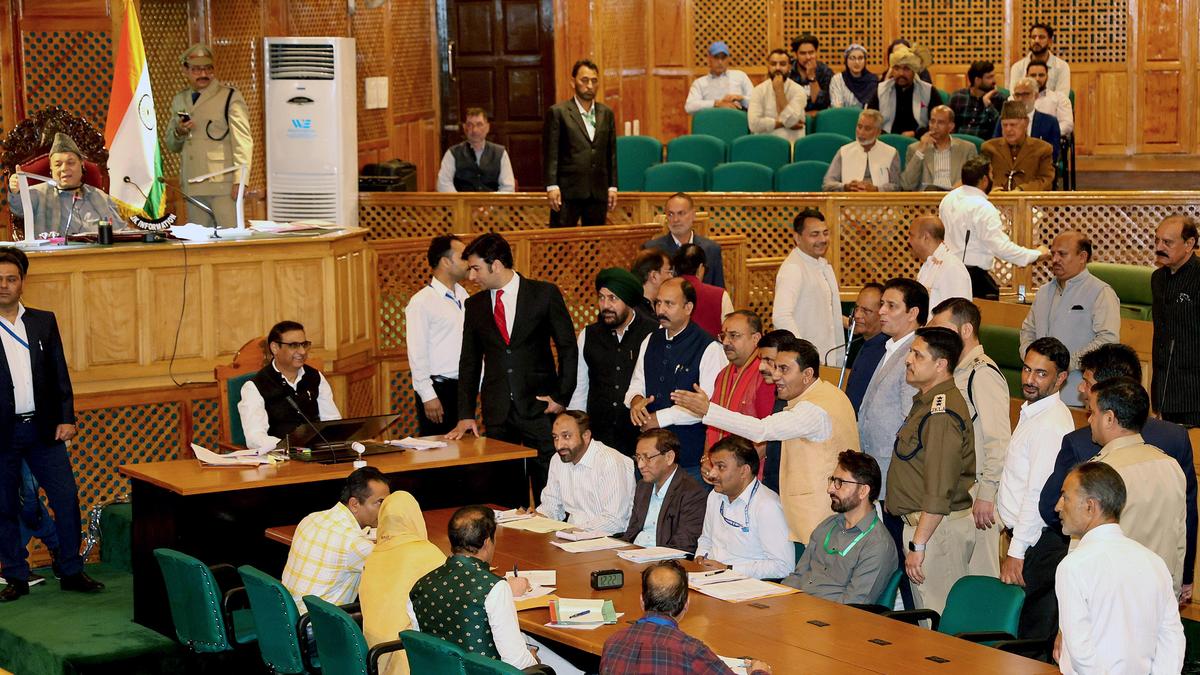
The Opposition Bharatiya Janata Party (BJP) took exception to the wording of the resolution. The part that piqued the BJP was that the current resolution was “in addition to the resolutions passed by this House on June 26, 2000 and November 6, 2024”, referring to the 2000 autonomy resolution and the special status. The BJP legislators raised a hue and cry, stormed into the well of the house and staged walkouts over the resolution. J&K Leader of Opposition Sunil Sharma termed references to the 2000 autonomy resolution and the 2024 special status “unnecessary”. The BJP asked the ruling NC to bring a resolution confined exclusively to the issue of Statehood. Mr. Sharma said J&K was a sensitive region with neighbours who always try to take advantage of internal issues and disturb peace. He said there was no room for any Pakistan agenda in J&K, which is an integral part of India. The BJP also targeted NC leader and Speaker Abdul Rahim Rather for allowing the resolution and moved a motion seeking his removal.

What is the 2000 autonomy resolution?
At the peak of militancy that forced National Conference leader and sitting Chief Minister Dr. Farooq Abdullah to step down and flee Kashmir in the 1990s. However, Mr. Abdullah returned to power again in 1996 and set up a committee to identify the parts of the regional autonomy eroded since 1953. The NC attempted to provide an alternative within the Constitution to the separatists who were pushing for Kashmir’s complete independence or merger with Pakistan. On June 26, 2000, Mr. A. Abdullah, as the Chief Minister of the erstwhile State, tabled the resolution, and it was passed with unanimity among all the regional parties. It called for re-designation of the Governor as Sadr-e-Riyasat (Head of State) and the Chief Minister as Wazir-e-Azam (Prime Minister).
It proposed that the word “temporary” in Article 370 be substituted with “Special”, barring the use of Article 356 of the Indian Constitution to impose President’s Rule, the Election Commission of India and the Comptroller and Auditor General (CAG) and rescinding all post-1954 Constitutional orders. Once sent to Parliament, the then-Prime Minister Atal Bihari Vajpayee summarily rejected the resolution, and the Union Cabinet declared the recommendations unacceptable and an attempt to “set the clock back”.
Also Read | State of anticipation: on Jammu and Kashmir and Statehood
Why does Omar Abdullah include the previous resolutions?
After the erstwhile State of J&K was downgraded to a UT, the mainstream political parties in Kashmir are again offering an alternative to the alienated sections within the Constitution to protect land, jobs and identity. The 2000 autonomy resolution and the 2024 special status resolution are bids by the ruling NC to bring a solution to Kashmir within the ambit of the Constitution and address all the political constituencies. While Mr. Abdullah clarified in the Assembly that the current resolution was only on Statehood, he cautioned the Centre not to link the restoration of Statehood to complete cessation of militancy and allow Pakistan to decide on it.
He underlined that the decision on Statehood should be taken in New Delhi and not be left dependent on any other factor or external consideration. Mr. Abdullah also stalled the bid of eight NC legislators to include, through amendments, terms like Article 370, 35A and the pre-August 5, 2019 position in the resolution. The Chief Minister argued these words could provide an excuse for the BJP not to participate in the voting and stall a unanimous resolution on Statehood.
How this resolution also caused rift with bureaucracy?
Chief Minister Abdullah informed the J&K Assembly that a day after he moved the resolution on September 25, Chief Secretary Atal Dulloo and Law Secretary Achal Sethi sent two separate communiques to Speaker Lone, suggesting against allowing the resolution. Mr. Abdullah said the letters shot off by the Chief Secretary and Law Secretary cited “matter sub judice” as the reason to not allow the resolution on Statehood. Mr. Abdullah lamented that this bid by bureaucracy to scuttle the Statehood resolution only highlighted the need to restore Statehood.
“The Law Secretary and the Chief Secretary had forwarded their opinions to the Speaker that the subject was sub judice and should not be discussed. He said that, as J&K’s Chief, the letters were not shown to him. “I don’t know on whose behalf they did this. Which State in the country will witness the Law Secretary and Chief Secretary oppose a resolution moved by the Chief Minister? It’s because of a Union Territory status,” said Mr. Abdullah. It has sparked a debate about the powers of the legislature in the UT.
Congress legislator Nizamuddin Bhat demanded that these letters should be made part of the records and put to discussion in the House. Mr. Bhat termed the act of sending letters to the Speaker a “challenge to the prestige, dignity and powers of the Assembly”. He asked if the officers could act as a government without consulting the government. He said it has challenged the authority of the Speaker as well as the House. The Congress said the House was governed by the same rule as that of a State. Neither the Constitution nor the J&K Reorganisation Act says it, argued the Congress legislator.