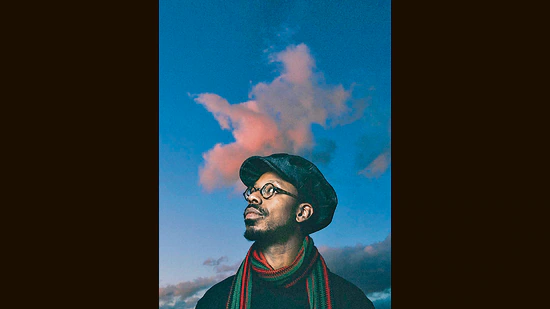
There is a chapter early in Shabaka Hutchings’s creative lore that feels almost mythological in retrospect.

A young man with roots in Barbados, born in Britain and training at London’s Guildhall school of music, absorbs the full canon of Western jazz and then quietly decides it isn’t enough. He goes looking for the rest: for the South African township sounds of pianist Abdullah Ibrahim, the spiritual fire of American saxophonist Pharoah Sanders, the poly-rhythmic thrum of the Caribbean, the electronic pulse of the London underground.
What he builds from all of it over the next 15 years will become one of the most restlessly original bodies of work in contemporary music.
Shabaka’s third solo album, Of the Earth, released earlier this month by his Shabaka Records label, is both a summation of this career, and a leap in a new direction.
Written, performed, produced and mixed entirely by Shabaka (he goes by only his first name now), it is as complete a solo endeavour as the form allows. Every note, beat and texture is his. Electronic beats and loops made on portable devices while on the road lay the foundation for choral flute melodies, with sequences of electronic rhythms outlining a story of diasporic progression.
In a move even his most devoted listeners likely didn’t anticipate, the album sees him rap for the first time, inspired, he has said, by André 3000’s courage in exploring new dimensions.
The saxophone, Shabaka’s original instrument and the one that made him famous, also makes its return. A self-imposed hiatus with the sax ended in mid-2025 with a performance at a memorial concert for the South African drum maestro Louis Moholo. His reunion with the horn feels hard-won, approached now from the perspective of a musician who spent 18 months learning to hear differently.
As Shabaka, now 41, puts it, Brown Sugar by the late D’Angelo was the first CD he ever bought, and the emotional possibilities of the self-produced album never left him. Of the Earth is his response to that early fascination, and it arrives already garlanded with the kind of critical warmth that tends to greet artists operating at the height of their powers.
To understand why this album matters, though, one needs to go back to all his bands.
Shabaka and the Ancestors, formed in Johannesburg in the early 2010s, was the project that announced his seriousness of intent to the world. Drawing on South African jazz, spiritual music and traditional song, it was an audacious project for a British musician — an act of cultural excavation and reimagination, executed with such authority that South African jazz veterans embraced it unreservedly. The 2016 album Wisdom of Elders remains one of the defining jazz records of that decade, filled with history and alive with invention.
Sons of Kemet, his London-based quartet built around two drummers and a tuba, was a different kind of statement entirely. Here his Caribbean roots entered the picture fully, the tuba borrowing from New Orleans funeral traditions, the drums channelling Trinidadian carnival rhythms, the saxophone riding over all of it in long, inquisitive phrases. This group’s 2018 Mercury Prize-nominated album, Your Queen is a Reptile, was explicitly political, each track named for a Black woman who deserved to be on a banknote, and announced Shabaka as a force with something to say through his music.
Sons of Kemet dissolved in 2022, but its DNA runs through everything that followed.
The Comet Is Coming came next, a cosmic, electronic-infused jazz trio with keyboardist Danalogue and drummer Betamax that plunged headlong into Sun Ra territory and emerged with music that felt simultaneously ancient and from the near future. Their debut, Channel the Spirits, was nominated for a Mercury Prize in 2016.
Side projects proliferated in generous abundance. Collaborations with Floating Points (the stage name of Sam Shepherd, an acclaimed British electronic musician) and the London-based saxophonist Nubya Garcia. An appearance on André 3000’s flute-led odyssey, on at least two of his albums. A collaboration with Mulatu Astatke, the Ethiopian jazz legend, that sounds like the two share deep kinship. Every project added new layers to a portrait that refuses to restrict itself to a single, stable image.
Then came the saxophone hiatus and the solo albums, Afrikan Culture (2022) and Perceive Its Beauty, Acknowledge Its Grace (2024), which marked a deliberate retreat into meditative, flute-centred music that deviated from the communal energy of his previous efforts. Critics praised both, though some listeners missed the heat of the bands.
Of the Earth restores that heat, but with a difference. It establishes Shabaka as a new form of instrumentalist and producer, showing the musical range that connects his dance-based work in Sons of Kemet and The Comet Is Coming to the intricate textural sound world of his recent solo releases. The album was made, in significant part, while travelling, using portable instruments and production tools, with electronic beats and looping rhythms underpinning choral flute melodies that reflect themes of movement and memory. There is something fitting about that. Shabaka has spent his entire career in motion, crossing borders of genre and geography, carrying traditions from Barbados, South Africa, Britain and beyond into a music that belongs to all of them and to none of them exclusively.
Of the Earth is the sound of a musician who has figured out he no longer needs a band to do what bands do. He has become the whole thing: the rhythm section, horn section, producer, rapper, flautist; the overarching vision. That is a rare kind of freedom, and it sounds like he’s enjoying it.
(To reach out, email sanjoy.narayan@ gmail.com. The views expressed are personal)