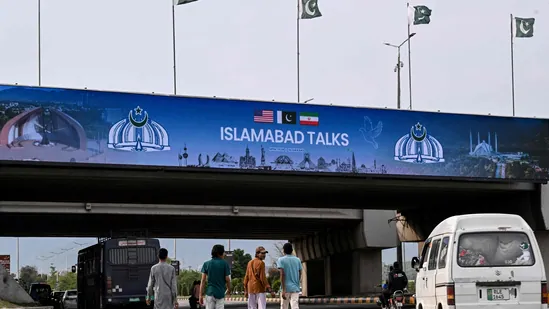
Iranian delegation headed by the country’s Parliament Speaker Mohammad Baqer Qalibaf arrived in Pakistan on the intervening night of Friday and Saturday for peace talks with the United States, reported Iranian media. A US delegation, led by Vice President JD Vance, is also set to arrive shortly for negotiations which Pakistan has termed ‘Islamabad Talks’.

These peace talks aimed to reach a sustainable solution to the ongoing war in West Asia comes after almost six weeks of fighting.
Who is attending the ‘Islamabad Talks’?
The Iranian delegation reportedly includes several key officials of the Islamic Republic’s regime, including Parliament Speaker Mohammad Baqer Qalibaf, who is leading the delegation, along with Iranian foreign minister Abbas Araghchi, defence council secretary, central bank governor and several members of parliament, reported news agency Reuters.
According to the report, several key political, military, and economic Iranian officials are a part of the delegation.
Also read: US-Iran ceasefire talks: Why JD Vance leading the Islamabad talks is not good news – Expert explains
The United States’ delegation, which is also set to arrive in Pakistan, will be headed by JD Vance, who will be accompanied by Trump’s top envoy Steve Witkoff and senior adviser Jared Kushner, also the US President’s son-in-law.
Both the delegation will reportedly arrive at a hotel where negotiations will take place in Islamabad.
The upcoming talks would the highest-level meeting between the US and Iran since the 1979 Islamic Revolution.
‘Preconditions’ clouding Iran-US peace talks
After the Iranian delegation arrived in Islamabad, the country’s state media reported that the negotiations will be held only if Washington agrees to their “preconditions”.
The delegation’s leader, Qalibaf, also said in a post on X just hours back that two measures, which he said were mutually agreed upon by both the parties, must be implemented before negotiations can start. These measures include a ceasefire in Lebanon and release of Iran’s blocked assets.
Also read: ‘Loading ships with best ammunition’: Trump details US plan if talks fail with Iran
“Two of the measures mutually agreed upon between the parties have yet to be implemented: a ceasefire in Lebanon and the release of Iran’s blocked assets prior to the commencement of negotiations. These two matters must be fulfilled before negotiations begin,” Qalibaf wrote in the post.
The officials in White House are also reportedly skeptical about the upcoming talks. A Reuters report cited two White House officials, who spoke on condition of anonymity, that President Trump had somewhat accepted that reopening of the Strait of Hormuz would not be easy, even if the talks lead to some positive outcome.
Lebanon and Israel to start talks on Tuesday
As the question of whether Lebanon was included in the two-week long ceasefire agreed upon by the US and Iran clouds the Islamabad talks, Lebanon and Israel will start their own direct talks next Tuesday, said Lebanese President Joseph Aoun’s office.
The country is seeking an end to the ongoing hostilities between Israel and Iran-backed militia Hezbollah in Lebanon.