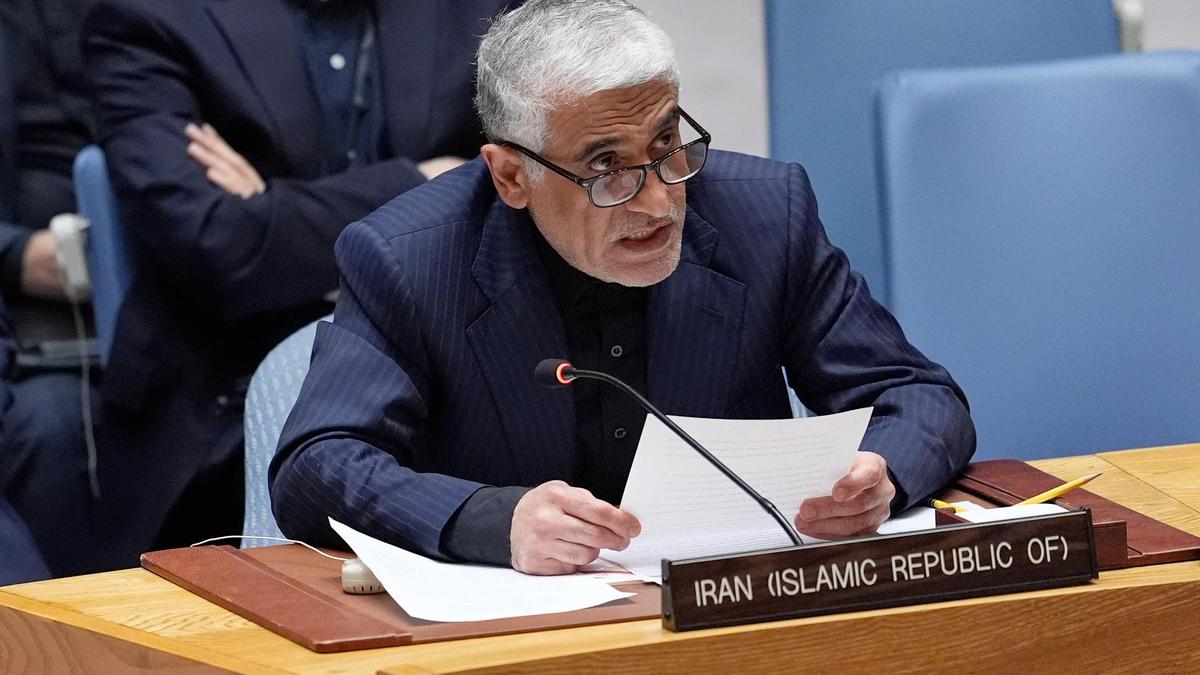
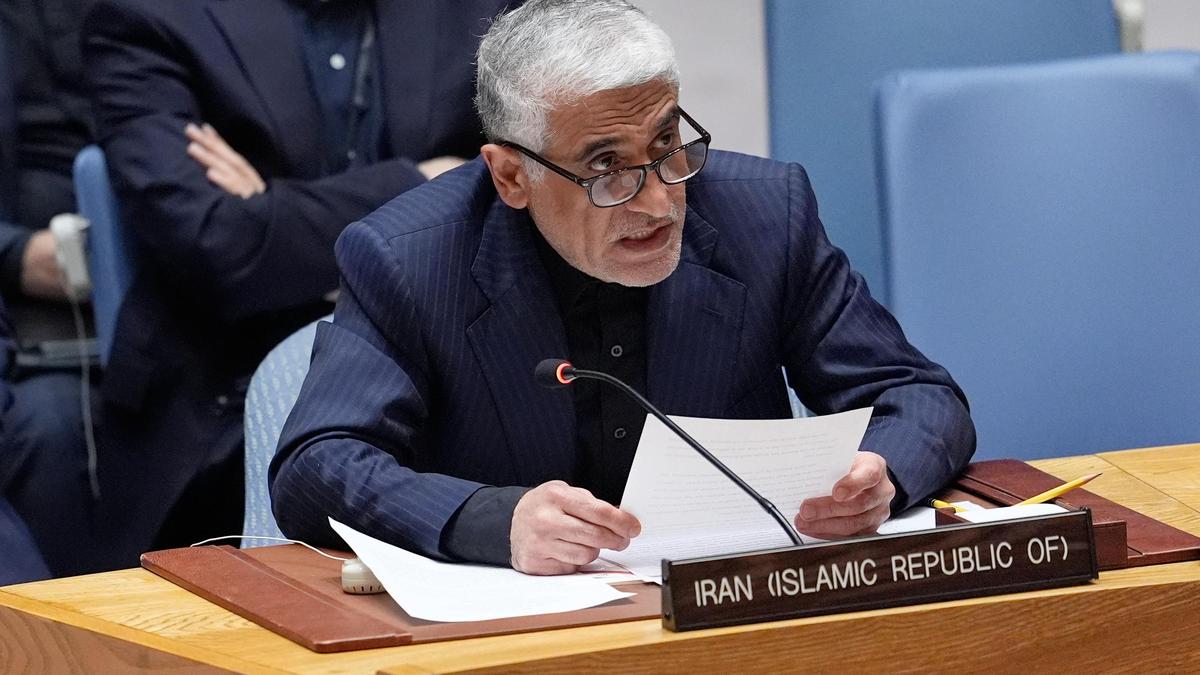
Iran’s U.N. Ambassador said on Thursday (March 12, 2026) that Tehran was not going to close the Strait of Hormuz, but added that it was Iran’s right to preserve the security of the key shipping route.
Amir Saeid Iravani made his comments to reporters at the United Nations when asked about remarks by new Iranian supreme leader, Mojtaba Khamenei, who said that the “lever of blocking the Strait of Hormuz must continue to be used.”
“We are not going to close the Strait of Hormuz,” Mr. Iravani said. “But it is our inherent right to preserve the peace and security in this waterway.”
Iran-Israel war LIVE
In a prepared statement he read to reporters before responding to questions, Mr. Iravani said that “Iran fully respects and remains committed to the principle of freedom of navigation under the law of the sea. “However, the current situation in the region, including in the Strait of Hormuz, is not the result of Iran’s lawful exercise of its right of self-defence.
“Rather, it is the direct consequence of the destabilizing actions of the United States in launching aggression against Iran and undermining regional security.”
He said he had no response to a comment by U.S. Treasury Secretary Scott Bessent, who told Sky News in an interview on Thursday (March 12, 2026) that the U.S. Navy, perhaps with an international coalition, would escort vessels through the Strait of Hormuz when it is militarily possible.

Ships must coordinate with Iran’s navy to pass through Strait of Hormuz, foreign ministry says
Ships must coordinate with Iran’s navy to pass through the Strait of Hormuz, the country’s foreign ministry spokesperson said in comments carried by Mehr news agency on Thursday (March 12, 2026).
“The security of the Strait of Hormuz is of vital importance to Iran, because the country’s security is tied to the security of the region. With the longest coastlines on the Persian Gulf and the Sea of Oman, Iran has always borne costs to protect this strategic waterway,” said Esmaeil Baghaei, the spokesperson.

“The insecurity created in the region by the United States and the Zionist regime can affect the movement of ships. However, Iran does not want this strait to become insecure, and ships must coordinate with the Iranian navy when passing through so that maritime security is maintained,” Mr. Baghaei added.
The prospect that one of the most severe disruptions ever to hit global energy supplies could drag on sent oil prices surging back above $100 a barrel, after falling earlier in the week on hopes of a swift end to the conflict.