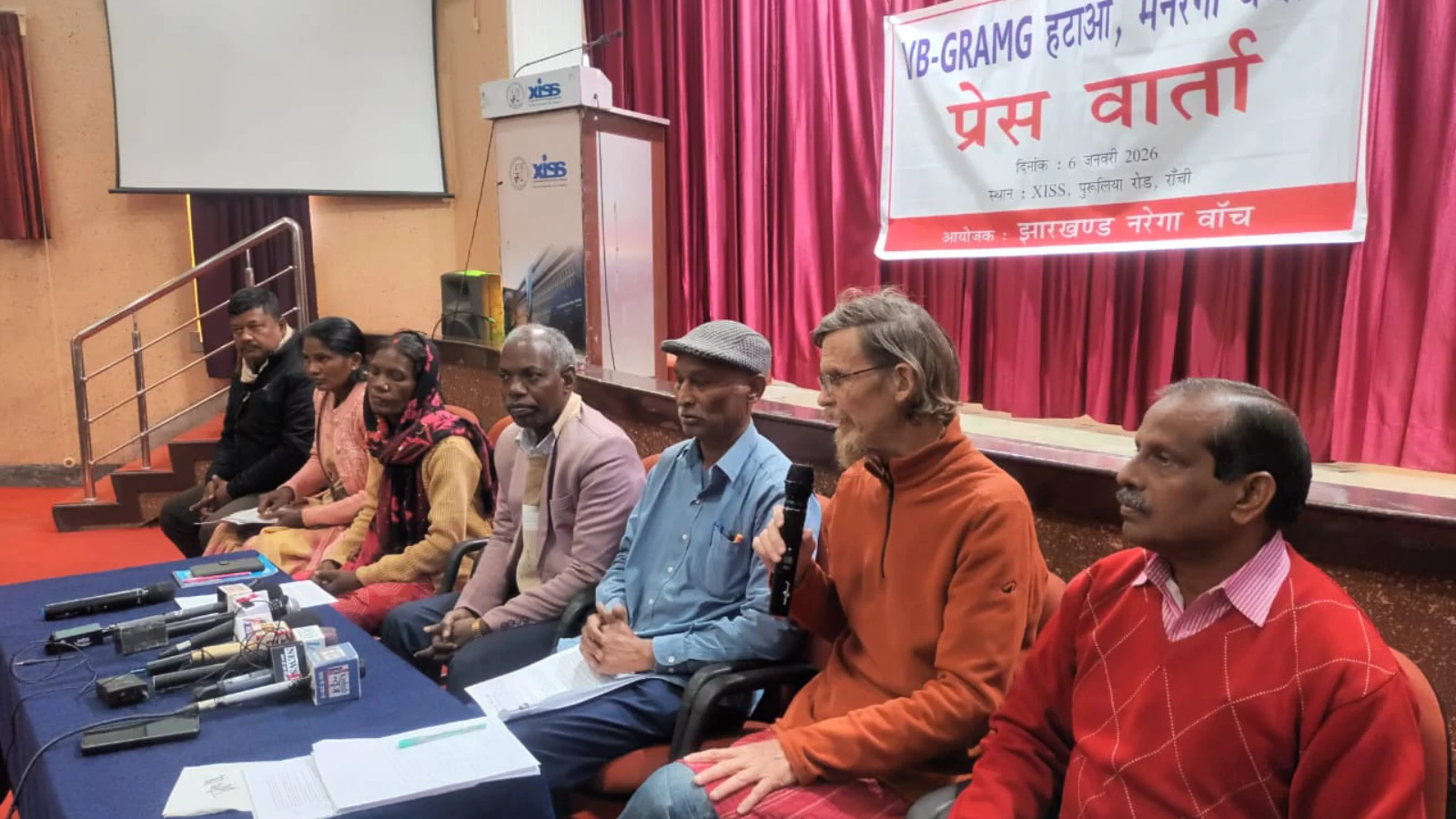
Activists and labour rights groups in Jharkhand on Tuesday warned that the Centre’s new VB-G RAM G (Viksit Bharat – Grameen Rozgar Aur Aajeevika Mission Guarantee) Act will intensify distress migration and deepen livelihood insecurity in states like Jharkhand that depend heavily on the Mahatma Gandhi National Rural Employment Guarantee Act (MGNREGA), which the new Bill seeks to replace.
Addressing a press conference, members of Jharkhand NREGA Watch described the legislation as a “bulldozer Act” that demolishes the legal right to work by repealing MGNREGA and replacing it with a centrally controlled scheme.

Economist Jean Drèze said the group would approach the Jharkhand government and build pressure during the Budget session of the Legislative Assembly to pass a resolution opposing the VB-G RAM G Act, on the lines of similar proposals adopted by states such as Punjab and Karnataka.
When contacted by The Indian Express, the general secretary of the state’s ruling Jharkhand Mukti Morcha, Vinod Pandey, said he would respond later, declining to comment immediately.
Drèze said the new Act weakens employment guarantee in several ways. He said the law includes a “switch-off clause” that allows the Centre to start or stop the scheme whenever it wants, which goes against the idea of a guaranteed right to work. Drèze also pointed to a new funding system under which the Centre will fix state-wise allocations, pushing more financial responsibility onto states and ending the open-ended, demand-driven funding that existed under MGNREGA.
He further warned that the new Act relies heavily on digitisation, noting that words related to “digital” appear 35 times in the law, along with provisions for biometrics, artificial intelligence and facial recognition.
“Drawing from past experience under NREGA, such digital systems have led to delayed, blocked and rejected wage payments, and could further exclude workers, especially in rural areas with poor connectivity,” he said.
Story continues below this ad
James Herenj, coordinator of Jharkhand NREGA Watch, highlighted the implications of the VB-G RAM G framework on local governance. He said the Jharkhand government recently implemented the PESA Act “In the areas where Adivasis are in charge, they’re going to try to fight against the new act by using Gram Sabhas and by putting pressure on the Chief Minister, who leads the Tribal Advisory Council,” he said.
An activist group warned that weakening rural employment guarantee would increase distress migration from Jharkhand, which is already one of the states with the highest instances of this.
They said that during the Covid-19 lockdowns, the MGNREGA had prevented starvation and reverse migration, but the proposed 60-day work suspension during peak monsoon, historically a period of starvation deaths, will hit the state hardest.
The group claimed that women, the elderly, the disabled, and SC/ST communities, who cannot easily migrate, will be most affected, while the agro-forest economy, including horticulture and water conservation works, will also suffer.
Protest, counter
Story continues below this ad
On Monday, the Jharkhand unit of the Congress held a statewide protest against the proposed new Act and in support of MGNREGA. The protest titled “Save MGNREGA” saw the participation of several Congress leaders and workers and was concluded at Raj Bhavan.
In response to the protest, BJP Jharkhand president and Leader of the Opposition Babulal Marandi said the Congress was “confused, frustrated and demoralised” and was deliberately trying to mislead the public over the new scheme. Addressing a press conference on Tuesday at the BJP state office, Marandi said the scheme stood for Antyodaya, village-centric development, the welfare of the poor, farmers and labourers, and Mahatma Gandhi’s vision of Ram Rajya and corruption-free rural development.
Marandi alleged that MGNREGA had turned into a centre of corruption and financial irregularities despite repeated reform attempts. Referring to Jharkhand, he cited the alleged Rs 24-crore embezzlement case in Khunti district and said similar irregularities had surfaced across districts. He also claimed that monitoring during the 2025–26 financial year across 23 states, including 19 districts in West Bengal, revealed work existing only on paper, large-scale use of machines in labour-intensive projects and commission demands of up to 40%.
He said the Union government had therefore decided to replace the 20-year-old MGNREGA framework with the new law, aligned with the goals of Viksit Bharat 2047. Under the proposed framework, he said, “guaranteed employment would increase from 100 to 125 days annually, with a focus on water conservation, rural infrastructure, employment-generating assets and climate-resilient works”.
Story continues below this ad
Marandi said the new law would include AI-based fraud detection, GPS-enabled monitoring, central and state-level oversight committees, weekly public disclosures and mandatory social audits twice a year in every panchayat. He added that a 60-day no-work period had been provided during peak agricultural seasons, unemployment allowance would be paid if work was not allotted, and the Centre–state funding ratio would be 60:40.
Accusing the Congress of being anti-village and anti-poor, Marandi said the party was uncomfortable with corruption being curbed, employment days being increased from 100 to 125, and the use of the word “Ram” in the scheme’s name. “BJP workers will take the provisions of the new law to the public and counter the Congress’s misinformation,” he said.