Khaleda Zia Death: Three-time Bangladesh Prime Minister, Khaleda Zia, who passed away in Dhaka on December 26, 2025, had a love-hate relationship with India, a nation where she had her roots.
Zia was born on August 15, 1946, to Taiyaba and Iskandar Ali Majumdar in Dinajpur district in undivided India. Majumder ran a tea business in Jalpaiguri – a key city in northern West Bengal; at the time it was part of the Bengal Province of British India. His ancestral home was in Feni district, which is now part of Bangladesh’s Chattogram division. Incidentally, Zia’s nomination for the upcoming elections on Febuary 12, 2026, was filed from Feni-1 constituency a day before her death.

 Former Prime Minister Atal Bihari Vajpayee meets Begum Khaleda Zia on the sidelines of a SAARC Summit in Kathmandu, Nepal, in 2002. (Express Archive Photo)
Khaleda Zia’s mother, Taiyaba Majumder, too, was born in Chandbari village in Uttar Dinajpur district, in present-day West Bengal. After Partition in 1947, her family moved to Dinajpur, which later became part of independent Bangladesh’s Rangpur division. As a result, although she was born in what is now Indian territory, she became a Bangladeshi citizen.
Post-Mujib India-Bangladesh relations and rise of Khaleda Zia
India, which was instrumental in Bangladesh’s Independence in 1971, historically shared close ties with the nation. However, the assassination of Sheikh Mujibur Rehman, the rise of the military-backed and military-run governments of Khaleda Zia’s husband General Ziaur Rahman was a turning point in the history of the subcontinent.
Ziaur Rahman was inclined towards China, the West, and Islamic nations like Pakistan. General Hussain Muhammad Ershad, who followed Zia in about 2 years, continued with a similar policy and falsely projected India as an imperialistic and opportunistic regional power.
After the assassination of General Rahman in 1981, she decided to drop her image of a woman who kept a low profile. She joined the Bangladesh National Party in 1982.
Story continues below this ad
Khaleda Zia’s rise to power
Khaleda Zia emerged as a national leader in the late 1980s and early 1990s by positioning her Bangladesh Nationalist Party (BNP) as a force of sovereignty-first nationalism, in contrast to the Awami League’s historic closeness to India. In public rallies in the run up to the election in 1991, BNP leaders repeatedly warned that an Awami League government would leave Bangladesh “shackled” or vulnerable to Indian domination, framing hard bargaining with New Delhi as a defence of Independence.
Among her first opposition to India was the refusal for land transit to India’s northeastern states, which, she argued, would compromise Bangladesh’s security and sovereignty. Her government’s stance on Farakka dam and transit fed a domestic narrative that resisting Indian requests was essential to protecting national interests. The Farakka dam dispute that began in 1976, continued during Khaleda Zia’s tenure despite the signing of bilateral agreements in the meantime.
In 1989, owing to pressure from Zia’s BNP and other parties, General Ershad announced General elections for 1991. This brought Zia to power for the first time. One of her main poll planks in the run up to the elections was opposing Awami League’s “sympathetic” stance towards India.
Story continues below this ad
ALSO READ | Married at 15, Khaleda Zia broke through power ranks to become first woman Prime Minister of Bangladesh
Khaleda Zia’s relation with India
Zia, however, turned a different leaf after becoming Prime Minister of Bangladesh. She tried to normalise relations with India. In 1992, she visited India and signed a joint statement agreeing to mutual efforts to reach an equitable and long-term water-sharing arrangement. This was opposed by the Sheikh Hasina-led Awami League, which said she had failed to fetch ‘even a mug of water’ from India.
 Prime Minister PV Narasimha Rao with Khaleda Zia at Rashtrapati Bhawan on her arrival in India in 1992 (Express Archive photo).
This put Zia on the backfoot and she refrained from signing further negotiations and sought to seek international attention. Eventually the historic Ganga Water Treaty was signed with India by Sheikh Hasina when she came to power in 1996.
When the BNP returned to power in 2001, bilateral relations with India sank to what many analysts describe as their lowest point since the restoration of democracy. Indian officials accused Dhaka of harbouring or tolerating insurgent and militant outfits targeting India’s Northeast, while connectivity and regional cooperation initiatives largely stalled. A study in the European Scientific Journal described: “The relations aggravated to their lowest ebb when the BNP came to power and held the state power between 2001 and 2006.”
Story continues below this ad
Khaleda Zia further opposed the renewal of the 1972 ‘India-Bangladesh Treaty of Friendship, Cooperation and Peace’, aka Indira-Mujib Treaty, calling it a constraint on Bangladesh’s sovereignty and a symbol of unequal ties with India.
Khaleda Zia’s tenures (1991-96 and 2001-06) were also marked by the rise of separatist and secessionist groups, like ULFA and NDFB, from Assam and other Northeastern states of India. As per an op-ed published by the Dhaka Tribune, Bangladesh under Zia was used by Pakistan to fight a proxy war against India. It was only after Zia lost power to Hasina in 2006 that the bases of the militant outfits were dismantled and their operations largely curbed. However, chief of ULFA, Paresh Baruah, is still believed to be hiding in Bangladesh.
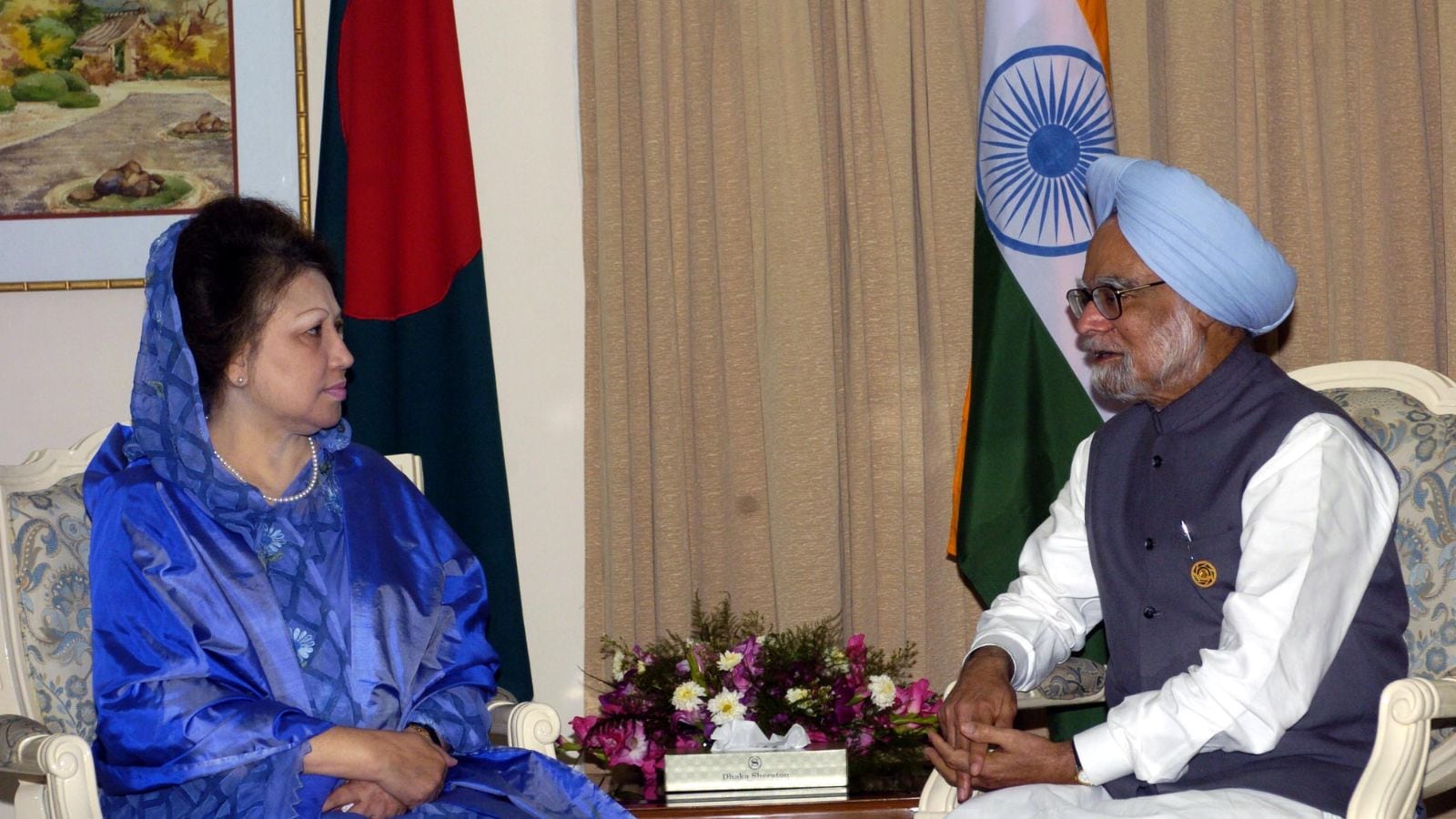
Despite her tough stance against India, Khaleda Zia did engage with New Delhi at the highest level, stressing that outright hostility was never her official line. In March 2006, she paid a state visit to New Delhi during Manmohan Singh’s tenure as the PM, where the two sides discussed water-sharing, border management, trade, and security, and signed a revised trade agreement along with a new accord on combating drug smuggling.
Story continues below this ad
 Begum Khaleda Zia in a meeting with the former Minister of State for External affairs Eduardo Faleiro in New Delhi in 1992. (Express Archive photo)
Khaleda Zia on India in Sheikh Hasina regime
Even after leaving office, she continued to deploy anti-India themes in her speeches, warning against Bangladesh becoming economically or strategically dependent on its larger neighbour. Khaleda Zia continued her stance against India after losing power and criticised the Sheikh Hasina government for signing various deals with India, including the coal-fired power plant at Rampal near Sundarbans.
In 2015, she met PM Narendra Modi during his visit to Dhaka and had a “warm meeting”. PM Modi on Tuesday said: “We hope that her vision and legacy will continue to guide our partnership.”
ALSO READ | Khaleda-Hasina spat again,Delhi keeps track
With her death, the reins of the BNP is likely to go to her son Tarique Rahman, who is also a frontrunner for the Prime Minister’s post. In his address after returning to Bangladesh after a 17-year exile, Rahman said he had a plan to build an “inclusive Bangladesh” where people across religions and regions could live without fear. While this does signal towards a peace plan for the violence-hit nation, the BNP is yet to officially lay out its plan for an India-Bangladesh policy.
CHECK THE LATEST UPDATES AND REACTIONS AROUND BNP CHAIRMAN KHALEDA ZIA’S DEATH HERE.