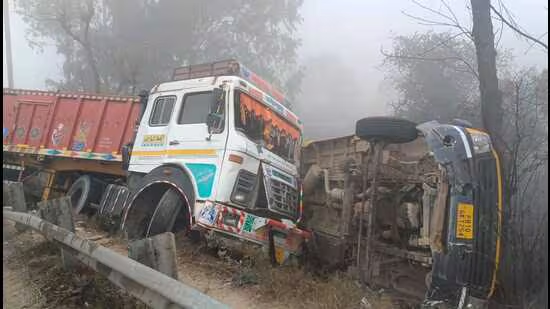
The truth is uncomfortable: India does not lack laws to curb reckless driving. What it lacks is seriousness in enforcement, courage in prosecution and urgency in judicial response.

India’s roads kill more than 1.6 lakh people every year — one of the highest road fatality counts in the world. Speeding, racing, drunk driving and underage driving have become routine headlines. Yet despite the scale of devastation, our criminal justice system continues to treat most fatal crashes as unfortunate accidents rather than preventable crimes of dangerous behaviour.
Real deterrence can begin tomorrow — without a single amendment. It simply requires using the legal powers that already exist. The first failure happens at the FIR stage.
Most fatal crashes are registered under mild negligence provisions, framing death as a mistake rather than criminal recklessness. This automatically makes offences bailable, weakens punishment and sends a message that killing on the road is legally survivable.
Yet where drivers are speeding excessively, racing, intoxicated, using phones, or repeatedly violating traffic laws, the conduct clearly shows knowledge of risk to life. Criminal law already permits treating such behaviour as serious culpable negligence — even culpable homicide in extreme cases. Police rarely apply these stronger provisions.
By calling recklessness an “accident,” the justice system dilutes accountability from the very first step. Courts can be far firmer — but rarely are. Judges already have the authority to demand full driving histories before bail, examine repeat violations as danger to society, refuse bail where recklessness is extreme, and hear victim impact before release decisions. Yet bail is often granted mechanically, without examining whether the accused has a pattern of dangerous conduct.
Courts also have the power to order immediate interim compensation through victim compensation funds. Families should not wait years for relief while cases crawl through tribunals. Yet this authority is underused.
Justice delayed becomes economic punishment for victims. Underage driving is where deterrence should be the strongest, but enforcement remains weakest. Indian law already fixes responsibility on parents or guardians who allow minors to drive. It permits prosecution, heavy fines, cancellation of vehicle registration and long-term disqualification from licensing. Yet parental liability is often symbolic.
Allowing a child access to a vehicle is not harmless parenting — it is conscious endangerment of public life. Until guardians face visible criminal consequences, underage driving will remain routine. Police must also investigate like lives matter.
Fatal crashes should involve forensic reconstruction, CCTV analysis, mobile data review and automatic documentation of prior violations. Weak investigation produces weak prosecution and predictable acquittals.
Equally critical is proper documentation of traffic violations. In many developed countries, driving operates under strict point-based systems. Each serious offence adds penalty points to a central digital record. Once a threshold is crossed, licence suspension or cancellation is automatic. Repeat offenders are flagged nationwide. Administrative escalation does not depend on discretion — the system enforces it.
In India, digital databases exist, but they are disjointed. Which is why enforcement remains fragmented. Violations often fail to escalate meaningfully. Drivers accumulate multiple challans yet retain licences. Habitual offenders remain on the road until tragedy occurs.
Licensing standards also differ sharply. In much of Europe, the UK and the United States, obtaining a licence requires structured training, supervised driving hours, probationary periods and rigorous testing. Even minor early violations can trigger suspension. Driving is treated as a privilege that must be earned and monitored continuously.
In India, licence acquisition in many regions remains inconsistent, testing standards vary, and enforcement of probationary restrictions is weak. When licences are easy to obtain and difficult to suspend, prevention collapses.
Transport authorities therefore cannot remain silent enablers. When fatal crashes involve drivers with long histories of violations, questions must be asked: Why was the licence not suspended? Why were escalating penalties not imposed? Why did administrative systems fail to intervene before someone died?
Transport departments already possess powers to suspend licences and impound vehicles. These powers must be exercised proactively, not posthumously. The traffic police and the transport department work in silos.
Another underused tool is vehicle forfeiture. Criminal law allows seizure of instruments used in serious offences. A vehicle that kills through reckless use is no different from a weapon used in crime. Confiscation and auction — with proceeds directed toward victim compensation — would deliver immediate relief and create powerful deterrence.
The core problem is not legal deficiency — it is enforcement culture. Western countries did not reduce road deaths merely by drafting harsher statutes. They changed how seriously they treat dangerous driving. Recklessness is framed as public endangerment. Repeat violations are tracked rigorously. Administrative action is automatic. Victims are heard. Compensation is timely.
India treats road deaths as unfortunate misjudgment. Until that mindset shifts, death will continue to feel legally cheap.
Without any new law, India can already register serious criminal charges in reckless deaths, deny bail where conduct shows danger, enforce parental liability strictly, order immediate compensation, suspend licences for repeat offenders, and confiscate vehicles used in fatal negligence.
The tools exist. The will does not. Every time reckless driving is softened into an “accident,” the justice system signals that lives lost on roads matter less than lives lost elsewhere. They do not.
Until courts become firmer, police braver in charging, licensing authorities stricter in suspension, and departments accountable for inaction, India’s road carnage will continue — not because it is unavoidable, but because it is tolerated.
Reckless driving is not misfortune. It is preventable crime. And the criminal justice system already has everything it needs to stop it — if it chooses to act.
(The writer, India’s first female IPS officer, is former lieutenant governor of Puducherry)