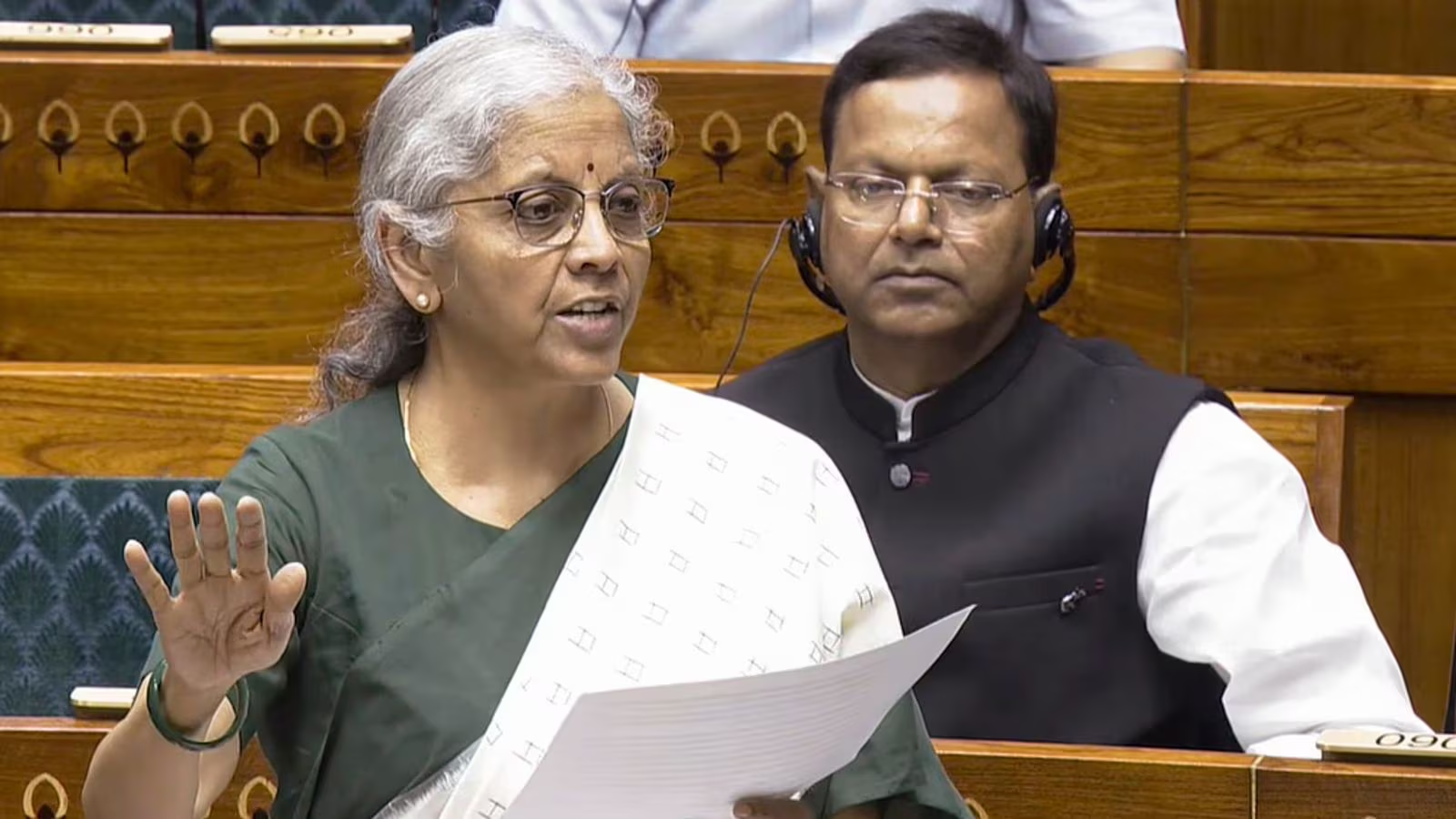
Replying to the debate, Finance Minister Nirmala Sitharaman said the Code was not meant to function merely as a debt recovery mechanism but as a framework to save viable businesses. She said the Bill has 12 amendments, 11 recommended by the Select Committee that examined it and one introduced by the government.
Sitharaman said the Insolvency and Bankruptcy Code has contributed significantly to companies over the last 10 years. “The IBC has been a crucial factor in improving the overall health of the country’s banking sector,” she said.
Responding to Opposition criticism about some economic offenders fleeing the country, she said that a law was enacted in 2018 against fugitive economic offenders, including the confiscation of their property, noting that some Opposition members had flagged the matter.
The Insolvency and Bankruptcy Code, 2016, provides a time-bound process for resolving insolvency among companies and individuals, according to PRS Legislative Research. The Bill aims to address procedural delays the Code has faced to date.
The Bill removes the liquidator’s powers to admit or reject claims and to determine their value. It grants the committee of creditors (CoC) the power to appoint or remove the liquidator and to supervise the liquidation process, establishing a Creditor-Initiated Insolvency Resolution Process (CIIRP) that permits select financial institutions to commence insolvency proceedings out of court.
“For liquidation proceedings, the Code grants the liquidator quasi-judicial powers with respect to claims. This is to ensure finality of claims as rights get extinguished once assets are distributed under liquidation. However, the Bill removes these powers of the liquidator, who must now act under the supervision of the CoC,” PRS says in its analysis. “CIIRP may only be initiated by select financial institutions specified by the central government.”
Story continues below this ad
Anurag Thakur points to low NPA
Earlier, Lok Sabha last Wednesday debated the Bill, with ruling National Democratic Alliance (NDA) MPs commending it as a draft law to resolve insolvency, while opposition MPs said it would not serve the purpose.
BJP MP Anurag Thakur said during the debate that the legislative framework before the Narendra Modi government came to power led to delays. He added that it took seven years to either revive or shut down a sick company. He added that the matters would then reach the courts, leading to another delay of 10-15 years.
He said that all 12 public sector banks, 11 of which were in bad shape earlier, are profitable today because of the Modi government’s reforms. Thakur added that Atal Bihari Vajpayee’s government brought down non-performing assets (NPAs) from 16 per cent to 7.8 per cent; that these again went up to 11-12 per cent in the United Progressive Alliance (UPA) days, after which they are now as low as 2.3 per cent.
Taking an oblique dig at Rahul Gandhi, he said that the Congress had the “biggest NPA” in democracy.
Story continues below this ad
Opposition counters with examples of fugitive economic offenders
Countering Thakur, Saugata Roy of the Trinamool Congress (TMC) pointed out that Nirav Modi, Mehul Choksi and Vijay Mallya had become fugitive offenders and could not be brought back. He said that the new Bill was not sufficiently strong and would not solve the problem; that companies were swindling banks’ money; and that the law needed to be tightened.
Kalanadhi Veeraswami of the Dravida Munnetra Kazhagam (DMK) said the law was benefiting a select few, distributing national assets to them. He added that the NPAs were rising and the amounts were not being recovered.
Rahul Kaswan of the Congress said that the government was constantly amending its own 2016 law and asked why, if the law was not a failure, it was doing so. He said creditors have direct financial interests and cannot be allowed to oversee liquidation.
He added that liquidation as a process has lost its independence in the Bill and would lead to biased decision-making. He asserted that the Bill did not constitute a reform. Kaswan said that a minimum level of protection for MSMEs was required in the Bill.
Story continues below this ad
Abhay Kumar Sinha of the Rashtriya Janata Dal (RJD) said the Bill would benefit big corporations but harm small entrepreneurs in Bihar.