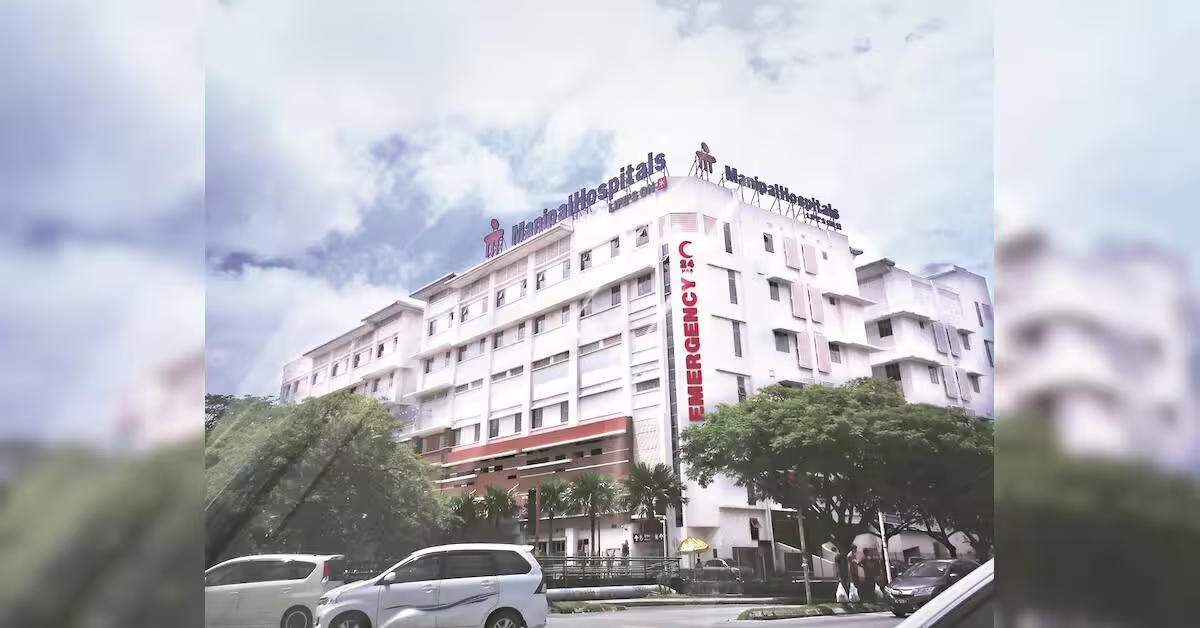
Manipal Hospitals plans to build 80 per cent of the 2,426 beds in its identified expansion pipeline through greenfield projects, signalling a greater reliance on constructing hospitals from scratch after several yearsof acquisition-led growth.
The hospital chain plans to add around 1,943 greenfield beds and 483 beds through brownfield expansion by 2030, according to Manipal Health Enterprises’ first annual report following its public listing on August 5. Greenfield beds, thus, account for 80.1 percent of the planned capacity.
The expansion will focus primarily on markets where Manipal already has a presence, including Karnataka, Maharashtra, Goa, and eastern India.
The company is also evaluating acquisitions in these markets, as well as in Delhi-NCR, Telangana, Kerala, Andhra Pradesh, and Chhattisgarh. It has identified the Mumbai-Pune corridor as a key growth opportunity and is considering acquisitions to consolidate its position in Delhi-NCR.
Greenfield expansion, however, requires substantial upfront investment. Dilip Jose, managing director and chief executive officer of Manipal Hospitals, had told Business Standard in an earlier interview that a greenfield hospital of around 250 beds typically requires an investment of ₹380 crore-₹390 crore, excluding the cost of land and the building.
Spending on medical equipment, technology, information technology, and interiorsworks out to around ₹1.5 crore per bed, he had said. At that benchmark, the planned 1,943 greenfield beds could entail an investment of around ₹2,915 crore, excluding land and building costs. This is an indicative calculation based on the per-bed investment.
Manipal’s existing hospitals also provide room for growth. Its occupancy stood at 64.5 per cent in FY26, compared with 67.1 per cent in the previous year, even as operational beds increased 20.2 per cent to 6,227 from 5,179. The company generally begins assessing additional capacity when a hospital approaches 70 per cent occupancy, allowing time for construction before existing facilities become constrained.
The expansion plan follows a period of rapid inorganic growth. Between FY21 and FY26, Manipal added 5,548 beds through the acquisitions of Columbia Asia, Vikram Hospitals, AMRI, Medica Synergie and Sahyadri Hospitals.
The acquisition of Sahyadri, completed in stages beginning October 2025, added 10 hospitals and 1,606 licensed beds in Maharashtra. Manipal paid around ₹5,255 crore during FY26 for a stake of nearly 90 percent and has committed another ₹574 crore for a further tranche.
The consolidation of Sahyadri, along with higher patient volumes, helped Manipal’s consolidated revenue from operations increase 25.4 per cent to ₹10,335.75 crore in FY26 from ₹8,242.26 crore a year earlier. Earnings before interest, tax, depreciation and amortisation rose 22.1 percent to ₹2,644 crore, although the Ebitda margin narrowed to 25.6 per cent from 26.3 per cent. Profit after tax declined 15.3 per cent to ₹916.59 crore from ₹1,081.67 crore. Finance costs rose 68.9 per cent to ₹864.29 crore, primarily because of higher borrowings, including non-convertible debentures raised for acquisitions and expansion. Depreciation and amortisation increased 34.1 per cent to ₹679.55 crore, reflecting the larger asset base following the Sahyadri acquisition. Tax expense also rose to ₹261.51 crore from ₹160.64 crore.
The acquisition and expansion programme increased net debt, including lease liabilities, to 3.7 times Ebitda in FY26 from two-fold in FY25. Return on capital employed declined to 22 per cent from 27 per cent.
Operating metrics, however, improved. Average revenue per occupied bed rose 8.8 per cent to ₹68,900 per day from ₹63,300. Inpatient volumes increased 19.9 per cent to 527,227, while outpatient volumes rose 16.2 per cent to 5.48 million.
Cardiac sciences, oncology, neurosciences, gastro sciences, orthopaedics and renal sciences — classified together by Manipal as CONGO-R — contributed 64.3 per cent of gross inpatient revenue, up from 62.6 per cent in FY25. Oncology recorded the strongest growth among these specialties.
Manipal’s ₹9,275.21-crore initial public offering comprised a fresh issue of ₹8,000 crore and an offer for sale of ₹1,275.21 crore. Manipal’s shares listed at ₹652 on the National Stock Exchange, a 10.5 per cent premium to the issue price of ₹590. The stock closed at ₹725.20 on September 4, gaining around 11.2 per cent from its listing price and 22.9 per cent from the issue price.