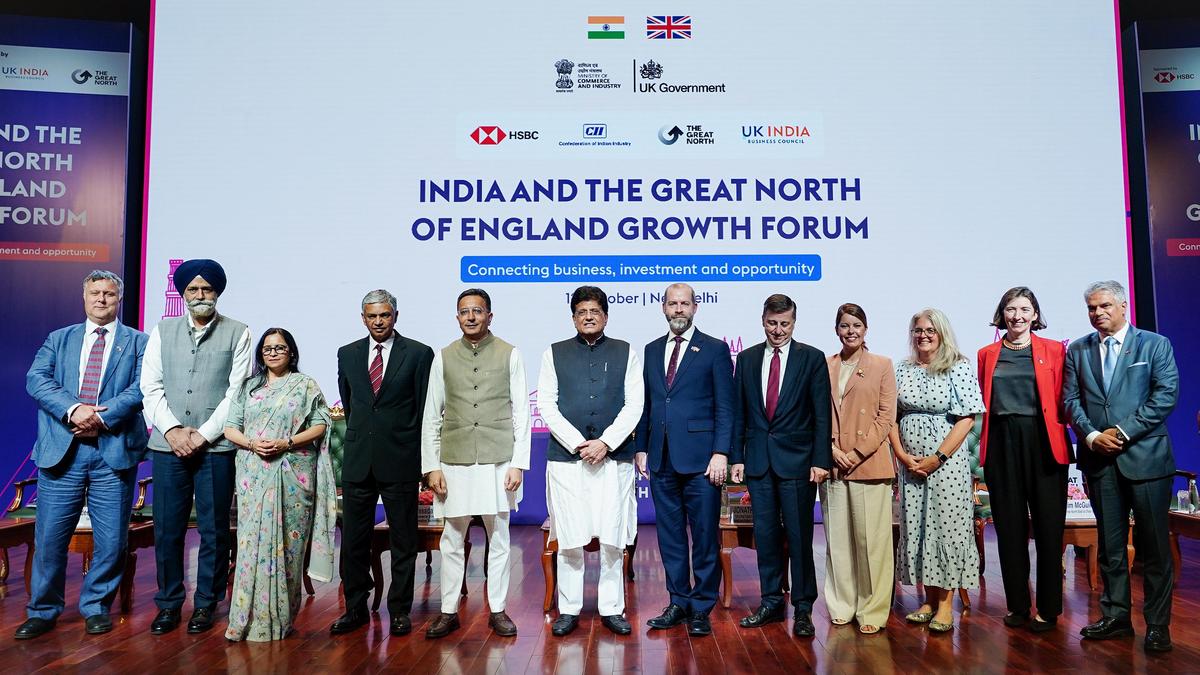
The India-United Kingdom Comprehensive Economic and Trade Agreement (CETA) has opened the door to a new phase in the relationship between the two countries, with the focus now shifting from agreement to action. The momentum is already being seen, as the leaders from across the North of England have been travelling together to India, for the first time under The Great North banner to strengthen ties on trade, investment, innovation, culture and the visitor economy.
Editorial | Maturing approach: On the India-U.K. Comprehensive Economic and Trade Agreement
Beyond headlines
Agreements are only as powerful as the opportunities they unlock. Tariff reductions, regulatory alignment, and mobility provisions matter enormously; yet, their true value is realised only when businesses on the ground understand precisely where and how they apply. Keeping this in mind, the Northern Mayors were joined by businesses, small and medium enterprises and universities from across the region to help bolster links, showcase the North’s economic assets and create new opportunities for trade, investment and academic collaboration. The North of England and India already have deep and growing ties, with nearly 5,40,000 people of Indian origin living across the region. Indian companies have invested over £1bn in the Northwest alone, supporting more than 6,700 jobs, according to the Confederation of Indian Industry report. Nearly 200 delegates from across the North were part of the visit, bringing together mayors, businesses, universities and leaders from tourism, culture and sport to make the case for the North as a destination for investment, partnerships and growth.

U.K. Foreign Secretary David Lammy’s statement (made in 2024) describing the trade pact as “the floor, not the ceiling” of the bilateral relationship is the true essence of the current ties between New Delhi and London. The agreement is the result of several rounds of negotiations, over the years — 14 rounds of discussions, with each point deliberated to deliver and cash-in on strengths and individual goals of the two nations.
The U.K. India Business Council, a mission partner for the Great North delegation, is working to help U.K. businesses better understand the opportunity and reframe how they see India. India is no longer simply a market to sell into. It is a strategic partner with the potential to become an integral part of the U.K.’s research and development (R and D), technology, talent and supply chains.

Visits to action
In the last few years, the ministerial and government visits have been largely with a broader vision to keep the ball rolling. This was seen with former U.K. Prime Minister Sir Keir Starmer’s delegation coming to India in 2025 and vice-versa. But this time we see policymakers coming in to discuss the next steps. Government meetings, business delegations, university partnerships, R and D collaborations, sports and cultural ties and targeted regional engagements in business hubs of India. The itinerary was designed to build a long-term relationship.
There is already some impact, with the footprint of Indian businesses in the U.K. having expanded sharply this year, the number of Indian-owned companies rising nearly 60% from the previous year and combined revenues surpassing £105 billion, according to the latest India Meets Britain Tracker published by Grant Thornton UK.
Bilateral trade between India and the U.K. rose to £47.4 billion in 2025, marking an 11.7% increase from the previous year. Growth was concentrated on advanced manufacturing, clean energy and technology. With the CETA now in place, the India-U.K. corridor is poised for unprecedented growth, creating value for both economies.
In one of the U.K. India Business Council (UKIBC)’s reports on the CETA, it has focused on regional collaboration, mapping them against the sector-specific pathways for growth. A regional approach to trade engagement offers India a nuanced and targeted pathway into the U.K. economy; one that goes beyond London and into the innovation-rich heartlands of Britain. The report takes one step ahead from the macro view and delves into specifics. Examine Maharashtra’s aerospace ambitions, Gujarat’s chemical exports, Karnataka’s world-class IT ecosystem and Tamil Nadu’s pharmaceutical prowess. It asks not just what this deal means for India or the U.K. in aggregate, but also what it means for the industries and communities that will live with its consequences day to day.

Conversations need to translate into business. For a micro, small and medium enterprise, the challenge is often not whether the benefits of a trade agreement exist, but how one can access them. That means understanding and navigating the finer details, such as knowing that a tariff preference exists, establishing whether a product qualifies, meeting rules of origin, securing the right documentation, and managing the administrative costs of claiming the benefit. It can be seen as an empowering process.
Business guide
As India signs more trade agreements, the task is about ensuring businesses can take full advantage of what has been negotiated on their behalf. To simplify this, the UKIBC has developed a U.K.-India CETA Business Utilisation Manual — A Practical Activation Guide for Indian and UK Businesses, which was launched recently by Union Commerce and Industry Minister Piyush Goyal in London. The guide is designed to simplify the agreement and help businesses understand where the opportunities lie, whether they qualify, and how to act on them.
Kishore Jayaraman is the Group CEO of the UK India Business Council (UKIBC). He has been the India Chair of UKIBC and a Member of the UKIBC Group Board since 2016, and is also the former President of Rolls-Royce, India and South Asia
Published – October 21, 2026 12:08 am IST