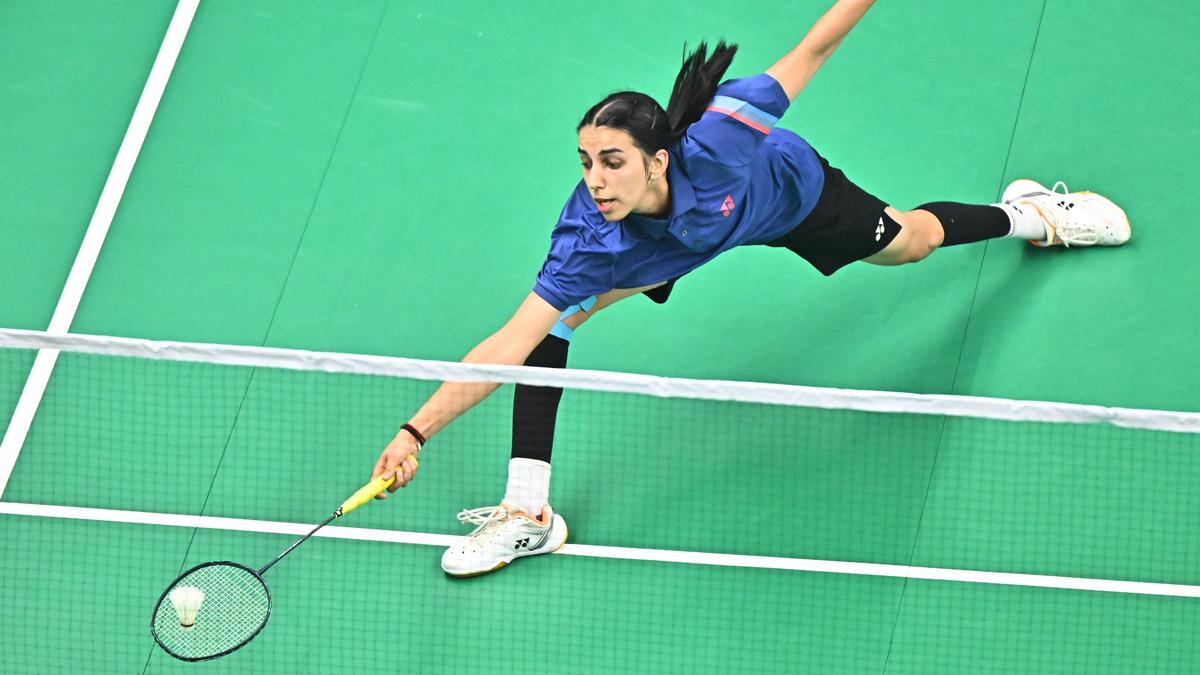
What began from the recreational courts of Panchkula has now taken Devika Sihag to the podium on the BWF circuit.
Her recent breakthrough performances at back-to-back tournaments in Thailand (a Super 300 event) and Azerbaijan, where she clinched the title, signal a promising phase in her young career and point to the emergence of a new offensive presence in Indian badminton.
She will next be in action at the Orleans Masters in France, beginning March 17 (Tuesday), as she looks to build on her recent run of form.
Hailing from Haryana, the same State that produced Olympian Saina Nehwal, the 5’9” shuttler literally stands tall with a frame that invites comparison with another Olympian P.V. Sindhu.
However, her ascent has not been without its structural and physical taxes. Battling the knee issues with her patella (the bone in front of the knee) inherent to tall athletes and overcoming the psychological complex of facing compatriots, Devika has been honing her game in the high performance environment of the Prakash Padukone Badminton Academy (PPBA) in Bengaluru since 2018.
Training alongside Olympic pedigree and balancing a degree in Sports Management, the 20-year-old, is now deep into her preparations for the top tier.
In a conversation with The Hindu, Devika spoke about the tactical shifts behind her recent success, the influence of being a sparring partner to Sindhu, and her early experiences on the senior circuit. Excerpts:
Can you take me back to the very beginning? How were you introduced to badminton?
My father used to go to Tau Devi Lal Stadium in Panchkula just for his fitness and running. He thought he would put me and my younger brother in badminton just for an evening hobby. At first, it was just like that, but after some time, I started playing well and performed well at the State and National level. Then my parents thought that I could pursue it professionally.
At what point in your childhood did you realise you had to leave home to train professionally?
I didn’t think about that. My coach suggested that now the level has increased, it is better to go there. I was 14 or 15 years old.
He convinced my parents and they talked with each other. That’s how it was decided. The first two weeks were very difficult; I was homesick. But later on, it became better. But I still miss them sometimes.
There was some hesitation from your father about you moving to Bengaluru, and your mother had to convince him…
My father was convinced, but he felt I had to focus on my studies as well, so it would be difficult if I moved. But he knew it was important for me, so he agreed. Now, I have almost finished my studies.
I am in my final year of graduation, pursuing BBA in Sports Management from Chitkara University. I mostly study on my own, so it is manageable.
Who was your earliest coach in Panchkula, and who are you training with now?
My earliest coach in Panchkula was Rohit Mandhan. Currently, I am training with coach Irwansyah (Adi Pratama). When I first came here, before Irwansyah, I was training under Mr. Umendra Rana.
I am also very grateful to my CBE team — Sagar sir (Sagar Chopda), (Umendra) Rana sir, Irwansyah, Sayali didi (Sayali Gokhale), and all the support staff. I also get financial support from Olympic Gold Quest (OGQ) and the Haryana Badminton Association (HBA). I am really thankful to them as well.
You’re currently training in one of the best environments in India. Who are the seniors or peers you train alongside, and how has watching their daily routine influenced your work ethic?
I have been training with Sindhu didi and Irwansyah for a few months now. It is a very good experience. She is a two-time Olympic medallist, so she knows what has to be done.
I watch her; she is very disciplined and does her work very meticulously. I have learned many things from her. She has good smashes and good footwork. I hope to learn more things from her.
You have a distinct advantage with your height compared to many other shuttlers, but of course, that comes with its own challenges. How did your coaches help you adapt your game to your frame?
My coaches always tell me that because of my height, I can play good back strokes. I can have good smashes and steep drops. So they have always made me work to improve that area.
I think tall players have a little bit of an advantage from the back, but it comes with consequences as well. Because of my height, I had knee pain for at least one year.
It was an on-and-off pain. I still get it, but it is not as bad as earlier. I’ve been doing my rehab and I consult my physios if I have pain.
Looking back at your training before the national set-up, what was your fitness regime like?
Where I used to train before, I didn’t know about the scientific side. We didn’t use to do much gym; we used to do light gym or just run and do on-court sessions. But here it was a balance of everything. I got to know the importance of the gym after coming here. So it helped me improve myself.
Tell us about your training schedule and diet?
We train around seven-eight hours in a day. We have half days on Wednesday and Saturday, and Sundays are off. In tournaments, I like Asian food, like ramen and Japanese food. At home, I mostly eat vegetarian food because my family is vegetarian. So I just eat what my mum makes.
With the increased travel, how are you managing the physical toll to stay injury-free?
It’s really difficult. If we are travelling to two tournaments together, the time zone is really different. This happened to me in Thailand and Azerbaijan; there was a three-hour difference. So I just try to recover by eating good food and covering up my sleep.
Against Supanida Katethong at the Thailand Masters, you were praised for your composure and control at crucial moments. How difficult was it to stick to your game plan?
Before the match, I just thought that Supanida is really an attacking player and she is really fast on court. So I just thought I’ll keep everything in. I will also attack, I won’t go too much into defence, but I have to match her pace. That helped me.
You stated that in Thailand you stopped thinking about winning or losing. Was there a specific conversation that triggered this?
Irwansyah talked to me before the match. He just said that I don’t have to worry too much. If we lose, we’ll come back and train harder and work on our mistakes. I wouldn’t say there was no pressure, but, my pressure was released a bit. So, I played calmly.
If you compare your game now to one year ago, what is the biggest mental or tactical shift you have made?
I would say that my speed is good; it has been better than before. Irwansyah has said that I have good strokes, but I have to work on my footwork and be faster on court. I can see that helping me in matches.
It has been better from before, and I can see that that is helping me as well in matches. So, I hope I can improve in that aspect more.
What are your targets for the next 12 months?
For this year, my target is to come in the top-30. I hope to get entries into Super 300 and 500 tournaments, and perform well in them.