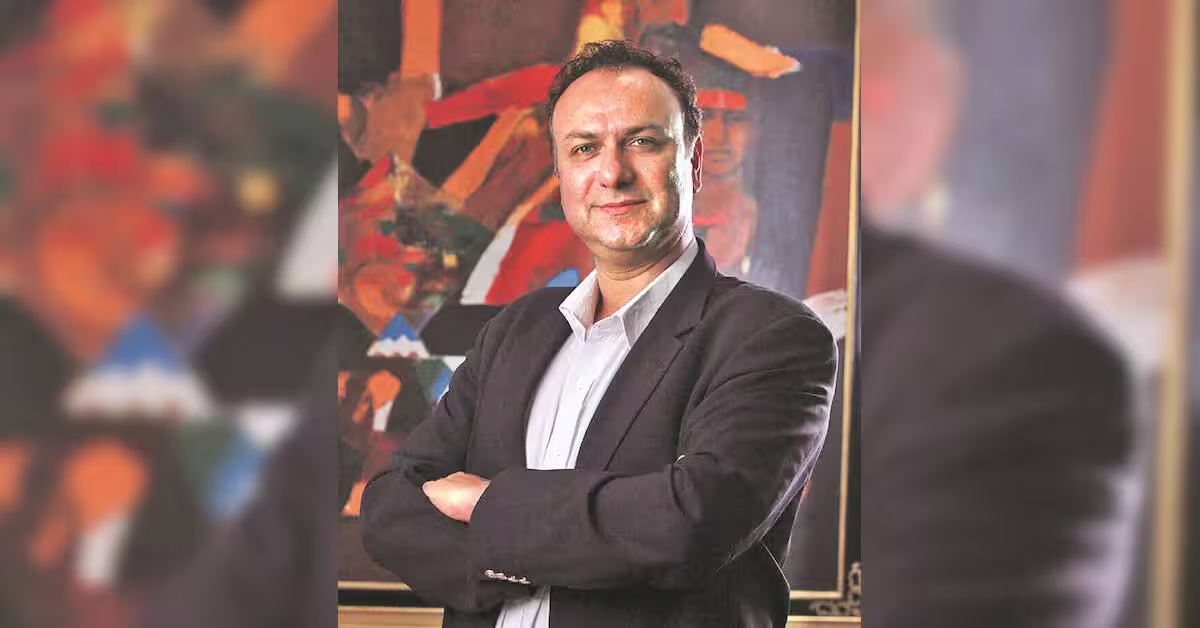
Shapoorji Pallonji Group, the second-largest shareholder in Tata Sons with an 18 per cent stake, has come out strongly in support of listing the holding company of the salt-to-software conglomerate.
A day after Tata Trusts Chairman Noel Tata opposed the listing proposal at the Tata Sons board meeting on September 17, Shapoorji Pallonji Mistry, chairman of Shapoorji Pallonji, issued an elaborate statement on why a stock exchange listing was the way forward for the company.
“The objective is not victory for one side. The objective is a stronger Tata institution, stronger philanthropy, greater accountability, deeper partnership and ultimately greater service to India,” Mistry said in a message contrasting with the position of Tata Trusts, the largest shareholder in Tata Sons with a 66 per cent stake.
Noel Tata is related to the Shapoorji Group through his marriage to the daughter of the late Pallonji Mistry and sister of current chairman Shapoorji Pallonji Mistry and the late Cyrus Mistry.
At the board meeting on Thursday, Noel Tata had tabled the Shapoorji Group’s proposal seeking ₹25,000 crore in monetisation through a partial sale of its stake in Tata Sons via a non-listing route.
On Friday, however, Mistry said: “I receive the Reserve Bank of India’s decision with deep respect and profound humility. I welcome the decision wholeheartedly, and I believe it marks a pivotal moment not merely for Tata Sons, but for the principles of transparency, accountability, fairness and responsible institution-building that should guide enterprises of national importance.”
Noel Tata pushed for Tata Sons to engage further with the Reserve Bank of India (RBI) to remain privately held, while stating that the regulator’s order of September 11, 2026, did not specify listing.
“On my reading, it does not say that listing is the only option. Considerable room remains and this board should occupy that room rather than concede it,” he had said on Thursday in a late-evening statement.
However, a day later, Mistry said: “The Reserve Bank of India has provided full clarity. Tata Sons had been classified as an Upper-Layer NBFC under the RBI’s Scale-Based Regulatory Framework, and the prescribed listing route followed from that regulatory architecture. With the RBI having rejected the application to surrender its registration and directing Tata Sons towards the necessary compliance at the earliest, the path forward is clear. I want to acknowledge the RBI and the government for the clarity of purpose brought to this process and the discipline shown in holding all institutions, regardless of size or standing to the same standard.”
He also expressed admiration for the leadership of Prime Minister Narendra Modi, “particularly his commitment to strengthening institutions and enabling them to discharge their responsibilities with clarity, authority and purpose”.
Mistry reiterated that the public listing of Tata Sons was not merely a financial or regulatory matter.
“It is a social and moral imperative. It is about strengthening transparency and public accountability in one of India’s most consequential business institutions, while preserving and advancing the extraordinary philanthropic purpose that lies at the heart of the Tata legacy.”
He added that this “landmark decision should not be viewed as a victory of one stakeholder over another. It should be viewed as an opportunity to bring people and institutions together”.
According to Mistry, the listing of Tata Sons could become a bridge.
“A bridge between shareholders and Tata Trusts, between private heritage and public accountability, between generations of stewardship, and between India’s great past and the extraordinary future that lies ahead.”
Pointing out that the relationship between the Shapoorji Pallonji and Tata groups was itself more than a century old, he said he was looking forward not merely to a resolution of the present chapter, but to forging a greater partnership, greater engagement and deeper relationships with Tata Sons and Tata Trusts in the years ahead.
“Always with a spirit of mutual respect and always keeping the national interest paramount.”
Analysts are of the view that Mistry’s statement will be watched closely against the backdrop of the listing battle as well as the Tata leadership contest, with veto votes being cast over the reappointment of N Chandrasekaran as chairman of Tata Sons for a third term.
The founding philosophy of Jamsetji Tata provides the moral foundation for this moment, according to Mistry.
He quoted Jamsetji as saying, “in a free enterprise, the community is not just another stakeholder in business but is in fact the very purpose of its existence.”
He added that Jamsetji Tata’s life demonstrated that enterprise and nation-building need not be separate pursuits; enterprise can itself be an instrument of national progress.
“That very philosophy should guide the next chapter of Tata Sons. The question before us should not simply be who owns what, or how a corporate structure is preserved. The larger question should be how can one of India’s greatest industrial institutions become even stronger, more transparent, more accountable and more capable of serving the nation.”
The Tata Group and Shapoorji Pallonji Group have had decades of close business ties.
In 2012, the group’s scion Cyrus Mistry was appointed chairman of Tata Sons. Subsequently, in 2016, he was removed as chairman following a boardroom battle led by then Tata Trusts Chairman Ratan Tata.
A decade after that incident, the chairman of the Shapoorji Group said on Friday: “I believe a transparent and publicly accountable Tata Sons can strengthen the entire ecosystem. It can broaden participation, enhance governance, give greater visibility to value, protect the legitimate interests of investors and provide the basis for a more robust and equitable dividend policy.”
He added that Tata Sons as a listed entity could strengthen the capacity of Tata Trusts to pursue its philanthropic responsibilities over generations.
“A stronger Tata Sons, operating transparently and responsibly, can help make that ambition possible through sustained enterprise growth and a durable flow of value towards philanthropy.”