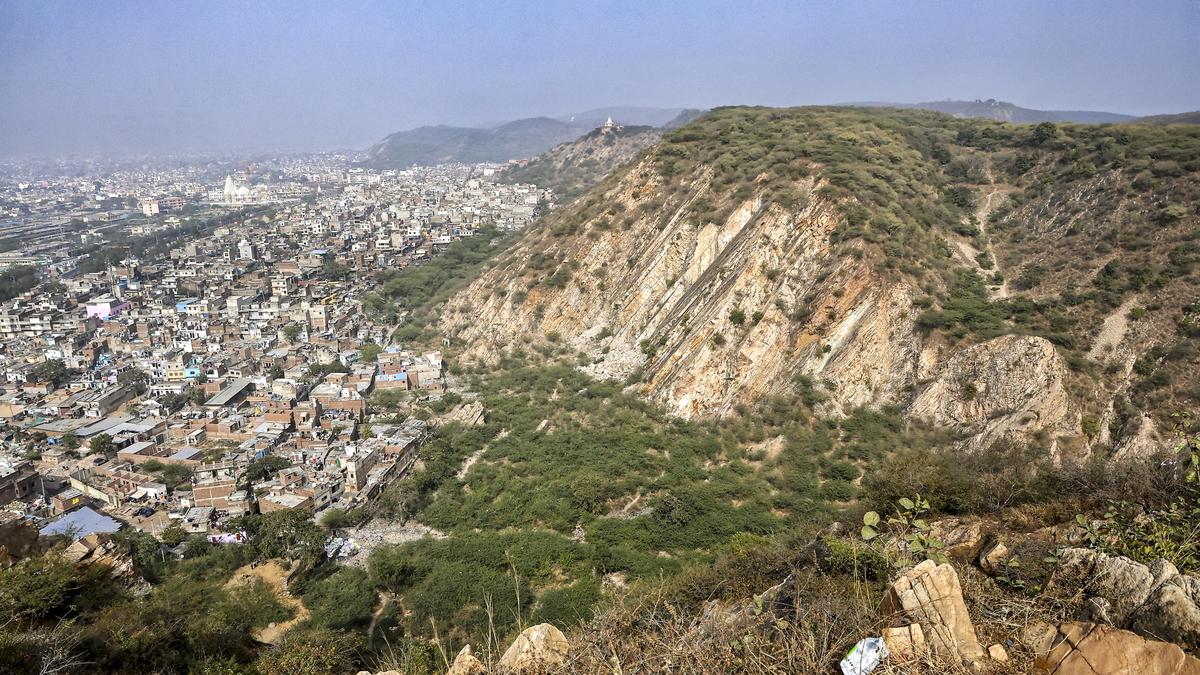
The districts in Rajasthan, which host roughly 70% of the entire Aravalli range, are suffering from a disproportionately high volume of illegal mining, data show. While these Aravalli districts account for less than 45% of the State’s mining leases and contribute only 40% of its total mineral output, their share of illegal mining cases exceeds 56%. The Aravalli districts also account for more than 77% of all First Information Reports (FIRs) lodged for illegal mining in the State.
Clearly, the Aravalli landscape is the epicentre of Rajasthan’s mining crisis. Recent proposed changes to the legal definition of what constitutes an ‘Aravalli hill’ threaten to further aggravate this situation by potentially removing protections against mining from vast stretches of the range. Ironically, the changes proposed were actually initiated as a measure to curb illegal mining in the first place.
Legal tussle
The Aravalli hills, among the oldest mountain systems in the world, have become the focus of an ongoing legal and policy dispute over their definition and the rules governing mining activity. While examining issues related to mining in the region, the Supreme Court observed in May 2024 that the lack of a consistent definition of the Aravalli hills and ranges across States has been a key factor enabling illegal mining.
Since 2010, expert agencies, such as the Forest Survey of India (FSI), have identified the Aravalli hills based on a set of physical parameters, including a slope greater than three degrees, a 100-metre foothill buffer, an inter-hill distance or valley width of 500 metres, and an area enclosed by such hills from all sides.

To address the lack of uniformity in how the range is defined, the Court set up a committee led by the Union Environment Secretary, bringing together officials from the FSI, State Forest Departments, the Geological Survey of India, and the Central Empowered Committee. The panel was mandated to evolve a scientifically robust definition of the Aravallis that could be applied across the country.
The technical committee (comprising officials from scientific agencies and not the Environment Ministry) in 2024 suggested that any landform with a slope of at least 4.57 degrees and a height of at least 30 metres be identified as an Aravalli hill. The Environment Ministry, however, advanced a different approach, suggesting that only landforms in Aravalli districts rising at least 100 metres above the local relief be classified as Aravalli hills, and that hills within 500 metres of each other be treated collectively as part of the Aravalli range. This approach eventually reflected in the Supreme Court’s November 2025 order.
Experts including the FSI, which was part of the committee, raised red flags saying this may exclude most of the hills, leaving them potentially open to mining. The amicus curiae, K. Parameswar, also objected to this conclusion, stating that it was too narrow and could open hills below 100 metres to mining, thereby compromising the continuity and integrity of the Aravalli system.
With protests intensifying across the State, the Court subsequently kept the judgment in abeyance, ordering that the stay would remain until the matter reached finality. In the interim, the Union government imposed a freeze on granting new mining leases in the Aravalli landscape.
Impact on Rajasthan
Reclassification carries significant implications for mining regulation. If a landform is no longer classified as part of the Aravallis, it falls outside the specific mining controls and moratorium linked to the Aravalli framework.
The stakes are particularly high in Rajasthan. Of the roughly 800-km-long Aravalli range, around 560 km lie within Rajasthan. The range passes through 37 districts of which 20 are in Rajasthan. Moreover, Rajasthan hosts 16 of the 22 wildlife sanctuaries located in the Aravalli landscape, including three tiger reserves (Ranthambore, Sariska, Mukundra).
In 2021-22, States across India reported 90,173 illegal mining cases. Rajasthan accounted for more than 10% of these cases, placing it among the States with the highest number of reported incidents nationally. More importantly, within the State, the burden of these violations falls heavily on one specific geographic region.
Between 2020 and 2023, Rajasthan recorded 28,166 illegal mining cases, of which 15,772 (or 56%) were registered in Aravalli districts, even though these districts account for less than 45% of the State’s mining leases issued in the same period. Policing data show that of the 2,671 FIRs related to illegal mining lodged during this period, 2,070 (nearly 77.5%), originated from Aravalli districts between 2020 and 2023.
Moreover, between 2015 and 2022, Aravalli districts produced 918.8 million tonnes of minerals, accounting for only 40.6% of Rajasthan’s total output of 2.26 billion tonnes. Together, these figures reveal a stark reality: the Aravallis contribute a smaller portion of the State’s legal mineral wealth, but they bear a vastly disproportionate share of its mining-related lawlessness.
Beyond questions of legal classification, the Aravallis are ecologically vital. They slow the spread of sand and dust from the Thar Desert towards eastern Rajasthan, Haryana, and western Uttar Pradesh. They support groundwater recharge in an arid region, stabilise the local climate, and function as an important wildlife corridor.
Source: Lok Sabha replies; the Department of Mines and Geology, Government of Rajasthan; the Union Ministry of Mines; and the Environment Ministry’s affidavit in the Aravalli case, submitted to the Supreme Court
