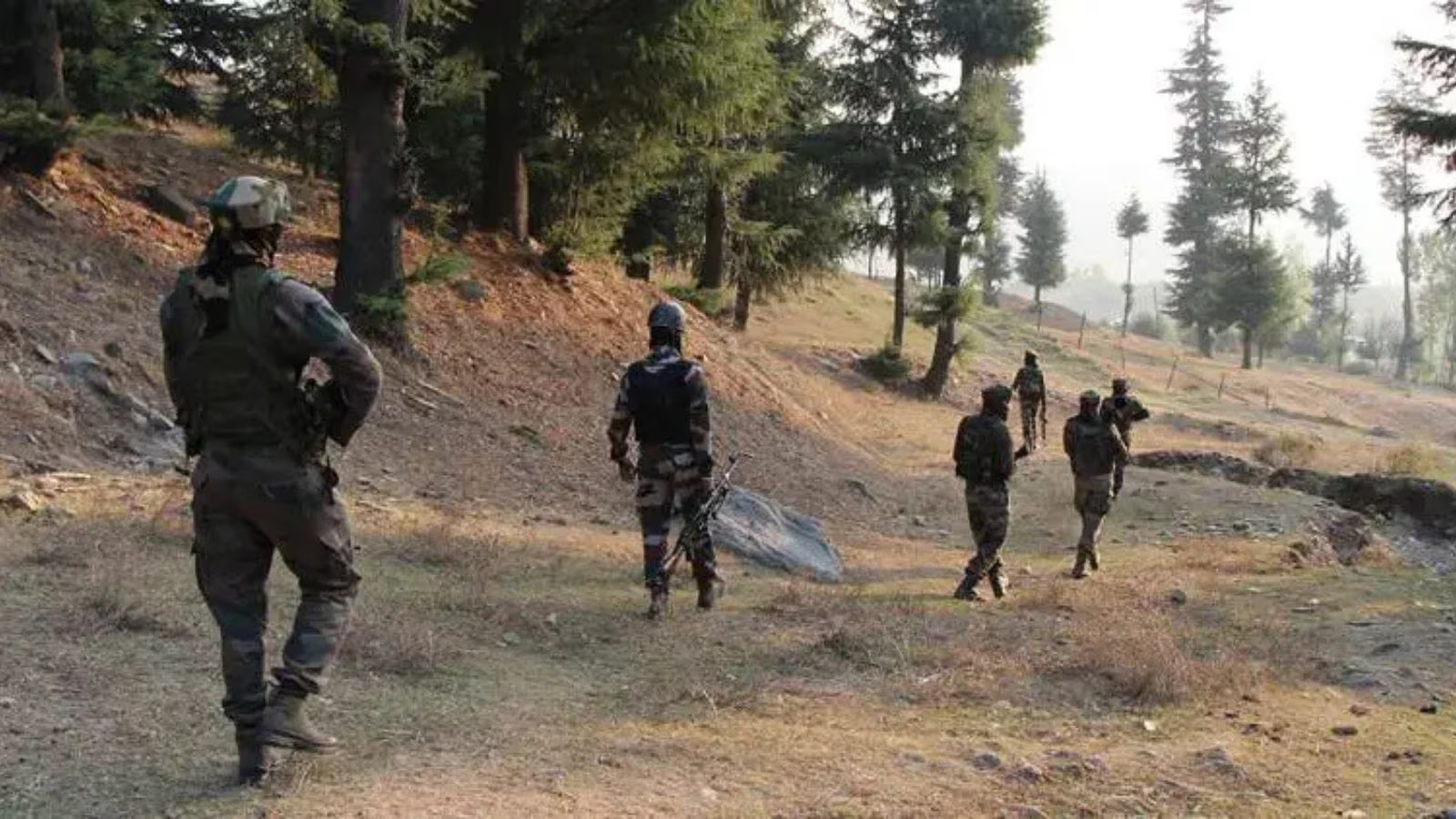
Nearly seven months after suffering large-scale damage to its defence infrastructure during Operation Sindoor, Pakistan has once again activated over 70 terror launch pads near Jammu, the Border Security Force (BSF) has said.
In the months since India’s Operation Sindoor inflicted extensive damage on Pakistani posts and terror infrastructure, security agencies say Pakistan has quietly rebuilt and reactivated 72 terror launch pads along the Jammu frontier. Senior BSF officers caution that despite Islamabad’s stated shift of such facilities to depth areas, several launch pads have resurfaced close to the International Border and the LoC, even as Pakistan restores abandoned posts and adapts to evolving tactics such as drone use.

BSF Deputy Inspector General Vikram Kunwar said at a press conference Saturday that after India caused extensive damage to terror infrastructure and Pakistani border posts during Operation Sindoor, Pakistan adopted a policy to move all terror launch pads from the border to depth areas.
“However, old habits die hard. Twelve terror launch pads have become active near the International Border in Pakistan’s Sialkot and Zafarwal areas. The other 60 launch pads have come up in the areas across the LoC [near Jammu],” he said, adding that while terrorist numbers keep changing, they generally keep them in groups of two to three.
There are no terrorist training camps in areas across the International Border at the moment, though there are reports of such camps in depth areas across the Line of Control, he said.
A total of 118 Pakistani posts that had targeted BSF forward positions along the International Border and the LoC in Jammu province were extensively damaged during Operation Sindoor, the DIG said — 72 along the IB in Hiranagar, Samba and Jammu, and 46 along the LoC in Rajouri and Poonch.
“Their surveillance system was also destroyed,” he said. “This information was not available immediately after the cessation of hostilities in May but has emerged over time.”
Story continues below this ad
BSF Inspector General Shashank Anand said the Pakistani Rangers who had abandoned their posts during Operation Sindoor have returned, and “we are keeping a watch on all activity and the installations of our counterpart across the border”.
“We know where and under what conditions and terrain they dig tunnels,” he said, adding that the BSF is using modern technology such as ground surveillance radars, electro-optical thermals and UAVs to safeguard the borders.
Noting that drones have emerged as a new threat since 2019, he said the BSF has kept pace with changing dynamics and “we have not only trained our troops, but have also installed counter-drone systems”.
He said all wars in the 21st Century — from Russia and Ukraine, Armenia and Azerbaijan, Israel and Palestine, Israel and Iran, or the recent Indo-Pak — have an aerial dimension.
Story continues below this ad
The BSF’s School of Drone Warfare at Gwalior has signed an MoU with IIT Delhi and IIT Chennai to work on it, he said. “We are constantly working on it and we feel that the aerial dimension will always be there in wars in the future or even cross-border firing,” he said.
According to The Indian Express, Operation Sindoor was launched on the night of May 6-7, 2025 in retaliation to the terror attack on April 22 in Pahalgam that killed 26 people – including a local.
The operation involved precision strikes on nine terror-infrastructure sites across Pakistan and Pakistan-occupied Kashmir (PoK), including well-known terror-camp hubs such as Bahawalpur, Muridke, and PoK towns Muzaffarabad and Kotli.