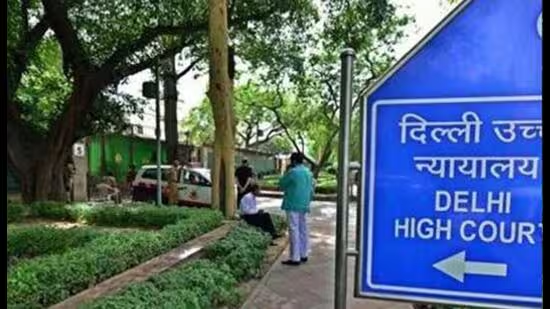
The Delhi High Court on Monday directed the Delhi government’s Directorate of Education (DoE) to refrain until February 20 from insisting that schools constitute fee regulation committees for determining fees for three academic years beginning 2026–27.

A bench of chief justice DK Upadhyaya and justice Tejas Karia issued the order while hearing petitions filed by Forum of Minority Schools and Action Committee Unaided Recognised Private Schools challenging the Delhi government’s February 1 notification.
The notification, titled Delhi School Education (Removal of Difficulties) Order, mandated all schools to constitute school-level fee regulation committees (SLFRCs) by February 10 for fixing fees for three academic years commencing from 2026–27. The petitioners contended that the order was contrary to the Delhi School Education (Transparency in Fixation and Regulation of Fees) Act, 2025, which provides that such committees must be formed by July 15.
The high court observed that extending the deadline from February 10 to February 20 would neither prejudice the government nor disrupt the timeline for fee fixation. Issuing notice in the petitions, the court directed the DoE to file its response by February 20, the next date of hearing.
During the hearing, the bench questioned DoE’s decision to advance the deadline through subordinate legislation instead of amending the parent Act. The court observed that a “removal of difficulties” order could not override or go beyond the provisions of the Act itself.
“Can the removal of difficulties order exceed or be in contravention of the provisions of the Act? If the Act fixes July, it can be changed only by amendment of the Act. Can you do it by subordinate legislation?” the bench asked.
In its interim order, the court said that since the challenge was to the February 1 notification and the application seeking a stay was scheduled to be heard on February 20, no prejudice would be caused to either side if the government did not insist on formation of the committees until then.
“Accordingly, we provide that till the next date of listing of the application for stay, i.e., February 20, 2026, those schools that have not formed the committee shall not be insisted upon by the GNCTD,” the court ordered.
The relief was granted after counsel for the petitioners – senior advocate Romy Chacko for the Forum of Minority Schools and advocate Kamal Gupta for the Action Committee of Unaided Recognised Private Schools – urged the court to extend the deadline during the pendency of their petitions. They argued that advancing the timeline without amending the Act was arbitrary and legally unsustainable.
The petitioners also pointed out that DoE had informed the Supreme Court on February 2 that it would not implement the fee regulation law for private schools in the 2025–26 academic session. This submission came after the apex court had asked the DoE to reconsider its decision on implementing the Act.
Opposing the plea for extension, DoE was represented by additional solicitor general SV Raju and advocate Zoheb Hossain. They argued that delaying the formation of committees would derail the fee fixation schedule and submitted that nearly 85% of schools had already constituted the SLFRCs. The law officer also pointed out that the DoE had previously extended deadlines for committee formation in earlier academic years and maintained that no prejudice would be caused if the process continued.
The matter will be heard next on February 20.