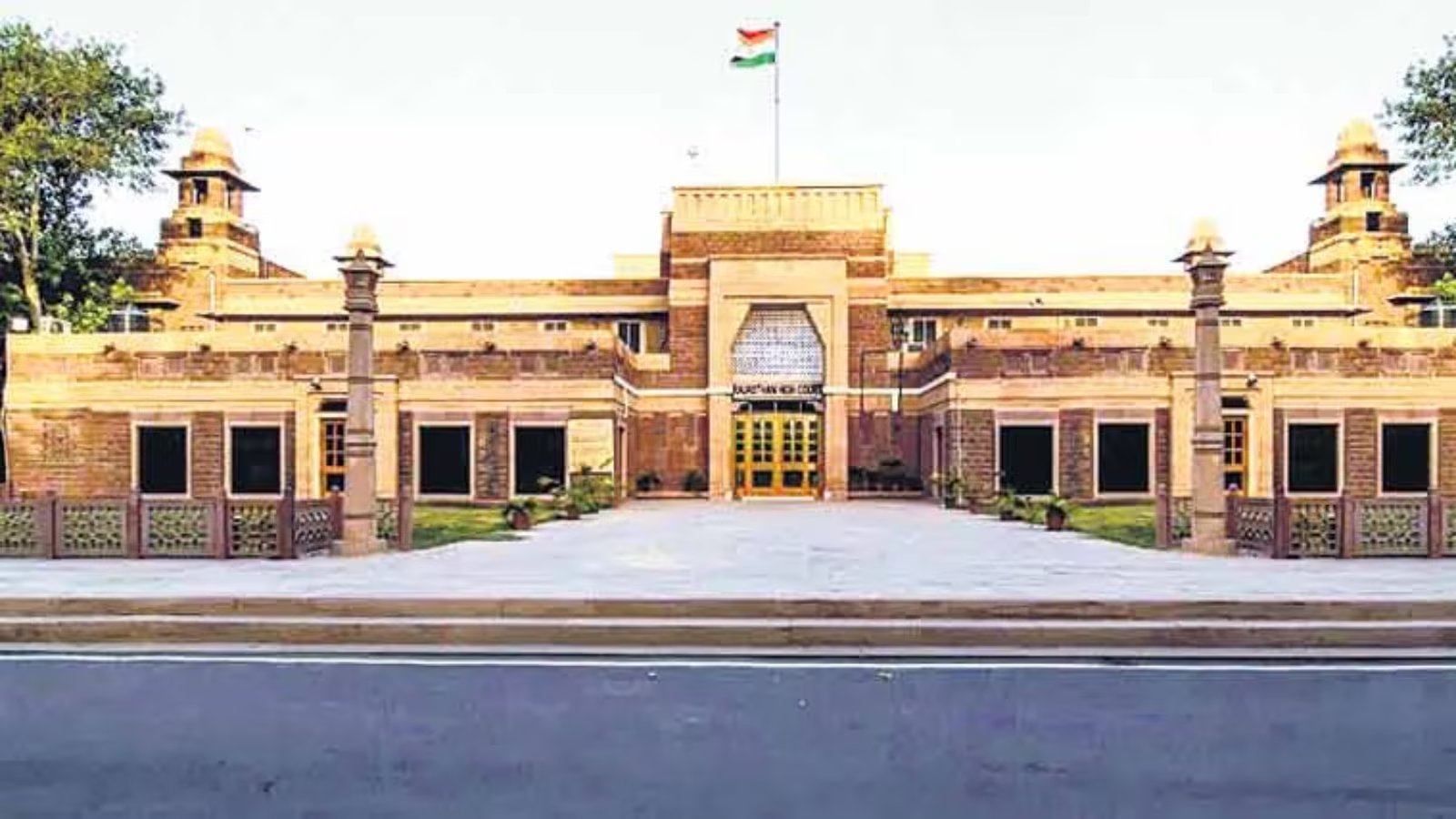
The Rajasthan High Court Friday declined to issue directions for the conduct of Students’ Union elections for the current academic year in Rajasthan, stating that these may lead to “avoidable disruption of the academic schedule, examination process and allied scholastic activities” at this advanced stage in the academic year, instead issuing prospective directions.
Dismissing the petitions as premature, the court observed that a “handful of students”, without any representative mandate, cannot claim to speak for lakhs of students across the state. It also noted that the petitioners had not approached internal university authorities such as the Dean, Student Welfare, or the prescribed election bodies before invoking the court’s writ jurisdiction. In the absence of any prior representation, grievance or adverse decision by the authorities, the court said there was nothing amenable to judicial review.

“Direct recourse to constitutional courts, without exhausting available institutional remedies, ought to remain an exception and not the rule,” a bench of Justice Sameer Jain said.
The HC also directed the state government and the Rajasthan University — a party in the case — to grant an effective hearing to the petitioners and other interested or aggrieved students on January 19, 2026, at a venue to be notified by the Vice-Chancellor or Dean, Student Welfare. The court said that after consultations with student representatives and affiliated colleges, the authorities have to deliberate on the grievances and evolve a workable framework for conducting Students’ Union elections in forthcoming academic years, strictly in accordance with the governing statutes and rules.
The HC issued the directions while hearing a bunch of petitions, including one by student Jai Rao, 24, who had broadly sought student union elections and compliance with Lyngdoh Committee recommendations that polls be held within six to eight weeks of the start of the academic session.
The court issued directions to universities and the state government to ensure accountability and transparency, particularly as fees are collected from students under various heads linked to student activities and elections. It directed the constitution or maintenance of duly notified Students’ Union Election Boards, adherence to principles of natural justice while hearing grievances, and proper accounting and utilisation of election-related fees. It said the election calendar should ordinarily be issued in March each year, adhered to strictly, and any deviation supported by cogent reasons recorded in writing.
In a significant direction aimed at minimising academic disruption, the court also issued directions to the Election Commission of India and civil authorities, stating that universities and colleges should, as far as practicable, not be requisitioned for polling or related purposes if it hampers academic activities. The ECI was asked to explore alternate arrangements such as community halls or government buildings and to factor in academic calendars while planning elections, to safeguard instructional time and academic continuity.
Story continues below this ad
Earlier, lawyers for the respondents had contended that the right to vote “or to participate in an election is no more than a statutory right and is entirely distinct from any alleged right to demand that elections must necessarily be conducted at a particular point of time.”
They had also claimed that the petitioners have no locus standi as only a “handful” of petitioners have approached the court, “claiming to represent the interests of the student community at large, without any authorisation or representative capacity.” Factually speaking, they said, there are approximately 28 state-funded universities, 53 private universities and 596 government colleges in Rajasthan. Even within the University of Rajasthan alone, there are approximately 26,500 students.
Following in the footsteps of the previous Ashok Gehlot government, the Bhajan Lal Sharma government had cited the National Education Policy (NEP) and violation of Lyngdoh Committee recommendations to skip student union elections this year. In 2023, a state election year, the Congress party, which was still smarting from NSUI having failed to win any president post in the student union elections in 2022, had cited similar reasons to skip student union elections.
