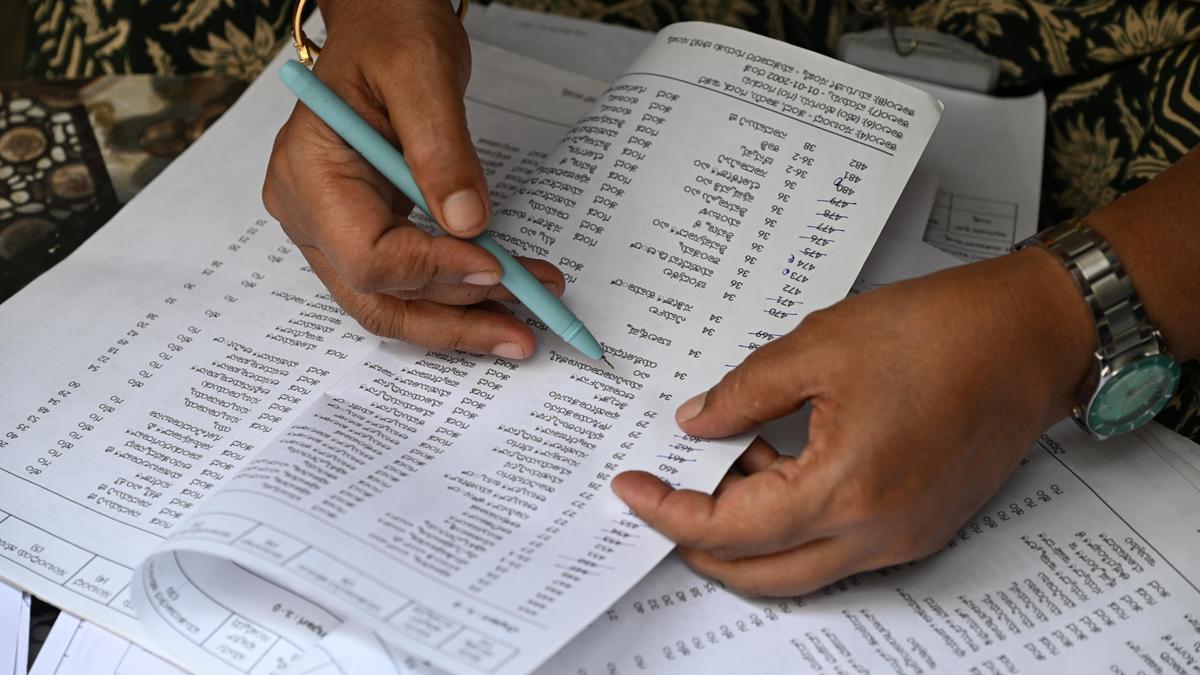

Even after completing 100% digitisation of enumeration forms and publishing the Absent, Shifted, Duplicate, Dead or Others (ASDDO) list, at least 85 Assembly constituencies in the State have reported an increase in the number of people marked under this category, raising questions about how more voters could have been added.
The ASDDO list was published on August 4, enabling people who were wrongly marked to check their names and request corrections if they were listed under any of the ASDDO categories. Following this, several voters who found their names on the list took it up with their respective Booth Level Officers (BLOs).
However, in many cases, voters argued that they were not removed from the ASDDO list but merely shifted from one category to another. In some cases, voters also told The Hindu that BLOs had collected their details but had not updated the changes.
A comparison of data from Friday and Sunday shows that many districts and constituencies reported an increase in ASDDO entries. This occurred despite official figures showing that the same constituencies had completed the digitisation of all enumeration forms, including those related to ASDDO cases.
Across the State
For instance, across Mysuru district, numbers rose under the ‘already enrolled or duplicate’ category, with all 11 Assembly constituencies seeing a spike. Alongside this, eight constituencies recorded an increase in the number of voters marked as dead. In total, across Mysuru district, the number of voters marked as dead increased by at least 98, while the number of duplicate or already enrolled voters rose by 175 between Friday and Sunday.
The situation was similar in Chamarajanagar, where all four Assembly constituencies recorded an increase in both the ‘dead’ and ‘duplicate’ categories. Of the four constituencies, Hanur, Kollegal and Chamarajanagar also recorded a rise in the number of voters marked under both ‘shifted’ and ‘absent’.
A similar trend — with a spike across multiple ASDDO categories — was seen in districts such as Koppal, Raichur, Vijayapura and Bengaluru Urban, among other areas.
BLOs told The Hindu that when they visited many of these houses, they could not locate the voters and thus classified them as ‘absent’. Later, when the voters contacted them, the BLOs distributed the forms.
However, if 100% of the enumeration forms, including those related to ASDDO cases, were distributed and digitised, the ASDDO figures should not have subsequently increased on account of those same forms. Further, if a voter has filled out and returned the enumeration form, they cannot be marked under ASDDO in the first place. Any error in such cases may result in logical discrepancies, but the voter cannot be classified under ASDDO.
CEO office explains
Officials in the Chief Electoral Officer’s (CEO) office said this could occur because a voter’s form might have been digitised first and, when the list was shared with political parties, the person was subsequently flagged and marked under ASDDO based on information indicating that the voter had shifted or passed away. The officials added that it could also be because someone was wrongly categorised as dead instead of duplicate, or shifted instead of absent, leading to an increase in one category and a corresponding decline in another.