Rising geopolitical tensions and disruptions to global trade routes are keeping investors cautious, even as stock market valuations begin to look more attractive. Market participants are closely watching developments around the Strait of Hormuz, a key global energy corridor, as any disruption there has implications for oil prices, supply chains and investor sentiment.
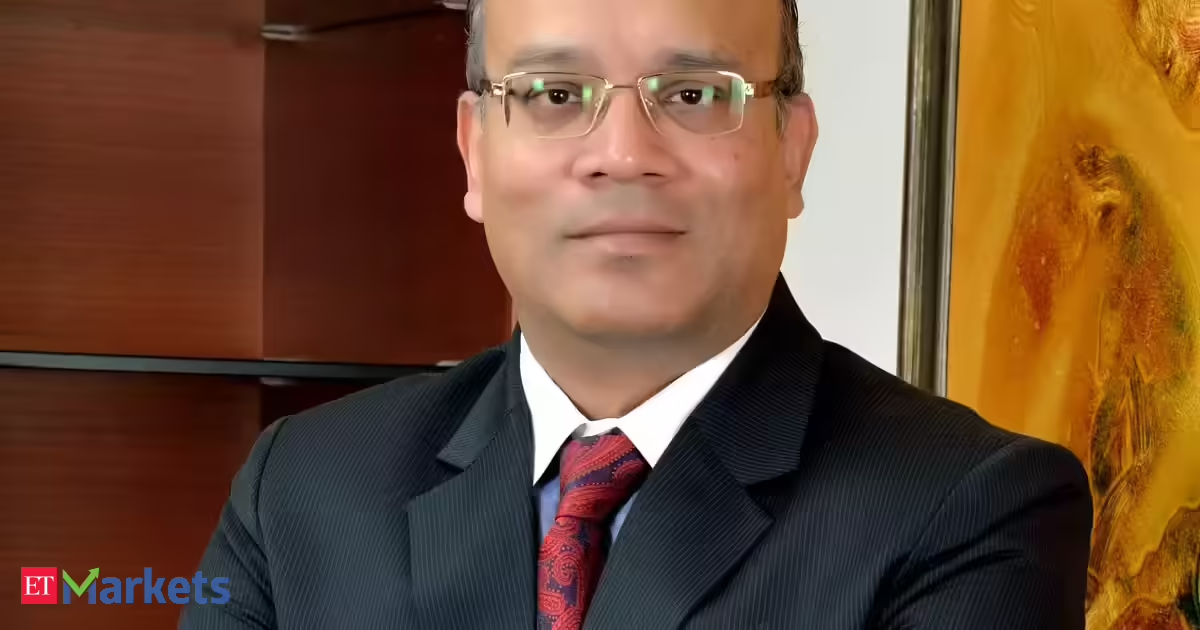
Speaking to ET Now, Prateek Agarwal, MD & CEO, MOAMC said that geopolitical shocks typically push valuations lower as uncertainty rises, but they often create opportunities once clarity emerges.
“When such situations arise, uncertainty rises sharply and markets price in higher risk. Valuations fall below long-term averages, which can eventually set the stage for strong outcomes once uncertainty fades. The key question is how long this uncertainty lasts. For us, the biggest issue is continuity of trade and whether ships can move through Hormuz. If that happens, oil prices could fall significantly and markets can stabilise.”
Gas Supply Disruptions Begin to Affect Industries
The impact of the ongoing crisis is already being felt in parts of the economy. Several companies have disclosed disruptions due to reduced gas availability as supplies are diverted toward domestic use and transportation.

Industries dependent on gas as a fuel or feedstock could face challenges if the disruption continues for an extended period.
Agarwal noted that the severity of the impact depends largely on how quickly the situation improves.
“If the disruption lasts only a few days, companies can adjust by advancing maintenance shutdowns. But if it continues, sectors using gas as fuel could face shortages, and even fertiliser companies may eventually be affected. The quicker trade routes stabilise and additional gas supplies come in, the faster these issues can ease.”
He also pointed out that India’s strength in refined petroleum products could provide some cushion if exports slow temporarily.
“India is among the exporters of refined products. If Hormuz disruptions prevent exports, some of that supply may come back into the domestic market, which could help maintain normalcy for some time. But the overall impact remains highly time-dependent.”
Minimal Cash, Limited Portfolio Changes
Despite the uncertainty, Agarwal said his fund remains largely invested and is not taking aggressive cash positions.
“We do not believe in making large cash calls. Our funds usually remain invested with only minor adjustments. If you want a number, the cash level would be around 4–5%.”
He added that the portfolio has seen only selective trimming rather than major shifts.
“We are not taking a view on the conflict itself; we are watching whether the Strait of Hormuz remains open for trade. We had already been light on IT and trimmed some positions earlier. We also have limited exposure to sectors that are immediately impacted by gas shortages such as restaurants, ceramics, fertilisers and certain metals.”
Gradual Investing May Be the Better Approach
For investors looking to deploy money during the current volatility, Agarwal recommended spreading investments over time rather than trying to predict the exact bottom.
“A practical approach is to gradually deploy capital. If you have a fixed amount, invest a portion regularly and adjust depending on how the situation evolves. If the crisis ends sooner, you can accelerate; if it lasts longer, you can slow down.”
He also noted that Indian markets may be relatively resilient given their recent underperformance.
“India has been among the weaker performing markets globally in recent months. Because we were not in a momentum phase, the first round of corrections here could be relatively limited, which is the saving grace.”
Markets Await Clarity
For now, investors remain focused on developments around the Strait of Hormuz and the broader geopolitical landscape. Any signal that trade routes are stabilising could quickly improve sentiment and trigger a rebound in equities.
Until then, market participants are expected to stay cautious while selectively accumulating stocks at more reasonable valuations.