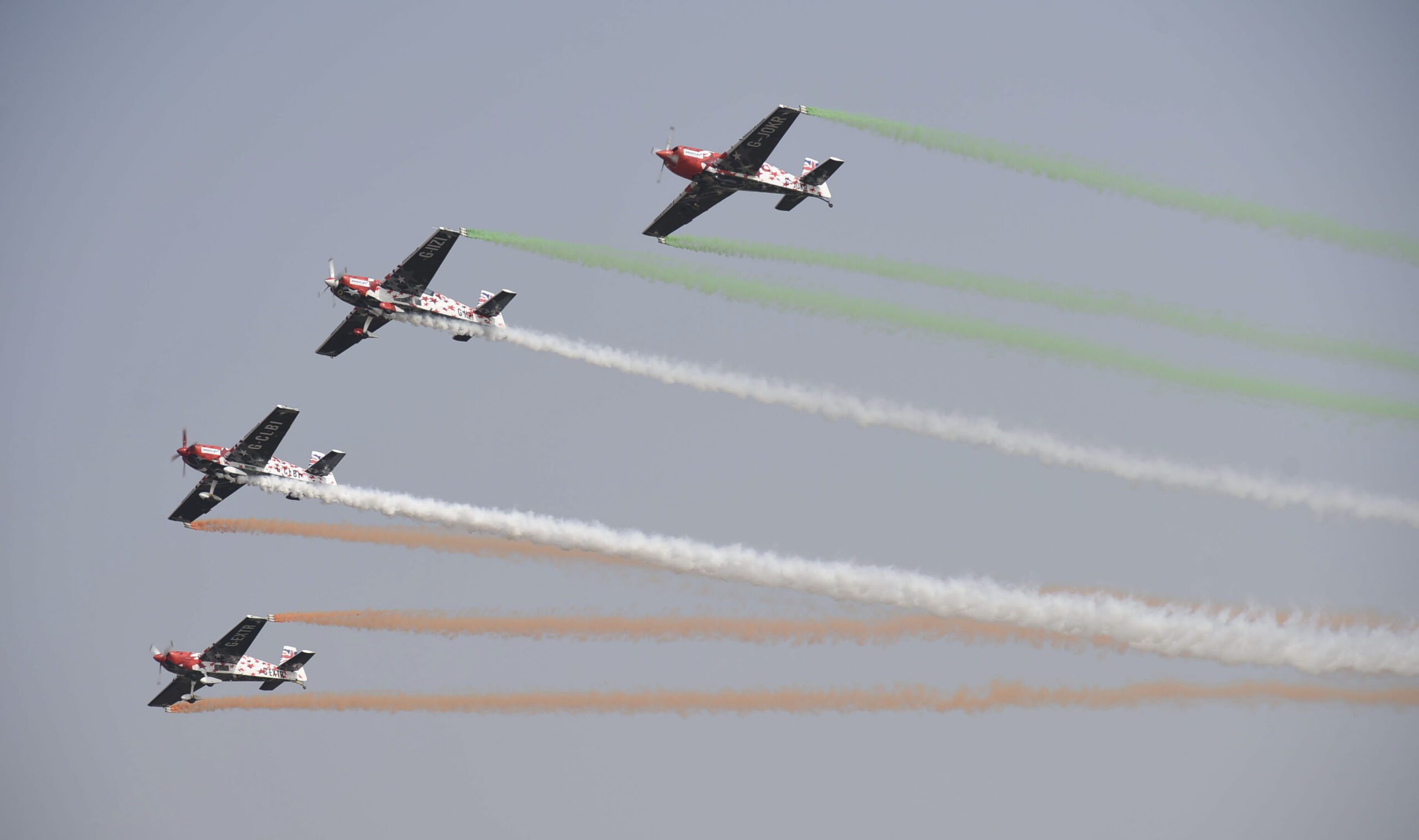

Hyderabad: When nine Hawk jets flew over Hyderabad at Wings India 2026, the spectacle lasted minutes but the preparation took far longer. The city’s dense skyline, bird activity and proximity to water demanded advance sorties, fixed distances and rehearsed corrections for the Surya Kiran Aerobatic Team. Once the display begins, there is little room for improvisation — a distinction the pilots emphasise when speaking about flying at this year’s event.
Lieutenant Kanwal Sandhu and Squadron Leader Sanjesh Singh said their display over Hyderabad rested on familiarity rather than novelty, with their base at Bidar only a few hours away. “Hyderabad is not only close to us geographically but also very close to our hearts,” Sandhu said. Recalling a display over the city lake in 2024, she noted the response then and now remained strong. “Performing here always gives us a lot of joy. The enthusiasm from the people makes it very special for us.”
Preparation, however, remains unchanged. Singh described the rehearsal a day earlier as a mapping sortie, with four aircraft covering the area to note obstructions and bird activity and to fix distances for each manoeuvre. “Before a pilot takes up a display position there is extensive practice on the ground and in the air,” he said. “For my number five position I did around 60 to 70 sorties for the full profile.”
The display used Hawk Mk 132 aircraft, a platform Singh said allows precision in formation and has appeared at global events. Formation flying demands discipline different from routine fighter operations. “This is completely visual,” Singh explained. “You stay extremely close to eight other aircraft and maintain exact references. Hands and legs adjust constantly to hold position. Any forward or backward movement creates risk for others.”
Flying over a dense urban area raises concerns absent in open ground, especially amid recent setbacks in civil aviation and flight safety. Singh insisted the team’s approach remains unchanged. “We are thorough with our SOPs and procedures. Our focus stays on reducing the margin of error. Every manoeuvre gets checked for flight safety and we keep working on that.”
Public displays place pilots before large crowds, especially children who view the team aspirationally. Sandhu said motivating young minds to join the armed forces is part of their mission. “Many pilots in the team once watched Surya Kiran as children. There are living examples in the team itself.”
Singh offered his own path as evidence, recalling how he saw Surya Kiran perform as a Class VIII student. “When I was in seventh or eighth standard, I watched a Surya Kiran air show. After that I joined the Air Force Academy, and my first instructor there was an ex‑Surya Kiran pilot. That was the motivation. That is how I came to be part of this team.”
Singh, who grew up in Jaipur in an Army family, joined the Indian Air Force in 2014. “It takes three to four years to become a complete fighter pilot,” he said. He later trained as an instructor at the Air Force Academy and then cleared trials for Surya Kiran. “After 60 to 70 team sorties I achieved the number five position. It takes about 11 years to become a display pilot.”
On representation in aviation, Sandhu said change within the armed forces has already taken place. “All arms of the Indian armed forces have seen major inclusion of women in combat roles. Once you wear the uniform, gender does not matter. Competence decides leadership.” She added that awareness still lags, with many young girls unaware such roles exist.