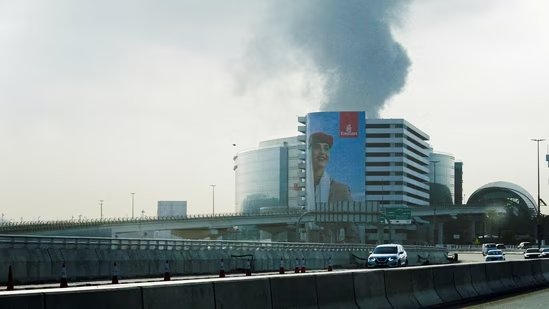
Something strange happens to Indians when you talk about the conflict between Iran and the United States. No matter what points you may make about the unipolar global order, most educated Indians are only interested in discussing two subjects.
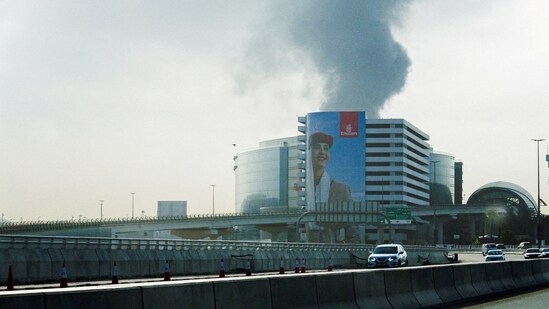
The first is the impact of the conflict on oil prices, the shortage of gas cylinders and the damage to the stock market. That, I guess, is understandable. Most people will respond to a global conflict by wondering what it will do to their lives.
It’s the second subject that I find more interesting. More time is spent discussing the drone attacks on Dubai (which have led to relatively little damage or casualties) than on the destruction of much of Tehran and the deaths there (at least 1,500 by conservative estimates) or the devastation of parts of Lebanon.
Why are we so fascinated by Dubai?
More people will want to know about a drone that was brought down near the Burj Al Khalifa than will care about the devastating Israeli attack that destroyed Iran’s top leadership and killed its Supreme Leader.
There are several reasons.
In the early stages of the conflict we saw gloating abuse of Dubai and especially abuse directed at Indians who lived in Dubai from a small but vocal minority. These were mostly motivated by a strange combination of schadenfreude, envy and plain old communalism. They have died down.
Also Read | The Taste by Vir Sanghvi: How travel has changed over the last five decades
The interest we now see is marked by a combination of other factors.
The first of these is familiarity. Many middle-class Indians have been to Dubai. When we hear about a drone being downed in the area around The Palm we know what they are talking about. So many of us have used and admired Dubai’s world class airport that any suggestion that it may be a target causes horror.
The second is concern for our own people. Two million Indians live in Dubai and most of us know someone who lives and works in Dubai. This is not true of Iran, Lebanon, Israel or the other countries affected by the conflict.
The third is a sense of shock at the unexpectedness of the attack. All of us know that West Asia can be a volatile and dangerous region. But, somehow, we never included the UAE and Dubai, in particular, in the list of places that any conflict could spread to. So, it is hard for us to accept that anyone would want to attack Dubai.
The fourth is astonishment over the unprovoked nature of the attacks. Dubai has played no part in the US-Israeli air invasion of Iran. The Americans have not sent planes from bases in Dubai. They have not launched any missiles from Dubai. The government of Dubai has a friends-with-all foreign policy, so there is no special enmity with Dubai.
So why make Dubai a target?
Fifth: In most (but sadly, not all) wars military targets are fair game. If civilians are hurt then it is usually as collateral damage. In the case of Dubai, the Iranians have gone out of their way to target civilian areas. More significantly, they have been most interested in areas where foreigners are likely to be found: Hotels, tourist attractions and the airport.
How can this be fair? How can it be right?
And finally, foreigners don’t always understand the historical links between India and Dubai. During the British Raj, Dubai was regarded as part of greater India and governed from India. Till the early 1960s the rupee was legal tender there. The Sheikhs would be invited to gatherings of Indian princes. Business links between Dubai and India date back centuries and just as many Indian millionaires made their fortunes trading with Dubai, so did many Emiratis prosper through trade with India.
It is not a coincidence that so many people from the subcontinent went to Dubai to find jobs. It wasn’t just the prospect of riches. It was also that they felt at home in Dubai.
For many Indians, especially those who live in such cities as Mumbai, Dubai represents our own missed opportunities. If Dubai, which has very little oil of its own, can prosper so much because of the smartness of its government’s policies then why couldn’t India? Why couldn’t Mumbai have been like Dubai? Why do Indians who struggle within the Indian system suddenly shine so brightly when they go to Dubai and take advantage of the opportunities the city offers?
These are hard questions to answer but the fact that they are asked so often tells us how Dubai is top of the mind for so many educated Indians. That’s why so much of our interest in the current war has been so singularly focused on Dubai.
Nobody knows how long this conflict will last. It could end tomorrow. Or it could drag on for a few weeks. But the longer it goes on, the more Iran will run out of drones to send to secondary targets like Dubai.
And when it does end, there will probably be a period of adjustment. But after that, I fully expect Dubai to regain its primacy as one of the world’s great cities. The infrastructure built over the last three decades will see it through. And soon it will be business as usual.
That’s good news for the world. But it is particularly good news for India because it is the one foreign capital in the world where Indians don’t feel like strangers, where we are welcome and where so many of us have found so much success.