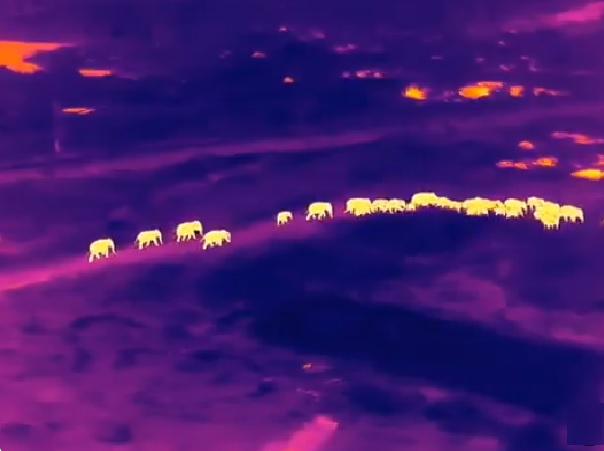
Bhubaneswar: In a rare nocturnal spectacle, a herd of elephants has been captured moving in an orderly line through a forest in Odisha’s Dhenkanal district, with a thermal camera revealing their movements in near-total darkness.
The footage offers a glimpse into how technology is helping forest officials monitor wildlife during hours when conventional cameras and direct observation often prove challenging.
The Dhenkanal Forest Division released the footage on Saturday, showing the elephants traversing the forest under the cover of darkness.
The animals appear as distinct heat signatures against the cooler forest surroundings, demonstrating how thermal imaging can help track their movements even when visibility is poor.
Unlike conventional cameras, which depend largely on visible light to produce clear images, thermal cameras detect infrared radiation emitted by objects and living beings.
The technology can therefore help forest personnel identify the presence and movement of elephants at night, when the animals are difficult to spot with the naked eye.
The footage, according to experts, reflects the growing importance of technology-assisted wildlife surveillance in forest management.
By monitoring the movement of elephant herds, forest officials can gain valuable information about their routes and patterns of movement, potentially enabling them to respond more quickly when the animals approach human habitations, agricultural fields or roads.
Odisha is among India’s important elephant-bearing states, with herds inhabiting forests across several districts.
Apart from Dhenkanal, significant elephant populations and movement corridors are found in Angul, Sundargarh, Keonjhar, Mayurbhanj, Sambalpur, Deogarh, Boudh and Kandhamal, among other areas.
Elephants also move through forest landscapes in parts of Khurda and Rayagada, sometimes crossing into human-dominated areas in search of food and water.
The state’s forest landscape provides elephants with essential habitat, food resources and routes connecting different forest patches.
However, habitat fragmentation, the expansion of settlements and infrastructure, and the conversion of forest-edge areas into agricultural land are allegedly disrupting traditional movement corridors.