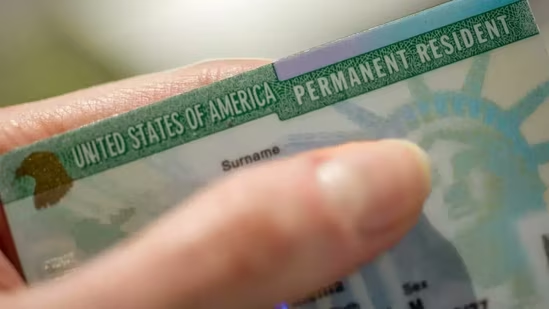
The Trump administration has proposed a new rule to significantly increase the cost of filing a form required for immigrants to apply to become naturalised US citizens. If the rule takes effect, it could potentially make green cards costlier — an impact that would also be felt by Indians in the States.

According to the rule proposed by the Department of Homeland Security, the cost of filing Form N-400 (application for naturalisation) by paper would increase from $760 to $1,330 — a 75 per cent surge. Meanwhile, the cost of filing the form online would increase from $710 to $1,280 — an 80 per cent surge.
The form for naturalisation for those with a household income below 400 per cent of the Federal Poverty Guidelines remains at $380, with no change proposed. The reduced-fee option form is only available for paper filing, the DHS document states. However, the new rule proposes to eliminate the reduced fee for Form N-400 and fee waivers for the application.
This new rule has been proposed under various sections of the Immigration and Nationality Act and the Homeland Security Act of 2002.
If the rule takes effect, it could affect hundreds of thousands of lawful permanent residents in the United States and make green cards much more expensive. The DHS proposal, however, notes that the new rule would not take effect for at least 60 days after it is posted, as it must first go through a public comment period.
Among those immigrants and non-US citizens who successfully receive green cards every year are Indians. Let’s take a look at how the Trump administration‘s new proposed rule could impact Indians:
What this could mean for Indians
According to data from India’s ministry of external affairs, there are around 6.7 million Indians in the United States — 60,79,221 to be precise — as of January 2026. Of these, 37,67,737 are persons of Indian origin, and 23,11,484 are non-resident Indians.
While there was no known data on how many Indians have earned lawful permanent residency, i.e., green card, in the US, data from the Office of Homeland Security Statistics for 2024 reveals that 66,800 Indians successfully received a green card.
The number might seem huge given the recent tensions and chaos over the H-1B visa, but in reality, it has dropped by more than 50 per cent compared to 2022.
In 2022, around 1,27,010 Indians became lawful permanent residents of the US. This further declined in 2023, when only 78,070 Indians were granted green cards. In 2024, the rate dropped to 66,800.
Despite the drop in numbers, DHS’s proposed changes to the naturalisation application fee could still significantly impact Indians. The higher prices might push Indians to mull other ways to reside or settle in the US lawfully.
What was the H-1B visa row?
US President Donald Trump raised the fee for an H-1B visa application from an average of $2,000 to $100,000 in September last year. The fee was to be paid by employers who wished to sponsor skilled immigrants to work in the US.
The H-1B programme is intended for employers seeking to “hire non-immigrant aliens as workers in speciality occupations or as fashion models of distinguished merit and ability”, a pathway that has enabled many Indians to work in the US.
The Trump administration believed that its ‘America First’ motto was being harmed by the H-1B programme, prompting it to introduce the whopping fee.
However, a federal court in Boston, Massachusetts, struck down Trump’s $100,000 H-1 visa fee, terming it “unlawful”.
The ruling served as a relief to many Indian immigrants who are H-1B visa holders, working in the US.