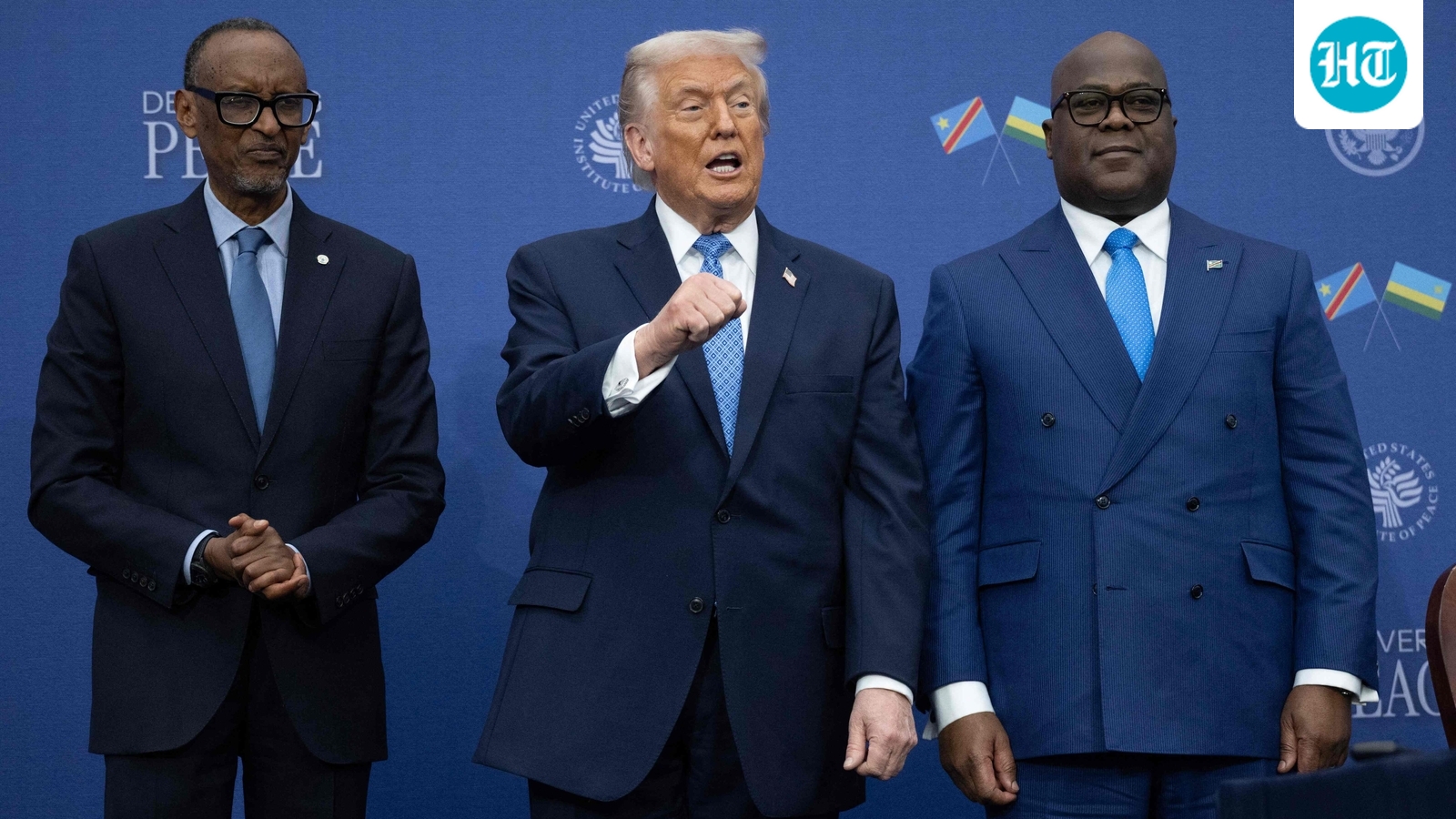
President Donald Trump gathered the leaders of Rwanda and the Democratic Republic of Congo to sign a peace treaty in Washington on Thursday, though it’s unclear that it will resolve a 30-year conflict that continues to fester.

“Look at the way they love each other,” Trump said at the event, referring to the two African leaders. He called it a “great day for Africa.”
The agreement, known as the Washington Accords, was scheduled to be signed Thursday at what was once known as the US Institute of Peace, which was renamed for Trump a day earlier by the State Department.
The peace initiative has been months in the making, after US political intervention earlier this year stalled a Rwanda-backed rebel advance that threatened to overthrow the government of Congolese President Felix Tshisekedi.
Since then, little has changed on the ground. The rebels, known as the M23, continue to occupy a large swath of mineral-rich eastern Congo and to capture new towns there.
Trump has repeatedly claimed ending the Rwanda-Congo conflict as one of several acts that should earn him the Nobel Peace Prize. Critics have said some of those accords have not actually resulted in meaningful changes, or that they resolved conflicts that weren’t actually wars to begin with.
Read: Trump’s Count of Wars He’s ‘Settled’ Remains a Matter of Dispute
The Trump administration is betting that the public signing of the accord and related economic and mining pacts will lure investors to the region and incentivize the two sides to keep the peace. Rwanda and Congo are also set to sign an economic integration agreement as part of the US-backed peace deal.
Eastern Congo is rich in gold, tin, tungsten and tantalum, which is in most portable electronics. Both the M23 and Rwanda stand accused by the US, European Union and United Nations of profiting from their illicit trade.
Congo is also the world’s biggest cobalt producer and the second-largest source of copper. Tshisekedi’s government is expected to sign a separate bilateral pact with the US to partner on future energy, mining and infrastructure projects.
On Wednesday, the peace deal already seemed under threat after Congo complained that the M23 was continuing to advance. Government spokesman Patrick Muyaya said Rwanda “doesn’t want peace,” just access to Congo’s natural resources.
The US, EU and UN experts have all accused Rwanda of supporting M23 by providing training, weapons and its own soldiers to fight alongside the rebels.
Rwandan President Paul Kagame has repeatedly denied such allegations, and accuses Congo of collaborating with a rebel group known as the FDLR — short for Forces Démocratiques de Libération du Rwanda — that has links to the perpetrators of the 1994 Rwandan genocide.
These long-standing grievances remain far from resolved by Thursday’s peace deal, according to Jason Stearns, founder of the Congo Research Group at New York University.
“The US initiatives have been successful, at least putting a damper on the conflict for now and getting everybody to the table,” Stearns said. “What the peace deal has not been able to do is to solve the underlying issues or to bring an end to the conflict.”
“All of this will only be implemented if and only if peace is truly achieved between our two countries, and trust as well,” Tshisekedi said in a Nov. 28 speech to the Congolese diaspora in Serbia. “You don’t do business with someone you don’t trust.”