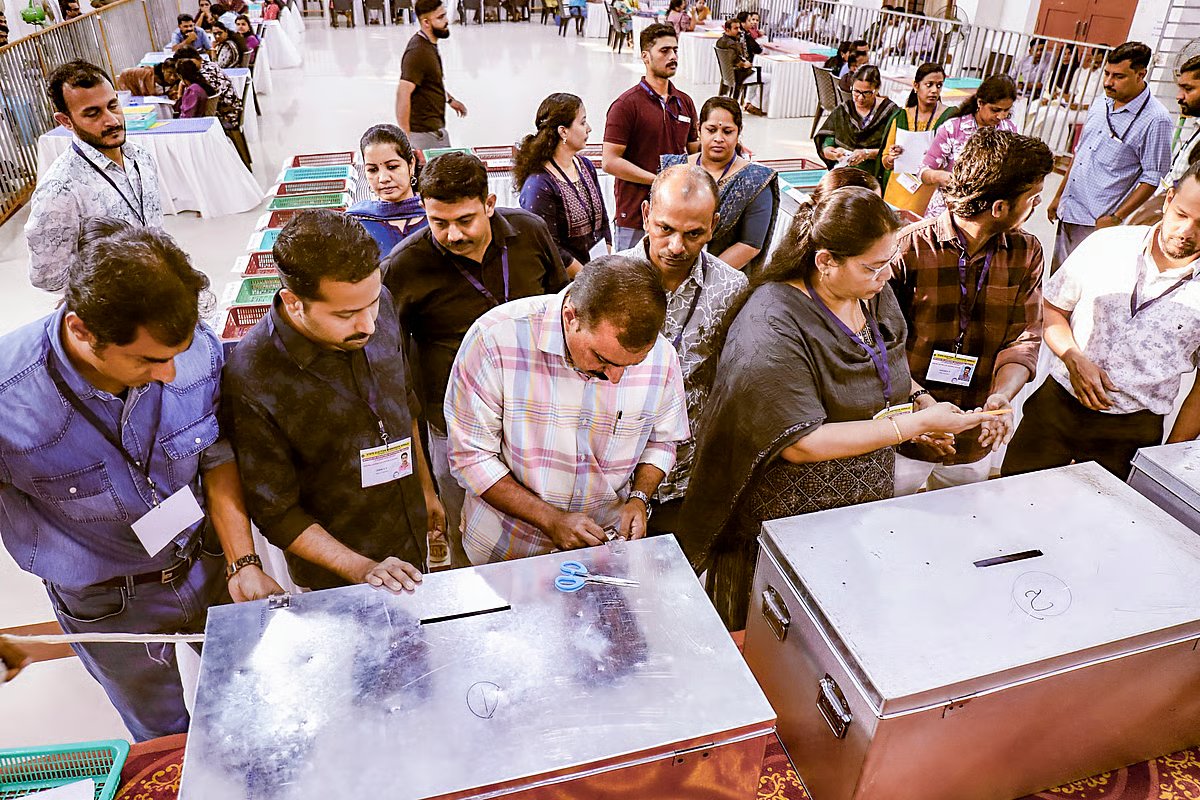
The Congress-led United Democratic Front (UDF) emerged victorious as the counting of votes for the 2025 Kerala local body elections concluded on Saturday.
UDF made a comeback in Alappuzha district, showcasing a thumping victory over the ruling Left Democratic Front (LDF), signalling a significant turnaround from the 2020 results.
The IUML-led United Democratic Front (UDF) tightened its political dominance in Malappuram and won an overwhelming majority of local bodies.
Despite deep internal conflicts, rebellions, and factional infighting within the Congress and allied parties, the UDF retained Kattappana and Thodupuzha municipalities.
UDF leads in Malappuram
In Malappuram, the Front secured victory in all block panchayats except Ponnani.
The UDF recorded a clean sweep in urban local bodies as well, winning all 11 municipalities, including key centres such as Nilambur and Perinthalmanna.
A significant turnaround was seen in Perinthalmanna municipality, where the UDF returned to power after a gap of three decades.
The IUML also staged a strong comeback in Nilambur municipality. With the backing of MLA P V Anvar, the UDF won all local bodies in the Nilambur Assembly constituency, including Vazhikkadavu, Moothedam, Edakkara, Karulai and Pothukal grama panchayats.
Reacting to the results, IUML general secretary P K Kunhalikutty said the verdict reflected public rejection of the CPM-led LDF’s politics.
“The CPM and the LDF were spreading divisive communal hatred among the people. This election has shown how decisively the public has rejected that agenda,” he told the media.
Meanwhile, IUML state president Pannakkad Sadiq Ali Shihab Thangal said the outcome would have a direct bearing on the forthcoming Assembly elections. “We thank the people for this victory. The mandate has exceeded our expectations. This election result marks our path to the Thiruvananthapuram Secretariat,” he said.
UDF’s comeback in Alappuzha
In the previous local body elections, the LDF had dominated Alappuzha district, winning more than 50 gram panchayats. In the municipalities, both Fronts had secured three each.
However, this time, the trend has shifted decisively in favour of the UDF, gaining substantial ground in the gram panchayats and winning five of the six municipalities in the district.
The UDF has also made notable gains in the district panchayat, where it is leading in a majority of divisions. This marks a major setback for the LDF, which had swept 22 of the 23 divisions in the 2020 elections.
In Alappuzha municipality, the UDF emerged as the single largest front, winning 23 of the 53 divisions. The LDF secured 21 divisions, while the NDA won five.
Four divisions were secured by others, including one each to the SDPI and PDP and two independent candidates.
The outcome has resulted in a hung council, with independent members expected to play a decisive role in the formation of the municipal administration.
In 2020, the LDF had won 35 seats, while the UDF had managed only 11.
In Chengannur municipality, the UDF retained power by winning 13 divisions. The NDA won six divisions, the LDF won five, and independent candidates secured three seats.
The LDF retained control of Cherthala municipality with 18 seats, while the UDF won 10 and the NDA secured four seats.
The UDF retained Haripad municipality, winning 12 seats. The LDF’s tally fell sharply to five seats from 10 in 2020.
The NDA strengthened its presence by winning six seats, one more than in the previous election.
In Kayamkulam municipality, the UDF wrested power from the LDF by securing 16 seats. The LDF, which had ruled the municipality with 23 seats in 2020, was reduced to nine seats.
The NDA won four seats, marking a gain of one.
Mavelikkara, which witnessed a triangular contest in 2020 with the LDF, UDF, and NDA winning nine seats each, saw a decisive shift in favour of the UDF this time.
The UDF won 15 seats to secure a clear majority, while the NDA won eight seats and the LDF secured just four seats.
UDF scrapes through Kattappana and Thodupuzha
The UDF emerged victorious in both municipalities, defying expectations that sustained internal turmoil would hand an advantage to the LDF.
Party insiders, however, described the outcome as a ‘survival win’ rather than a ‘comfortable’ victory.
In Kattappana municipality, the UDF secured 20 seats, the LDF secured 12 seats, and others secured 3 seats. LDF candidate CR Murali emerged as a notable figure, defeating AICC member and former MLA EM Augusthy.
Disputes over seat allocation escalated into a full-blown social media drama, with Facebook posts, WhatsApp forwards, and cryptic status updates overshadowing official campaign announcements. The entry of rebels, such as former municipal chairperson Beena Joby, denied her preferred ward, further splitting the local cadre.
Even before polling, the Congress in Kattappana was grappling with internal rebellion. A section of party loyalists openly campaigned against their own senior leader, EM Augusthy, accusing the leadership of sidelining long-time workers.
Former councillor Prashanth Raju and other activists posted critical throwbacks and commentary, creating a digital spectacle that drew more attention than formal campaign messaging. Dissatisfaction over ward redistribution and lack of consensus in candidate selection led to parallel campaigns within the same political camp.
Meanwhile, rebels influenced outcomes in several wards, reducing margins for the candidates.
A senior Congress leader acknowledged that while organisational strength and the traditional voter base helped the UDF stay afloat and the internal rift significantly weakened campaign coordination.
“This could have easily slipped away,” the leader said, noting that reconciliation within the party will be essential for smooth municipal functioning.
In Thodupuzha municipality, the UDF won 19 seats, while the LDF managed to secure 3 seats, the NDA won 9 seats, and others secured 7 seats.
Despite many odds, the Front managed to edge past its rivals, aided by vote consolidation in key wards and traditional alliance arithmetic.