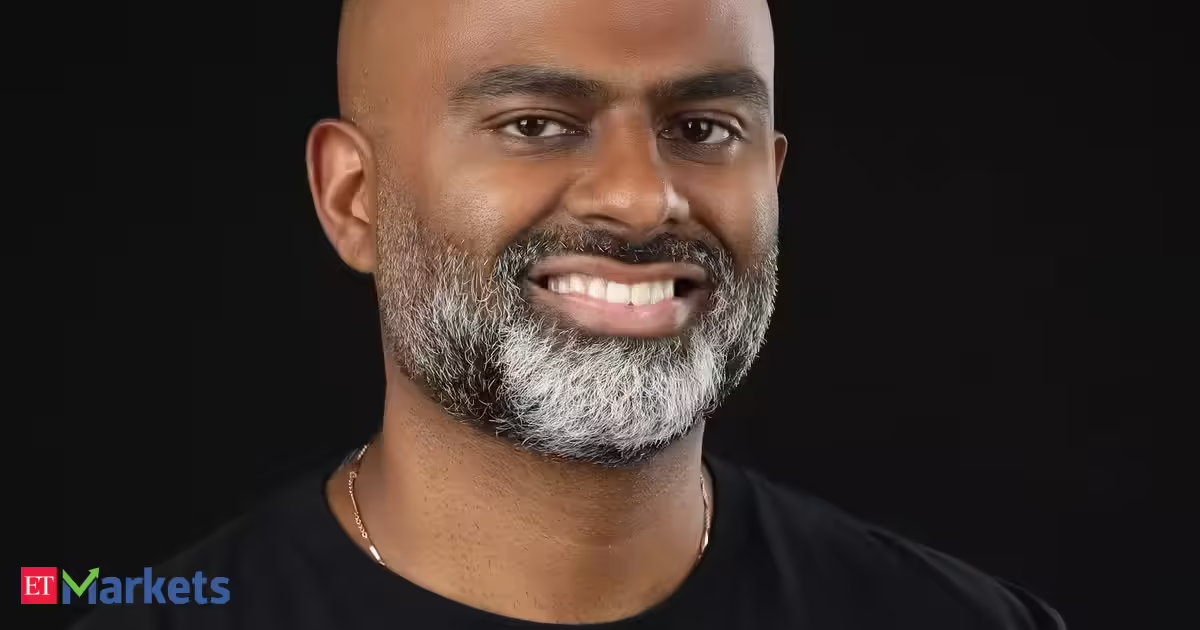
Upstox is not in a rush to go public, with the brokerage prioritising profitability and business diversification amid a tougher regulatory and market environment. The company is targeting a 2.3x jump in profit after tax to around ₹500 crore in FY26, driven by higher monetisation, operating leverage and growth in non-equity segments, said CEO and co-founder Ravi Kumar.
Edited excerpts from a chat:
After the Budget hiked STT on F&O, the break-even point for retail traders has moved much higher. Do you fear this is the ‘death knell’ for the high-frequency retail F&O boom that fueled Upstox’s early growth, and have you revised your revenue projections for FY27 downward as a result?
The impact of the STT hike remains difficult to quantify at this stage. However, the business has reduced its dependence on any single trading segment by building multiple revenue streams. Strong growth in other segments such as commodities, margin trading facility (MTF) and mutual funds, alongside improving profitability, provides resilience against regulatory changes. Diversification is viewed as a key hedge in an environment of evolving market structure.With the new STT regime likely to dampen trading volumes further, where will the next leg of revenue growth come from or are we entering a phase of consolidation?
The next leg of growth is increasingly being driven by diversification beyond core equity trading. The commodities business has reported nearly 400% growth in revenue, alongside a doubling of market share in average daily turnover. The margin trading facility book has grown more than two-fold year-on-year, with market share increasing by about 30%. Mutual funds have also emerged as a strong growth driver, with SIP assets-under-advisory market share rising nearly 12%, helping create a more balanced revenue mix.

At an industry level, how much of volume decline in F&O are you expecting in FY27?
At this stage, it’s difficult to comment on any potential decline or uptick, as F&O volumes are largely linked to overall market sentiment. In an environment shaped by geopolitical uncertainty, making precise forecasts would be premature.
Industry data indicates retail investors are now not as enthusiastic about equities as they were earlier. You have also seen a drop in active clients. What’s changing the dynamics for you?
Customer engagement has increasingly been driven by traders with higher intent levels and deeper participation. Monetisation has improved meaningfully, with active revenue per active user growing over 40% year-on-year, while retention among high-value traders remains above 90%. This focus on engagement and customer quality has strengthened revenues and profitability despite moderation in overall active client numbers.
Is this decline a temporary cyclical blip, or have we hit peak saturation for the discount broking model in India?
Equity participation in India remains in single digits, which is significantly lower than participation levels in developed markets such as the US and China. This suggests that the long-term opportunity for retail investing is still structurally large. While the current phase reflects a cyclical slowdown influenced by market volatility and regulatory changes, it does not indicate saturation of the discount broking model. The focus remains on long-term participation and gradual deepening of investor engagement.
You’ve been aggressively pushing into insurance, fixed deposits, and mutual funds to shed the ‘trading app’ tag. However, the distribution space is crowded. Why would a customer buy insurance from Upstox rather than PolicyBazaar or their bank? Does this segment generate enough margin to replace lost F&O income?
The expansion into insurance, fixed deposits and mutual funds is part of a broader effort to evolve into a more comprehensive financial services platform. In mutual funds, the platform is already the fourth-largest in India by monthly SIPs, with SIP assets-under-advisory market share rising by nearly 12%. Insurance is being built as a long-term, complementary business aimed at improving customer lifetime value, rather than as a near-term replacement for trading-linked income.
How has the year been so far for Upstox, considering the regulatory landscape, and market trends? How has the company performed?
The year has played out in a challenging environment marked by regulatory tightening, changes in taxation and market volatility. Despite this, the company has reported strong momentum in business performance, with sharp gains in profitability and monetisation. Profit after tax is projected to grow over 2.3x year-on-year, from ₹215 crore in FY25 to around ₹500 crore in FY26, while EBITDA is also expected to grow more than two-fold. The performance has been driven by operating discipline, product innovation and a sharper focus on higher-quality, active traders.
When are you planning an IPO?
There is currently no fixed timeline for an IPO. The business is not under any capital pressure and remains comfortable operating as a private company. While investor interest has increased following peer listings, the priority continues to be on strengthening profitability, expanding product capabilities and building long-term value before taking a call on going public.