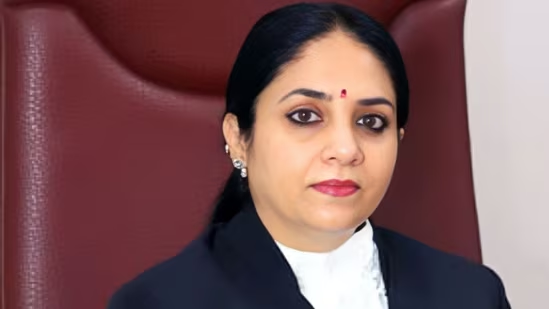
Arvind Kejriwal stood in the Delhi High Court on Monday and, in an unusual move, argued his own case — not the excise policy matter itself, but a plea seeking the recusal of the judge hearing it.

The judge is Justice Swarana Kanta Sharma.
Justice Sharma’s judicial career spans more than three decades. She was elevated as a permanent Judge of the High Court of Delhi on March 28, 2022.
From DU to HC
According to her official profile on the Delhi High Court website, she has a BA (Honours) in English Literature from Delhi University, where she was adjudged the best all-round student of the year by Daulat Ram College, says the website.
She obtained her LLB in 1991, and LLM in 2004, and also holds a Diploma in Marketing Management, Advertising, and Public Relations, says the profile. “In 2025, after four years of extensive research, she was awarded a PhD for her doctoral thesis titled ‘Achieving Constitutional Vision of Justice Through Judicial Education: A Comparative Study of the Best Practices in the UK, USA, Singapore, and Canada’,” it adds.
She became a magistrate at the age of 24 and a sessions judge 11 years later. During her long tenure in the Delhi district courts, she presided over a wide range of courts — Family Court, Motor Accident Claims Tribunal, Mahila Court, Special Court for Sexual Offences Against Women, and as Special Judge (CBI).
Five books, including fiction
The profile mentions that Justice Sharma has authored five books.
The first, ‘Don’t Break After Break-Up’, offers guidance to women who have chosen to remain single or experienced difficult break-ups.
Her second, ‘Beyond Baghban’ — the title referencing an Amitabh Bachchan-Hema Malini movie ‘Baghban’ from 2003 — is about challenges faced by senior citizens.
A third, ‘Tumhari Sakhi’ (your friend), focuses on women’s rights.
She has also written a work of fiction, ‘Love Full Circle’.
A fifth title, ‘Judicial Education: Achieving Constitutional Vision of Justice’, is drawn directly from her doctoral research.
Row over Kejriwal-liquor policy case
Justice Sharma recently came to wider public attention over cases linked to the Delhi excise policy matter. She rejected bail pleas of several prominent politicians, including Kejriwal, Manish Sisodia and Sanjay Singh of the AAP, and K Kavitha from Telangana.
After a trial court discharged Kejriwal and 22 other accused on February 27, the CBI challenged that order. On March 9, at the first hearing of the CBI’s petition, Justice Sharma stayed the trial court’s direction for departmental proceedings against the investigating CBI officer, and made the observation that some of the trial court’s observations were “erroneous”.
It’s this order that Kejriwal mentioned, among others, on Monday as a trigger for his “apprehension of bias”.
What Kejriwal said in court
Arguing the recusal plea, the AAP boss told Justice Sharma that the HC had passed a “sweeping order” on March 9 after hearing the CBI “for only five minutes”, without hearing his side.
“The order that the trial court had passed after a full day of hearing, after reading 40,000 pages of documents, was declared erroneous by this court after just a five-minute hearing,” he said.
He cited ‘Ranjith Thakur vs Union of India’ to argue that a judge does not need to be actually biased to have to recuse. “They have clearly said that a judge does not have to determine whether they are actually biased; rather, if there is an apprehension of bias in the mind of a party, then there is a case for recusal,” he said.
Kejriwal further noted that Justice Sharma had attended events organised by the Akhil Bharatiya Adhivakta Parishad — a lawyers’ body affiliated with the RSS, the parent body of AAP’s rival and Centre’s ruling BJP — on four occasions.
“The ideology they follow is something we strongly oppose, and we oppose it openly. This case is political,” he told the court.
When Justice Sharma asked whether he thought she followed that ideology, Kejriwal asked her directly: “Do you?”
He also contended that in five previous cases before her bench, including bail applications of Sanjay Singh, Kavitha, and Aman Dhall, the court’s observations had amounted to judgements. “Every single averment made by the CBI and ED has been endorsed by the court,” he argued.
Solicitor General Tushar Mehta, appearing for the prosecution, opposed the plea, arguing that allowing it would set a “dangerous precedent”, and noted that the Adhivakta Parishad is a bar association whose events judges are routinely invited to address.
She reserved her verdict on the recusal pleas filed by Kejriwal, Sisodia, and four others.