As Indian equity markets delivered modest returns in 2025 compared with stronger gains in global markets, the debate around portfolio diversification has moved sharply into focus. With currency depreciation, evolving global growth drivers, and transformative themes like AI, defence, and quantum computing reshaping investing opportunities, sticking to a purely domestic strategy may no longer be enough.
Kshitij Anand: In that case, I think that may have worked two decades ago, but things are changing now. No company survives indefinitely, and even within the Nifty 50 there is constant churn. If I take your point, yes, if I pick a Nifty 50 stock today, there is always a possibility it may not be part of the index six months down the line.
Kshitij Anand: Absolutely. We have seen that happen multiple times in the past.
Kshitij Anand: In fact, there is another dilemma Indian investors might be facing. In terms of GDP growth, India is likely to deliver around 7% in 2026–27, while global growth is expected to be around 2.5 to 3%. However, the scale of the economy differs significantly between the US and India, and even a 2.5 to 3% growth rate for the US is considered quite strong. Still, many Indian investors tend to focus on the headline numbers, 7% versus 3%. Could you help investors understand how to translate this into portfolio decisions, especially when investing abroad?
Kshitij Anand: US companies.
Kshitij Anand: Pepsi, and they are all US based companies.
Kshitij Anand: Absolutely. In fact, I recall the saying: if the US sneezes, India catches a cold. If you correlate that here, earlier any movement in the US used to impact India. That has not been true recently because much of the rally has been driven by DIIs rather than FIIs. FIIs have taken a bit of a backseat, and DIIs are running the show. But yes, if you go back five to seven years, you could definitely say that if the US sneezed, India caught a cold. So, when you talk about the bull run and say there is plenty of room left, can we say the party continues on Wall Street as well, and not just on Dalal Street?
Kshitij Anand: Another fear in the minds of Indian investors is currency risk. We have just touched 90 against the US dollar and are hovering around that level. There are headlines asking whether we are heading towards 95 or even 100. How should investors think about this?
Kshitij Anand: And the first step is to start doing it.
Kshitij Anand: My global exposure; well, it is not that much.
Kshitij Anand: Absolutely, less than 10%.
Kshitij Anand: One point you mentioned earlier was the concentration of the rally. Another concern Indian investors often have is the lack of research available beyond the Magnificent Seven. How can investors address this gap and gain confidence to invest in US small and mid caps, especially when even Indian markets sometimes lack adequate data?
Kshitij Anand: That is a smart approach, because lack of information and apprehension about where to start often keeps investors away. Most people only know a handful of global companies; Pepsi, Coke, as you mentioned, or the Magnificent Seven. Beyond that, unless a company makes headlines in Reuters or other global media, it tends to stay off the radar. It is good that you mentioned AI, because my next question is about that. Has the AI story moved from narrative to earnings?
Kshitij Anand: AI is here to stay, that is…
Kshitij Anand: You mentioned Elon Musk, and his companies have also diversified into India—Tesla is now in India. And in fact, most US companies are diversified not just into India but across the globe. That is really the core point. That is what makes them special, and that is why investing in US markets is not just a bet on the US, but on global growth.
Kshitij Anand: Another theme that has been getting a lot of attention from investors is Trump’s policies, especially on tariffs. Could that derail the US bull market story?
Kshitij Anand: For investors, the key takeaway is not to focus only on headlines but to look deeper. Tariffs are there, but as you said, they need not dominate investment decisions in US stocks. Another geopolitical concern that has come up is the recent military action in Venezuela. There could be more such events. Does that hurt the US investment story?
Kshitij Anand: Absolutely. Even historical data suggests that. Now, let us move to specific sectors. We have spoken about AI, and investors have already made significant gains in AI-led sectors, as well as in clean energy and healthcare. Are there specific sectors you believe investors should focus on in 2026 and beyond, from a long-term perspective?
Kshitij Anand: The next question usually revolves around choosing between global ETFs and individual stocks. How should one take that call?
Kshitij Anand: Absolutely, a mix-and-match approach works well. Also, there are certain barriers Indians face when investing in the US. How is Appreciate tackling those challenges? You spoke about data availability and how the app makes it seamless for Indian investors to make informed choices, with rankings and easy transactions for buying and selling.
Kshitij Anand: And the excitement is gone as well.
Kshitij Anand: You mentioned upcoming sectors earlier. How is Appreciate helping investors identify or track these themes? Is there something within the app that allows investors to go overweight on certain emerging sectors?
Kshitij Anand: Another concern for investors is regulatory compliance and taxation. How does Appreciate make that seamless?
Kshitij Anand: Absolutely. All of this helps Indian investors step out of their comfort zone and invest beyond borders. Any advice for investors heading into 2026?
Kshitij Anand: Whether India or abroad.
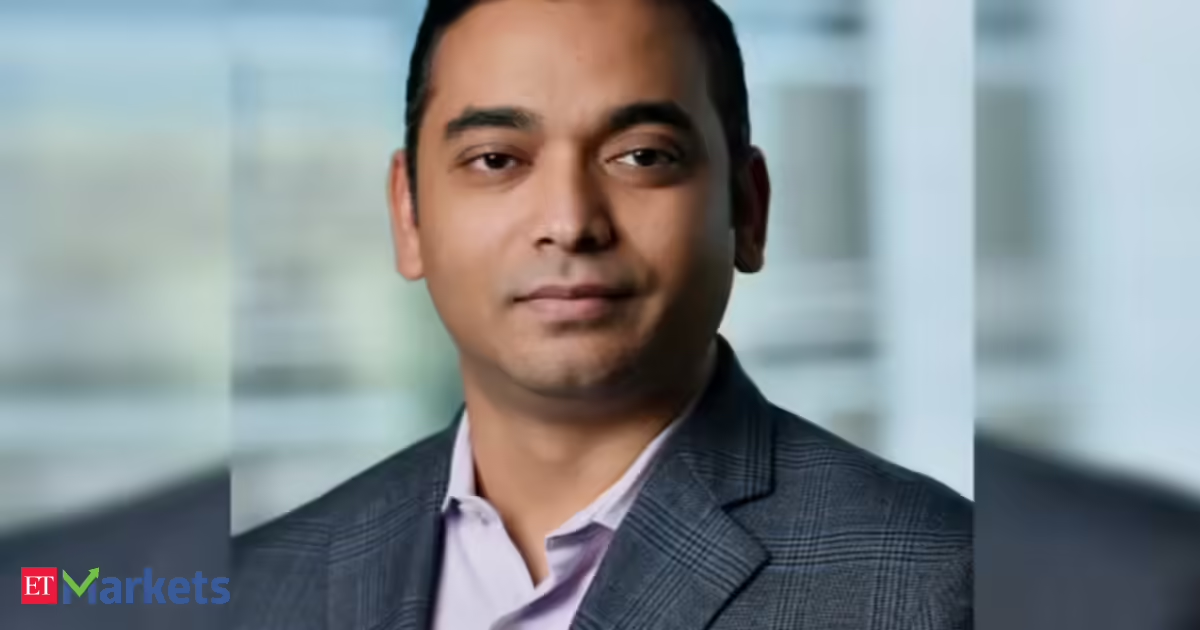
In this context, a balanced approach that combines home market familiarity with global exposure is becoming increasingly relevant. Speaking to Kshitij Anand of ETMarkets, Subho Moulik, Founder and CEO of Appreciate, explains why a 70:30 India–global portfolio can help investors improve risk adjusted returns, reduce concentration risk, and participate in the world’s most powerful long term growth trends in a rapidly changing global landscape.
Kshitij Anand: If you look at the data for 2025, the Nifty delivered around 10%, while US markets were well ahead with returns of about 16%. Do you think some Indian investors may have felt they missed the rally? And if you look at returns in dollar terms, which are slightly worse for Indian investors, what are your views on that?
Subho Moulik: If you are an Indian investor with no diversification, you essentially saw your portfolio go up by about 10%, while the US market delivered almost double that when you include currency, roughly around 22%. The rise in US portfolios is not a one year story. If you look at the past few years, they have been bumper years for US investors.For full disclosure, my portfolio is about 70 to 80% global and around 20% India. And of course, we are in the business of democratising global investing, so I do have a bias. But if you look at the numbers, it is a very rational decision for Indian investors to allocate money not just to India, but also globally.

On timing, I think there is still plenty of room left in the rally. Historically, the average bull market before World War II lasted about seven to eight years. There have also been bull markets that ran for as long as 15 to 16 years. The current bull market is well short of those durations. No one knows when a bull market will end. Anyone who claims they do, well, best of luck to them. I certainly do not know. But if you look at historical averages and current fundamentals, there should still be room for this bull market to continue.So, I do not think timing is the issue. The real question is about themes. What are you investing in, and why you did not diversify earlier. Let me ask you a question. We are all aware of the Nifty 50. If I told you the Nifty 50 exists, but you can only invest in two Nifty 50 stocks for the rest of your life, how would you react?
Kshitij Anand: In that case, I think that may have worked two decades ago, but things are changing now. No company survives indefinitely, and even within the Nifty 50 there is constant churn. If I take your point, yes, if I pick a Nifty 50 stock today, there is always a possibility it may not be part of the index six months down the line.
Subho Moulik: Exactly. If someone told you there are 50 stocks, but you can only invest in two, your first reaction would be why would I only invest in two stocks? You would want more choice. This ties back to the point you made earlier. India is a very important market from a future perspective, but it still represents only about 4%, or even less, of the global market. Therefore, as an investor, the rational choice is to think about diversification. How to allocate capital in a way that improves returns while reducing overall risk. That is what investors should be doing.
I do not think timing is an issue at all. In fact, if there is a sudden crash, say something completely unexpected happens in the next month and markets correct sharply, that would be a fabulous time to buy.
Kshitij Anand: Absolutely. We have seen that happen multiple times in the past.
Subho Moulik: Exactly.
Kshitij Anand: In fact, there is another dilemma Indian investors might be facing. In terms of GDP growth, India is likely to deliver around 7% in 2026–27, while global growth is expected to be around 2.5 to 3%. However, the scale of the economy differs significantly between the US and India, and even a 2.5 to 3% growth rate for the US is considered quite strong. Still, many Indian investors tend to focus on the headline numbers, 7% versus 3%. Could you help investors understand how to translate this into portfolio decisions, especially when investing abroad?
Subho Moulik: I will address that. This comparison is a fallacy, a red herring, and I will explain why. When you invest in the US, you are not investing only in US focused or US centric companies. Let us take an example from beverages. Whether or not you believe that the beverage market in India will grow rapidly, let us assume for a moment that it grows in line with GDP. It is a mass consumer segment and should broadly follow the economic cycle. Now, who do you think benefits from the growth of India’s beverage industry?
Kshitij Anand: US companies.
Subho Moulik: Coca Cola and Pepsi.
Kshitij Anand: Pepsi, and they are all US based companies.
Subho Moulik: Exactly. They are all based in the US. So, when you invest in US stocks, you are not necessarily investing in the US economy. Today, most global multinationals are listed in the US, and therefore, investing in US markets is effectively a bet on global growth.
What investors should increasingly think about is which sectors to invest in and where the global leaders in those sectors are located. To continue with the beverage example, if you believe beverages are a compelling investment theme, the global leaders in that space are listed in the US. If we move to a more realistic example, the leaders in semiconductors, companies like Nvidia, are also listed in the US. The leaders in genetics are largely in the US as well, with some presence in Europe and China. In defence, the dominant players are again largely US based. In emerging areas like quantum computing, which could become as exciting as, or even more exciting than, AI, there is once again a strong presence in the US and China.
So, while India has strong growth prospects, as an investor you already carry significant home country risk. You live in India, your home is in India, and your job is in India. From a portfolio perspective, diversification is important so that if something goes wrong domestically, at least part of your investments is insulated.
Another important point is how different markets react to shocks. Twenty years ago, if the US market moved up by a certain amount, India would usually follow. Over time, the correlation between the two markets has been declining, and we expect this trend to continue. That actually increases the benefits of diversification.
Finally, there is also the comfort of investing in markets where the rule of law is well established and investors have confidence in capital protection and repatriation. So, the real question is not about 2% GDP growth versus 7% GDP growth. The real question is where are the pockets of the highest growth in the world, and how can investors access them?
Kshitij Anand: Absolutely. In fact, I recall the saying: if the US sneezes, India catches a cold. If you correlate that here, earlier any movement in the US used to impact India. That has not been true recently because much of the rally has been driven by DIIs rather than FIIs. FIIs have taken a bit of a backseat, and DIIs are running the show. But yes, if you go back five to seven years, you could definitely say that if the US sneezed, India caught a cold. So, when you talk about the bull run and say there is plenty of room left, can we say the party continues on Wall Street as well, and not just on Dalal Street?
Subho Moulik: If you look at the current US bull run, there are a couple of common fears. One is that a large portion of returns has been concentrated in seven, eight or ten stocks; second, that forward earnings multiples are at all-time highs, making the market look bubbly and frothy; and third, that this is all speculation and will come crashing down. Let me address these one by one.
I do not think the data supports the view that the US market is becoming more concentrated. On a relative basis, if you look at gains over the last three years, 2025 was the lowest in terms of concentration. The Magnificent Seven contributed about 55% of gains in 2023 and around 42% in 2025, which shows a declining trend. You may still ask why seven stocks contribute around 40% of gains, but that is because these companies are expected to drive disproportionate disruption through what they are doing.
The second concern is about valuations. The S&P 500 is trading at around 22x forward earnings, while the Magnificent Seven trade at about 29–30x forward PE. The historical peak has been closer to 40x, so we are still below those levels. Another important point is that a few years ago, small caps—represented by the Russell 2000—were not delivering returns. That has now changed, and the Russell 2000 has delivered reasonable returns. It typically underperforms the S&P 500 slightly and does not suffer from the same concentration issues.
So, I think economic performance is much more broad-based than what headlines suggest. Clickbait headlines are easy to consume, but deeper analysis often gets missed. That does not mean returns are perfectly democratic across all 5,000 stocks, but around 500–600 companies are delivering returns. Unlike episodes such as the Tulip bubble or the dot-com bubble, there are real earnings backing this rally. One can debate the quality of earnings or whether there is circularity among a few players, but these are real earnings driven by disruptive technology, particularly AI.
If you look at what is emerging—the combination of quantum computing, expanding AI use cases, and even progress towards viable fusion energy—each of these reinforces the other. There is an energy challenge, a computing power challenge, and a question of how quickly AI use cases can become real. As these factors interact, a very interesting virtuous cycle could emerge, though it may or may not play out.
Because of this, I am less worried about an imminent collapse of the bull run. Even if the bull market ends due to a black swan event—say China invades Taiwan, another pandemic emerges, or some other unforeseen crisis occurs—markets will crash. No one predicted COVID before it happened. Black swans are, by definition, unpredictable.
But even in such scenarios, the right approach is to buy the dip. Dumb money buys at the peak; smart money buys on corrections. If you are fortunate enough to have cash during a market crash, invest it. A 25% correction is a good opportunity. Do not try to time the exact bottom—buy the dip.
Kshitij Anand: Another fear in the minds of Indian investors is currency risk. We have just touched 90 against the US dollar and are hovering around that level. There are headlines asking whether we are heading towards 95 or even 100. How should investors think about this?
Subho Moulik: It is very hard to fight basic economics. There will continue to be an inflation differential for some time. Even when the US was concerned about inflation, it was around 4%. The Fed will continue to focus on keeping inflation in check. India’s inflation is likely to remain higher, and as long as there is an inflation differential—and therefore an interest rate differential—I do not see the currency moving in any direction other than gradual depreciation.
If there were a structural economic shift where inflation and interest rate differentials reversed, then currencies would move the other way. I do not think that is likely over the next decade, though I could be wrong. Over the past three decades, the pattern has been consistent, and the next decade is likely to follow a similar trend. A 3–5% annual currency depreciation is quite plausible.
This is why I keep coming back to the point of diversification. Do not limit yourself to a narrow set of choices. Of course, back your own economy—you understand it well and there are many good opportunities in India—but do not put all your eggs in one basket. Diversify.
Diversification also gives you access to sectors that simply do not exist in India, not because there is anything wrong with India, but because markets develop differently. Whether it is AI, defence, genetics, rare earths, or exposure to regions like Latin America, there are many themes where India has limited or no exposure. I can name 40 such themes.
By diversifying globally, you get exposure to the themes you believe in and also reduce the impact of currency depreciation. If you look at historical data over the past 20 years, a simple allocation of 70% India and 30% global equities—pure equity, not debt—would have outperformed either market individually. That is because of better risk-adjusted returns and lower correlation. When one market suffers a shock, the portfolio holds up better.
The reasons to diversify keep piling up. The biggest hurdle is inertia.
Kshitij Anand: And the first step is to start doing it.
Subho Moulik: Exactly. Start doing it. Kshitij, what is your global exposure?
Kshitij Anand: My global exposure; well, it is not that much.
Subho Moulik: So, less than 10%?
Kshitij Anand: Absolutely, less than 10%.
Subho Moulik: Then you need to move closer to 30%. After this, we can talk about how to do that. If you look at the average Indian investor’s portfolio—say, someone invested in Indian mutual funds or stocks—the average international exposure is probably less than 1%. So, there is a massive opportunity simply to reach a basic level of diversification.
Kshitij Anand: One point you mentioned earlier was the concentration of the rally. Another concern Indian investors often have is the lack of research available beyond the Magnificent Seven. How can investors address this gap and gain confidence to invest in US small and mid caps, especially when even Indian markets sometimes lack adequate data?
Subho Moulik: I have three responses to that. First—and I will briefly plug what we do, since it is relevant—if you use an app that specialises in global stocks, like Appreciate, you get access to analyst ratings such as buy and sell calls, consensus views, financial ratio snapshots, and stock-specific news and perspectives. The US is a data-rich market. If you go to the right partner, app or platform—and we are one of the leading providers of global stock access—there is a wealth of information available, much more than in India, because the market is more mature.
Second, before you start actively trading, it is better to begin with broad-based bets. For example, you could invest in an index like the S&P 500 or take sector-level exposure. Before saying, “I have enough conviction to buy stock X and sell stock Y,” it makes sense to start with index or sectoral investments, which are easier to understand and form a view on.
Third, and this is something we plan to launch in the coming financial year, is AI-based investing advice and automated transactions. We are building a research engine with zero human analysts—completely AI-driven—that pulls insights from anywhere between 5 and 32 sources, monitors markets 24×7 (often in real time), distils that information, and provides recommendations that can be executed automatically. Investors can opt into such a plan, monitor performance, and continue only if they are comfortable. This is entirely optional. We believe we will be among the first Indian players to offer truly AI-based portfolios, and this will increasingly become another avenue for investors.
So, there are multiple ways for people to educate themselves. You can take a highly sophisticated route or a simpler one, but lack of information should not be a barrier.
Kshitij Anand: That is a smart approach, because lack of information and apprehension about where to start often keeps investors away. Most people only know a handful of global companies; Pepsi, Coke, as you mentioned, or the Magnificent Seven. Beyond that, unless a company makes headlines in Reuters or other global media, it tends to stay off the radar. It is good that you mentioned AI, because my next question is about that. Has the AI story moved from narrative to earnings?
Subho Moulik: Let us break the AI story into three parts: the infrastructure required for AI, general-purpose use cases, and AGI, or artificial general intelligence. The infrastructure story is very real. Data centre build-outs, energy consumption, and chip manufacturing are all happening at scale. Right now, this infrastructure is being built to support use-case development, and as those use cases see wider adoption, usage will increase, further driving infrastructure demand. Most of the earnings-driven value creation so far has been on the infrastructure side.
In terms of use cases, some are already seeing broad adoption, especially content-related applications. For example, AI-generated videos and creative content are becoming mainstream, and creative companies are increasingly exploring how to use these tools. As a small example, a large portion of advertising content today is already AI-generated.
Then there is AGI, which depending on who you listen to, is either imminent within the next five years, far away, or imminent but manageable. The debate there is more about governance and safeguards. Markets are not really pricing this in yet, because it is almost impossible to predict the timeline or outcomes.
So, there is a fair amount of reality in the AI story. The key question is whether a quarter of weaker-than-expected performance, due to slower scaling of use cases or a temporary dip in infrastructure demand, derails the theme, or whether investors look through it, recognising that this is a long-term, disruptive technology. In my view, AI is here to stay.
Kshitij Anand: AI is here to stay, that is…
Subho Moulik: AI is here to stay. Now, what form it will take, I do not know. I think we will see various avatars, no pun intended, over the next 2, 3, 5, 7 or even 10 years. If you think about it logically, and I may sound a bit philosophical here, if we take the idea of diversification and apply it to humanity as a planet, our best bet is to diversify onto other planets. I do not think we get there without some level of AI in space and related technologies. So, there are multiple reasons why I see AI continuing to evolve.
Another area where AI is clearly here to stay is defence. It is a genie that has been let out of the bottle and is not going back in. We are likely to see more autonomous systems and weapons of various kinds, and there is no reversing that trend. So, space and defence are other key use cases—some driven by utilitarian or altruistic motives, and others, quite frankly, driven by the objective of maximising efficiency in warfare because that is where money is made.
Kshitij Anand: You mentioned Elon Musk, and his companies have also diversified into India—Tesla is now in India. And in fact, most US companies are diversified not just into India but across the globe. That is really the core point. That is what makes them special, and that is why investing in US markets is not just a bet on the US, but on global growth.
Subho Moulik: That is right.
Kshitij Anand: Another theme that has been getting a lot of attention from investors is Trump’s policies, especially on tariffs. Could that derail the US bull market story?
Subho Moulik: I think tariffs are primarily being used by Trump as a negotiating tool. This is not crystal-ball gazing; it is quite evident. As negotiations progress, the extreme tariffs, like 300% tariffs, tend to get walked back, and what remains is a more reasonable, lower-level tariff regime. I think that is likely to persist.
People and companies are also adapting. Supply chains are being reconfigured. Earlier, companies manufactured where it was cheapest—Mexico, China, or elsewhere. Now, when they look at landed costs including tariffs, they reassess and move production accordingly. In some cases, production may return to the US; in others, it may shift to different locations.
I do not think inflationary effects from tariffs have fully played out yet. As they do, that itself becomes a pressure point for tariff rationalisation, because inflation is a very sensitive domestic issue. Tariffs have not turned out to be the market destroyer many feared, largely because each time markets approached a tariff cliff, Trump often stepped back and extended timelines. That is consistent with his style, announce something drastic, then revise it. Markets have learned to partially price this in and then wait for clarity.
So, I do not see tariffs as a doomsday scenario. Over time, tariffs are more likely to come down, especially if they start feeding meaningfully into inflation. There are also legal challenges in the US questioning whether tariffs have been imposed through entirely legal mechanisms.
Kshitij Anand: For investors, the key takeaway is not to focus only on headlines but to look deeper. Tariffs are there, but as you said, they need not dominate investment decisions in US stocks. Another geopolitical concern that has come up is the recent military action in Venezuela. There could be more such events. Does that hurt the US investment story?
Subho Moulik: There are multiple geopolitical flashpoints, Ukraine, Israel, Iran, parts of Africa, Venezuela, and potentially Taiwan. Among these, Taiwan is uniquely sensitive because of its role in global semiconductor supply and existing defence commitments. In most other cases, history shows a short-term disruption, usually a week or so, after which markets stabilise.
There are always winners and losers. I am not commenting on the legality or morality of actions, it has happened. Some companies lose, some gain. From a market perspective, the net impact is usually limited. In conflicts involving energy, oil companies tend to benefit. Defence companies almost always benefit. As long as shipping and logistics are not severely disrupted, markets move on.
Taiwan is the exception. But broadly, despite political turbulence and debates, such as discussions in the US around executive powers—markets tend to look through these events. As strange as it may sound, most of these developments turn out to be non-events from a market perspective.
Kshitij Anand: Absolutely. Even historical data suggests that. Now, let us move to specific sectors. We have spoken about AI, and investors have already made significant gains in AI-led sectors, as well as in clean energy and healthcare. Are there specific sectors you believe investors should focus on in 2026 and beyond, from a long-term perspective?
Subho Moulik: I will start with the more pessimistic view and move toward the optimistic. Defence spending is going to rise globally, as a percentage of GDP. I would invest in defence. I would also invest in space. Defence companies will increasingly look at space-related opportunities, not just launch systems but allied businesses. Space is a compelling long-term theme.
AI remains interesting, perhaps a bit bubbly, but still compelling. I am also very bullish on quantum computing. To put it in perspective, it took about 30–35 years to go from supercomputers to personal computers. I believe the first quantum supercomputers could emerge within the next 10 years. That implies that over the next half century, we could potentially see quantum personal computers. That would be a game changer in processing power and applications. The last time fundamental physics translated into real-world applications on this scale, it changed the world, think transistors or nuclear technology.
Energy is another major theme. Rare earths are in focus because of their importance to renewables like solar. Hydrogen could be a disruptive force. Fusion energy, though longer-term, could reshape the entire debate around energy generation. Whether these innovations come from new energy companies or existing ones reinventing themselves is an open question, but energy remains a very interesting space.
Healthcare and life sciences are equally exciting. Drug discovery timelines are collapsing due to AI and computational advances. We are likely to see more biosimilars and breakthrough therapies. Longevity science is advancing rapidly, there are already claims that someone alive today could live to 300. Treatments for Alzheimer’s, obesity, and other conditions are evolving at an unprecedented pace.
Much of this progress comes from deep, foundational scientific research that eventually leads to these breakthroughs. Which countries will lead that research? Will the US continue to maintain its edge? These are important questions. But in the near to medium term, these are the sectors I would focus on.
Kshitij Anand: The next question usually revolves around choosing between global ETFs and individual stocks. How should one take that call?
Subho Moulik: As I mentioned earlier, ETFs have a lot going for them. They give you sectoral or index exposure, they are relatively low-cost, and they allow you to invest in a basket of stocks in an efficient and inexpensive way. I would definitely say that global ETFs are far better than Indian mutual funds that invest in global ETFs, because the expense ratios tend to be much higher in the latter. It is usually better to own global ETFs directly.
Between ETFs and stocks, it really comes down to how comfortable you are making individual stock bets versus investing in a basket or a theme. It depends on your confidence level as an investor and where you are in your investment journey. Typically, I would suggest having a mix—some ETFs and some individual stocks. There is no magic formula.
Kshitij Anand: Absolutely, a mix-and-match approach works well. Also, there are certain barriers Indians face when investing in the US. How is Appreciate tackling those challenges? You spoke about data availability and how the app makes it seamless for Indian investors to make informed choices, with rankings and easy transactions for buying and selling.
Subho Moulik: Let me address that. First, we have worked very hard to simplify onboarding. This is a regulated space, so Appreciate is a registered broker-dealer with integrations across multiple banks. We go through rigorous information security processes, audits, and compliance checks, and we partner with trusted global brokers to ensure safety.
All investments are covered by SIPC insurance in the US—up to $500,000—not for market losses, but for broker or custodian failure. Assets are held with a custodian, not by us. So safety and trust are key pillars. We also partner with mainstream banks and operate within a fully regulated framework. These are basic hygiene factors.
Onboarding itself is very simple—PAN, Aadhaar, and basic profile information. While we ensure all regulatory requirements are met, the process typically takes about two minutes before you can start investing.
On remittances, we know how painful the traditional process can be, filling out A2 forms, visiting bank branches, submitting documents, and answering queries. By the time all that is done, the stock you wanted to buy may have already moved significantly, and the opportunity—and excitement—is gone.
Kshitij Anand: And the excitement is gone as well.
Subho Moulik: Exactly. What we enable is seamless, fully digital remittance that happens quickly. From the investor’s perspective, there is ample research available on the platform. We are also introducing AI-based recommendations, which we discussed earlier. Essentially, we remove the operational friction so that you can focus on portfolio performance and investment decisions, and leave the rest to us.
We also make tax compliance easy. You can download everything you need for tax filing and share it with your CA. We try to eliminate all the usual stress points so that investors can focus on making the right decisions.
Kshitij Anand: You mentioned upcoming sectors earlier. How is Appreciate helping investors identify or track these themes? Is there something within the app that allows investors to go overweight on certain emerging sectors?
Subho Moulik: We are doing this in two ways. First, we are launching access to global thematic portfolios. We scan global markets and work with some very interesting asset managers, evaluate past performance, and curate a set of around 30–35 thematic portfolios. These cover themes such as energy, AI, genetics, country-specific themes, and commodities versus equities.
These will be available at the beginning of the new financial year. Investors can choose from these themes, or even request a bespoke portfolio, provided they meet a minimum investment threshold.
Second, we are launching AI-based recommendations with automated execution. The idea is simple—no individual investor can realistically track 30-plus data sources, monitor real-time markets, interpret signals, and execute trades continuously. Our AI engine does exactly that, delivering a package of automated buy and sell decisions. Investors simply authorise participation in the programme and then assess performance. If they are comfortable, they continue; if not, they can opt out.
We believe these two offerings are strong differentiators, allowing investors to use their time more effectively—deep-diving into areas of interest and leaving the rest to us.
Kshitij Anand: Another concern for investors is regulatory compliance and taxation. How does Appreciate make that seamless?
Subho Moulik: From a compliance perspective, we are very strict about being fully compliant. We are a SEBI-registered investment adviser, a registered broker-dealer, and we are launching our own payment service provider to enable fully regulated remittances. We comply with all relevant Indian and US regulations, and investor assets are protected under SIPC insurance.
We work with leading banks in India and have undergone extensive due diligence, so this is a safe, mainstream, and well-regulated space—not a fringe asset class.
On taxation, we provide a simple solution. With the click of a button, you can download your complete tax package and hand it over to your CA. That makes the process very seamless.
Kshitij Anand: Absolutely. All of this helps Indian investors step out of their comfort zone and invest beyond borders. Any advice for investors heading into 2026?
Subho Moulik: I will take a cue from your first question. It is never too late to make the right investment decision. If you are already investing, you are doing something positive for your financial health. The question is how to make it better.
I strongly believe in a 70–30 portfolio—keep 70% in India, which you understand well, and allocate 30% globally. If you are unsure how to do this, you can come to Appreciate, reach out to us on social media, or even use another platform. The key point is diversification.
After diversifying, focus on disciplined investing. Very few individual investors successfully time the market. Invest regularly and focus on buying during corrections, which add far more value in the long term than chasing rallies.
Do not worry too much about timing. Systematic investing works. As you gain confidence, you can start taking sectoral or specific stock bets—but not necessarily at the very beginning. We have published several articles on this, and as you know, a diversified portfolio with systematic investing delivers better outcomes over time.
Do not rely on tips, they do not work. Focus on fundamentals, whether you are investing in India or abroad.
Kshitij Anand: Whether India or abroad.
Subho Moulik: Exactly. Stay the course, and you will be fine.
(Disclaimer: Recommendations, suggestions, views and opinions given by the experts are their own. These do not represent the views of The Economic Times.)