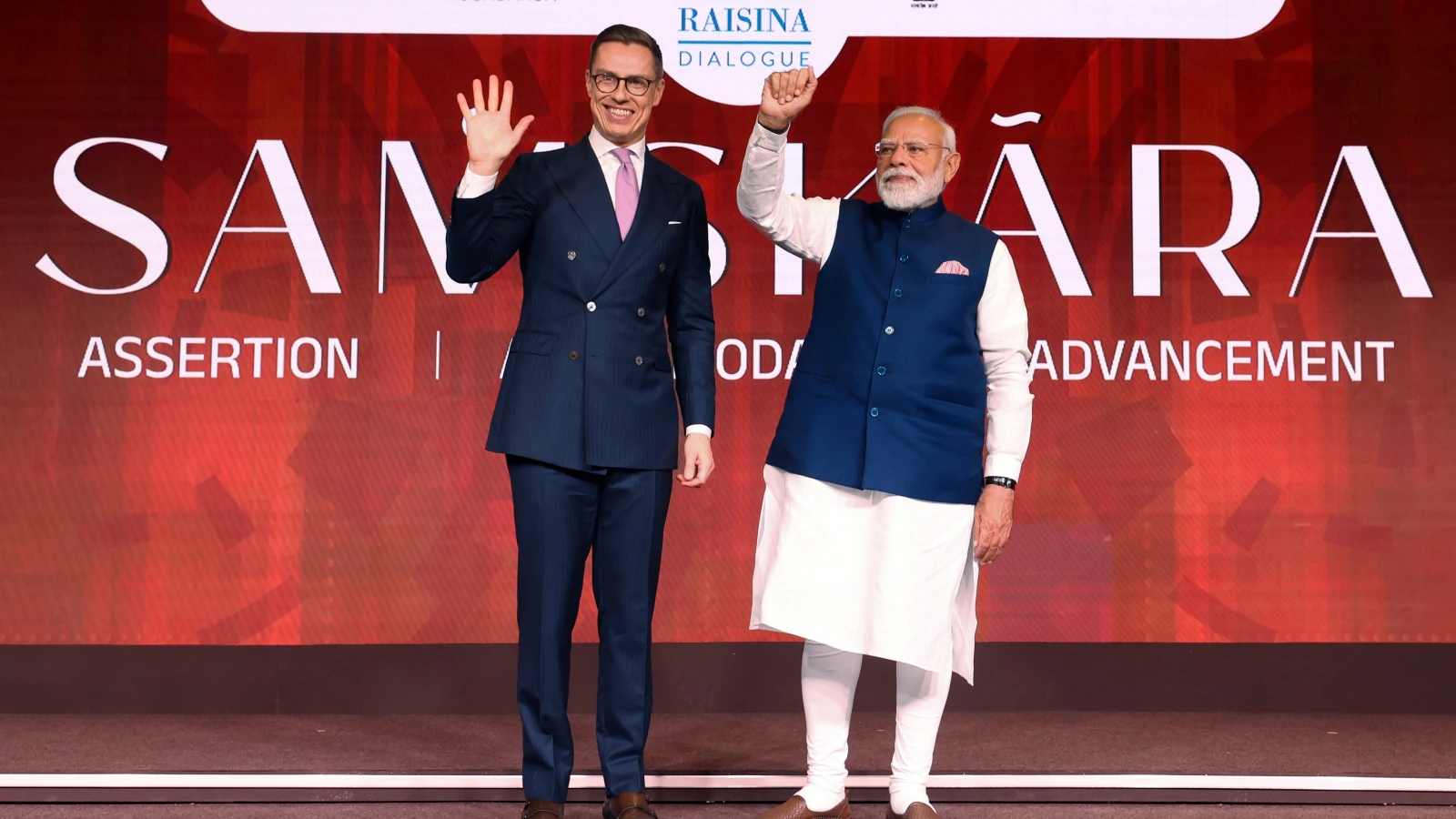
India and Finland elevated their ties to “Strategic Partnership in Digitalization and Sustainability”, after Prime Minister Narendra Modi and visiting Finnish President Alexander Stubb held bilateral talks in New Delhi on Thursday.
Following the talks, the two sides signed three pacts on mobility, environment and statistics, and set the aim to double bilateral trade by 2030; establish a joint working group on digitalisation, a joint task force on 6G and greater connectivity of startup ecosystems; co-host World Circular Economy Forum in India; and put in place a consular dialogue.
After the talks, PM Modi said, “At the beginning of 2026, the historic India-European Union Free Trade Agreement was concluded. This agreement (with Stubb) will further strengthen trade, investment, and technology cooperation between India and Finland. In areas such as digital technology, infrastructure, and sustainability, India and Finland are important partners.”
Citing examples of India-Finland cooperation, Modi, in a joint press statement at Hyderabad House, said that Nokia mobile phones and telecom networks have connected millions of people across India. With the cooperation of Finnish architects, India has built the world’s highest railway bridge over the Chenab River, he said. With Finland’s partnership, India has also established the world’s largest bamboo-to-bioethanol refinery in Numaligarh (Assam), Modi added.
“Inspired by such important examples, during President Stubb’s visit, we are elevating India-Finland relations to a Strategic Partnership in Digitalisation and Sustainability. This partnership will provide momentum and new energy to our cooperation across several high-technology sectors, from Artificial Intelligence to 6G telecommunications, and from clean energy to quantum computing,” he said.
“At the same time, our partnership will deepen further in key sectors such as defence, space, semiconductors, and critical minerals. This Strategic Partnership between democratic and responsible nations like India and Finland will contribute to ensuring trustworthy technologies and resilient supply chains for the entire world,” Modi said.
We should all become a little bit more Indian: Stubb
President Stubb said, “India, obviously, is one of the world’s largest and most influential countries and the world’s largest democracy, now a key strategic partner for Europe. Its importance in foreign and security policy and trade policies is difficult to overstate. You (India) are one of the fastest growing economies in the world that we can witness here every day. And what I really respect about your foreign policy is that you’ve never been under illusions. You’ve always based your foreign policy on a pragmatic and realistic worldview.”
Story continues below this ad
Stubb said, “You (India) have shown the rest of the world that strategic caution and safeguarding autonomy means a lot, all the while championing multilateralism and global corporation, and I believe, personally, that we should all become a little bit more Indian.”
Stating that Finland is increasingly becoming a preferred destination for Indian students and talent, and to connect the innovation ecosystems of two countries, Modi said, “Today, we have concluded a comprehensive Migration and Mobility Agreement with Finland.”
He said, “Along with this, we will further strengthen joint research and start-up collaboration. Finland is a role model in the field of education. Today, we have also agreed to enhance cooperation in teacher training, school-to-school partnerships, and research on the future of education.”
Stubb said, “There are over 20,000 Indians that reside in the capital region of Helsinki, and actually in Espoo… Finland has a population of 5.6 million, which is a little bit like a suburb in New Delhi…Our Indian friends are a very valued member of our society and contribute significantly to our economy and culture.”
Story continues below this ad
Underlining that Finland is an important partner for India in the Nordic region, Modi said, “Together with Finland, we are also enhancing our cooperation in Arctic and Polar research. A healthy planet is our shared priority. We are pleased that this year, together with Finland, we will host the World Circular Economy Forum in India. This will impart new momentum and fresh ideas to our efforts towards sustainability.”
Talking about geopolitical issues, he said, “We also share the view that reform of global institutions is not only necessary, but urgent in order to address the growing global challenges. Furthermore, eliminating terrorism in all its forms remains our shared commitment.”
Later in the evening, Stubb, while speaking at the Raisina dialogue organised by think tank ORF, said, “I am deeply concerned about what we see today in the Middle East, Sudan and Ukraine, just to name a few. My worry, though, is that these conflicts are incrementally becoming global. My aim today is to try to find a pathway back to an international order in which institutions, norms, and rules are respected. Without a functioning world order, power vacuums will be filled by raw power, rogue behaviour, and predatory hegemons.”
Stubb, who arrived in the Capital on Wednesday, also met President Droupadi Murmu, External Affairs minister S Jaishankar, among others. He will travel to Mumbai on Friday.