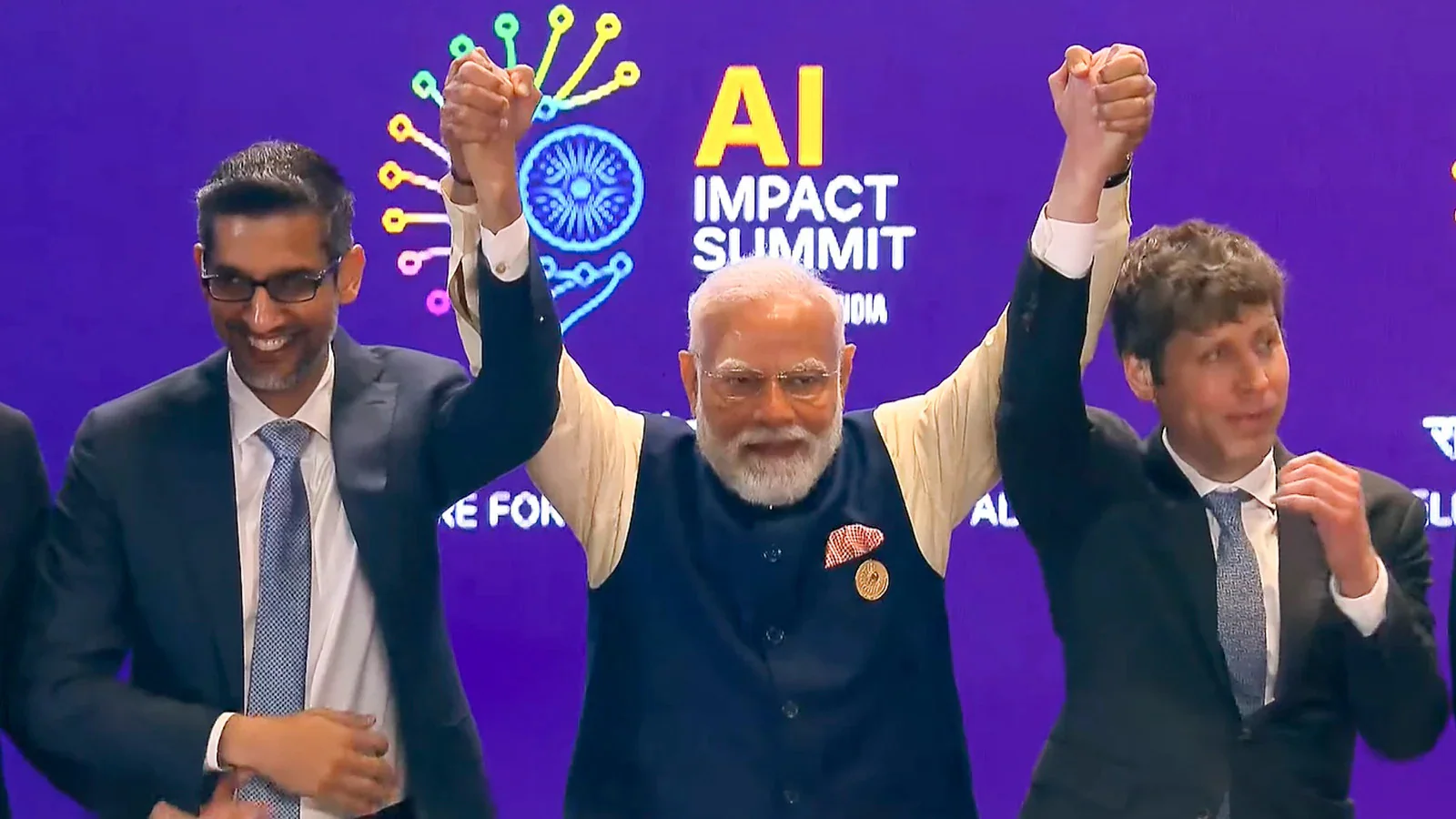
The AI Summit, which concluded in New Delhi on Friday, has proved to be a turning point for how the world will utilise the power of AI in the future, Prime Minister Narendra Modi said on Sunday in his monthly Mann Ki Baat address, adding that the “world witnessed India’s remarkable capabilities in the field of AI” at the event.
The PM said it “was the largest AI summit to date” and that “the enthusiasm and excitement of the youth for this summit was palpable”.
Modi said he had the opportunity to meet world leaders and tech CEOs at the event. “I showed the world leaders a lot of things at the AI Summit exhibition”, and two of these “greatly influenced world leaders,” said the PM.

“The first product was at Amul’s booth. It explained how AI is helping us treat animals and how farmers keep track of their dairy and livestock with the help of 24×7 AI assistance,” he said.
“The second product”, he added, “was related to our culture. Leaders around the world were amazed to see how, with the help of AI, we are preserving our ancient texts, our ancient knowledge, our manuscripts, and adapting them to suit today’s generation.”
Modi said, “The Sushruta Samhita was selected for display during the exhibition. The first step demonstrated how, with the help of technology, we are improving the image quality of manuscripts, making them readable. In the second step, this image was converted into machine-readable text. In the next step, the machine-readable text was read by an AI avatar. And then, in the next step, we also demonstrated how, with the help of technology, this precious Indian knowledge can be translated into Indian and foreign languages. World leaders showed great interest in learning about India’s ancient knowledge through its modern incarnation.”
He said that besides these achievements, “India also launched three made-in-India AI models.”
Modi mourns Aalin Sherin Abraham
The PM also took the opportunity to mourn 10-month-old Aalin Sherin Abraham, from Kerala, and lauded her parents for deciding to donate the child’s organs.
“There’s no greater sorrow for any parent than losing a child. The grief of losing a young child is even more profound”, he said, adding that Aalin “had a whole life ahead of her, which suddenly ended. So many dreams and joys remained unfulfilled. The pain her parents must be experiencing cannot be expressed in words.”
Story continues below this ad
He added, “But even amidst such profound pain, Aalin’s father Arun Abraham and mother Sherin made a decision that has filled every citizen of the country with respect. They decided to donate Aalin’s organs. This single decision reveals the breadth of their thinking and their immense personality. While they grieved the loss of their daughter, they were also filled with a spirit of helping others. They wanted no family to have to face such a day. Alin Sherin Abraham is no longer with us, but her name has been added to the list of the country’s youngest organ donors.”
Modi said that the “awareness about organ donation is steadily increasing in India these days” and “is helping those in need”. He said organ donation was also strengthening medical research in the country.
Citing a few other examples of organ donation, he said, “You will find many inspiring examples like this. This proves once again that one person’s kind gesture can change the lives of countless people.”
Indian cricketers and their overseas ‘karmabhoomi’
Modi’s address also highlighted how cricketers of Indian origin are playing in teams across the world, in their “karmabhoomi”, and termed it “the essence of Indianness”.
Story continues below this ad
“Sports also unite us. You must be watching the T20 World Cup matches these days. And I’m sure that while watching the match, your eyes must have often been fixed on a particular player. The jersey belongs to some other country, but hearing the name makes you feel like, hey, this guy is from our country. Then a slight joy fills a corner of the heart. Because that player is of Indian origin, and he is playing for the country where his family has settled.”
They enter the field wearing the jersey of their respective countries and represent that country wholeheartedly. The Canadian team has the highest number of players of Indian origin. The team’s captain, Dilpreet Bajwa, was born in Gurdaspur, Punjab. Navneet Dhaliwal is from Chandigarh. There are many names in this list, like Harsh Thakar and Shreyas Mowa, who are increasing the pride of Canada as well as India. Many faces in the American team have emerged from Indian domestic cricket. The captain of the American team, Monank Patel, has also played for the under-16 and under-18 teams of Gujarat.”
The PM said, “Players of Indian origin are also making their way into the teams of New Zealand, the UAE, and Italy. There are countless Indian-origin players who are bringing glory to their country and becoming an inspiration for its youth. This is the essence of Indianness. Wherever Indians go, they remain connected to the roots of their motherland and contribute to the development of their land of work, the country in which they live.”
Rajaji’s statue to replace that of Edwin Lutyens at Rashtrapati Bhavan
Story continues below this ad
Recalling his earlier calls for “freedom from the mentality of slavery”, the PM said, “Today, the country has left behind the symbols…and has begun to value things related to Indian culture.”
“Tomorrow, on February 23, Rajaji Utsav will be celebrated at Rashtrapati Bhavan. On this occasion, a statue of C Rajagopalachari will be unveiled in the central courtyard of Rashtrapati Bhavan. He was the first Indian governor-general of independent India. He was among those who viewed power not as a position but as a service. His conduct, self-restraint, and independent thinking in public life continue to inspire us. Unfortunately, even after independence, statues of British administrators were allowed to remain in Rashtrapati Bhavan, but those of the nation’s greatest sons were not given a place.”
Rajaji’s statue, he said, will replace the statue of British architect Edwin Lutyens currently installed in the Rashtrapati Bhavan.
Speaking of digital arrests and digital fraud, the PM said there had been considerable awareness in society after he spoke about them on Mann Ki Baat. “But unforgivable incidents are still occurring around us. Innocent people are being targeted by digital arrests and financial fraud. Many times, it’s revealed that a senior citizen has been swindled of their entire life savings,” he said.
Story continues below this ad
The PM stressed that “it’s crucial to remain vigilant and alert”.
KYC updates and password security
Modi urged countrymen not to be irritated by recurring prompts from banks to update KYC. “All of you must be aware of the process of KYC – Know Your Customer. Sometimes, when you get messages from your bank to update your KYC or get a re-KYC done, a question arises in your mind–I have already got my KYC done, then why this? I request you not to get irritated. This is only for the safety of your money. We all know that nowadays pensions, subsidies, insurance, UPI, and everything else are linked to the bank account. That is why banks do re-KYC from time to time, so that your bank account remains safe. Yes, in this also you have to remember one thing,” the PM said.
“Do not give OTP, Aadhaar number, or bank account-related information to anyone and most importantly, keep changing your password from time to time. Just like food and clothing change with every season, similarly, make it a rule that you have to change your password every few days,” he added.
Speaking of farmers, Modi said Indian farmers “today are blending tradition and technology, and…are now focusing not just on production but also on quality, value addition, and new markets.”
Story continues below this ad
In this connection, the PM recalled the story of a young farmer, Hirod Patel, in Odisha. Until about eight years ago, Patel used to cultivate rice in the traditional way with his father Shiv Shankar Patel, but he subsequently began to approach farming from a new perspective. Patel built a strong mesh structure over his farm’s pond, grew vine vegetables on it, planted bananas, guavas, and coconuts around the pond, and also started fish farming in the pond. This means traditional farming, vegetables, fruits, and fish are all happening in one place. “This led to better land use, water savings, and additional income. Today, farmers from far and wide come to see his model.”
The PM said that in a village in Kerala’s Thrissur district, 570 varieties of rice are grown in a single field, including local varieties, herbal varieties, and even those imported from other states. “This isn’t just farming, it’s a massive campaign to preserve seed heritage,” he said.
Modi said, “The results of our farmers’ hard work are evident in the statistics. Today, India has become the world’s largest rice producer. Producing over 150 million tons of rice is no small achievement. We are meeting our own needs and contributing to the world’s food basket.”
He added that agricultural products are now reaching foreign countries more easily than by air. “Karnataka’s Nanjangud bananas, Mysuru betel leaves, and Indi lemons have been shipped to the Maldives. These products are known for their taste and quality and have even earned GI tags. Today’s farmers seek quality, are also increasing quantity, and are establishing their own identity.”
‘Awakening of memory’ at Kerala Kumbh
Story continues below this ad
The PM also applauded the Maha Magha Festival, or Kerala Kumbh, held on the banks of the Bharatappuzha river in Tirunavaya, Kerala.
“Bathing in the sacred river during the month of Magha and making that moment an indelible memory for life is its very essence. Over time, this tradition seemed to have faded. For nearly two hundred and fifty years, the event wasn’t celebrated with the same grandeur as it once was. But today, as our country is re-acknowledging its heritage, history has taken a turn,” Modi said, adding that the event “was successfully held without any major announcements” but through word of mouth.
“Whether it’s the Maha Kumbh or the Kerala Kumbh, it’s not just a festival of bathing. It’s an awakening of memory. It’s a reclamation of culture. From north to south, the rivers may be different, the banks may be different, but the stream of faith is the same—this is India,” he said.
The PM also took the opportunity to pay tributes to the late Tamil Nadu chief minister and AIADMK leader J. Jayalalithaa, whose birthday falls on February 24.
Modi said she was one such popular leader who worked for the welfare of society and prioritised the public in their noble deeds.
Story continues below this ad
The PM said that “the mere mention of Amma Jayalalithaa brings a smile to the faces of the people of Tamil Nadu”.
Modi said that Jayalalithaa had taken concrete steps to maintain law and order in the state and was deeply patriotic and proud of India’s cultural heritage.