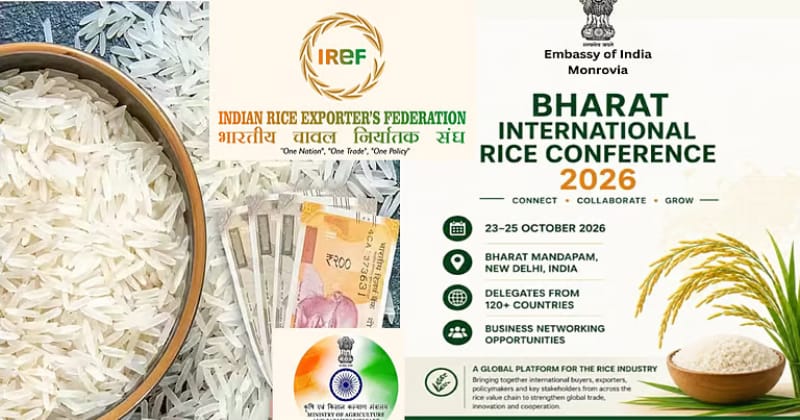
New Delhi : Rice industry body IREF on Wednesday said it has tied up with the International Rice Research Institute (IRRI), EY and S&P Global as knowledge partners for its upcoming conference in October.
Bharat International Rice Conference (BIRC) 2026 is scheduled to be held at Bharat Mandapam in the national capital during October 23-25. As many as 3,317 buyers from 138 countries have registered till August 30.
In a statement, Indian Rice Exporters’ Federation (IREF) said it has roped in three global institutions IRRI, EY and S&P Global, as knowledge partners.
“The participation brings together three distinct areas of expertise that are increasingly important for the global rice industry: scientific research and sustainability, market and commodity intelligence, and business strategy and transformation,” it said.
The tie-ups with three institutions would be valuable for the industry, which is currently facing changing global demand, volatile prices, evolving trade policies, rising logistics costs and increasing sustainability requirements, the federation said.
The BIRC 2026 has structured nine dedicated knowledge sessions around some of the key business questions facing the rice value chain.
These include global demand and supply outlook, price forecasting, new market opportunities, payment and credit risks, shipping, quality and certification, trade policy, sustainability, milling profitability and value-added products.
The participation of IRRI, EY and S&P Global in the upcoming global conference will help in holding meaningful discussions with data- and research-driven approach.
IRRI: bringing science into the rice value chain
As a global rice research institution, the IRRI brings scientific expertise covering rice production, farming systems, climate resilience and sustainable practices. Such knowledge has implications well beyond the farm gate.
Changes in production productivity and sustainability ultimately influence availability, quality, costs and the competitiveness of rice in international markets.
This connects directly with several BIRC Knowledge Sessions, including crop survey and price forecasting; sustainability and carbon credits; profitable rice milling and value-Added Products, the IREF said.
S&P Global: understanding the market behind the price
For rice exporters and buyers, market intelligence is becoming increasingly critical.
Rice prices are influenced by a combination of production estimates, weather, inventories, government policies, trade flows, freight costs, currency movements and demand from importing countries. A change in any one of these variables can alter the economics of a transaction.
S&P Global’s expertise in commodities, market intelligence, trade and related global economic data can therefore add an important market perspective to the BIRC discussions.
EY: translating information into business decisions
While research and market intelligence provide critical inputs, the ultimate test for businesses is how that information translates into decisions.
This is where EY’s business and strategic expertise can add another layer to the knowledge agenda.
For rice companies, questions around new markets, trade policy, documentation, insurance, credit, processing economics and value addition are ultimately questions of risk and profitability.
A new export market, for example, may offer strong demand but also involve payment risks, regulatory requirements, certification costs and logistical challenges.
Similarly, moving from commodity rice towards processed or branded products requires an assessment of investment, margins, consumer demand and scalability.
These issues are reflected in BIRC’s sessions on New Market Opportunities, Documentation, Insurance and Credit, Policy, Trade Schemes and Incentives, Profitable Rice Milling and Value-Added Products.
The objective, therefore, is not merely to understand what is happening in the market, but to assess what the industry should do about it.
Three institutions, one knowledge ecosystem
The significance of bringing IRRI, S&P Global and EY into the BIRC knowledge framework lies in the complementarity of their expertise.
IRRI brings the science and research perspective. S&P Global brings market and commodity intelligence. EY brings the business and strategic perspective. Together, these perspectives can create a knowledge chain extending from production and sustainability to global markets and, ultimately, business decisions.
That is particularly relevant for India’s rice industry, which operates across a complex ecosystem involving farmers, millers, exporters, logistics providers, processors, financial institutions and overseas buyers.
From information to actionable knowledge
The nine knowledge sessions are designed around questions that have direct commercial relevance for the industry.
Price forecasting addresses uncertainty. New market sessions focus on export opportunities. Documentation, insurance and credit address transaction risk. Shipping looks at logistics and margins. Quality and certification deal with market access. Policy sessions examine the changing trade environment, while sustainability, milling and value-added products address the industry’s longer-term competitiveness.
The common thread is the movement from information to decision-making.
For Indian rice exporters, millers and other industry participants, the value of the BIRC knowledge programme will ultimately depend on whether the insights generated can help them make better decisions on markets, pricing, risk, investment and competitiveness.
As the global rice trade becomes more data-driven and interconnected, industry knowledge is increasingly becoming a competitive asset.
BIRC 2026’s Knowledge Partnership with IRRI, EY and S&P Global could therefore mark an important shift in the way a rice trade platform approaches knowledge: not as an add-on to the business conversation, but as an integral part of it, the federation said.
The larger objective is clear: to bring scientific research, market intelligence and business strategy closer to the people making decisions across the global rice value chain.