LONDON: At a pharmacy in Tira, an Arab city in central Israel, a young cashier urged Amal to vote in the Israeli general election on Tuesday.
Amal is a Palestinian citizen of Israel, and the encounter reflected a sense of determination she has seen take hold among younger voters amid a desire to be heard in a country where many in her community have felt increasingly unsafe, or even targeted.
“Personally, I know we shouldn’t get too optimistic, but I’m proud — proud of the Arab community for standing together today,” said Amal, whose name has been changed to protect her identity. “People have realized that our future is on the line.”
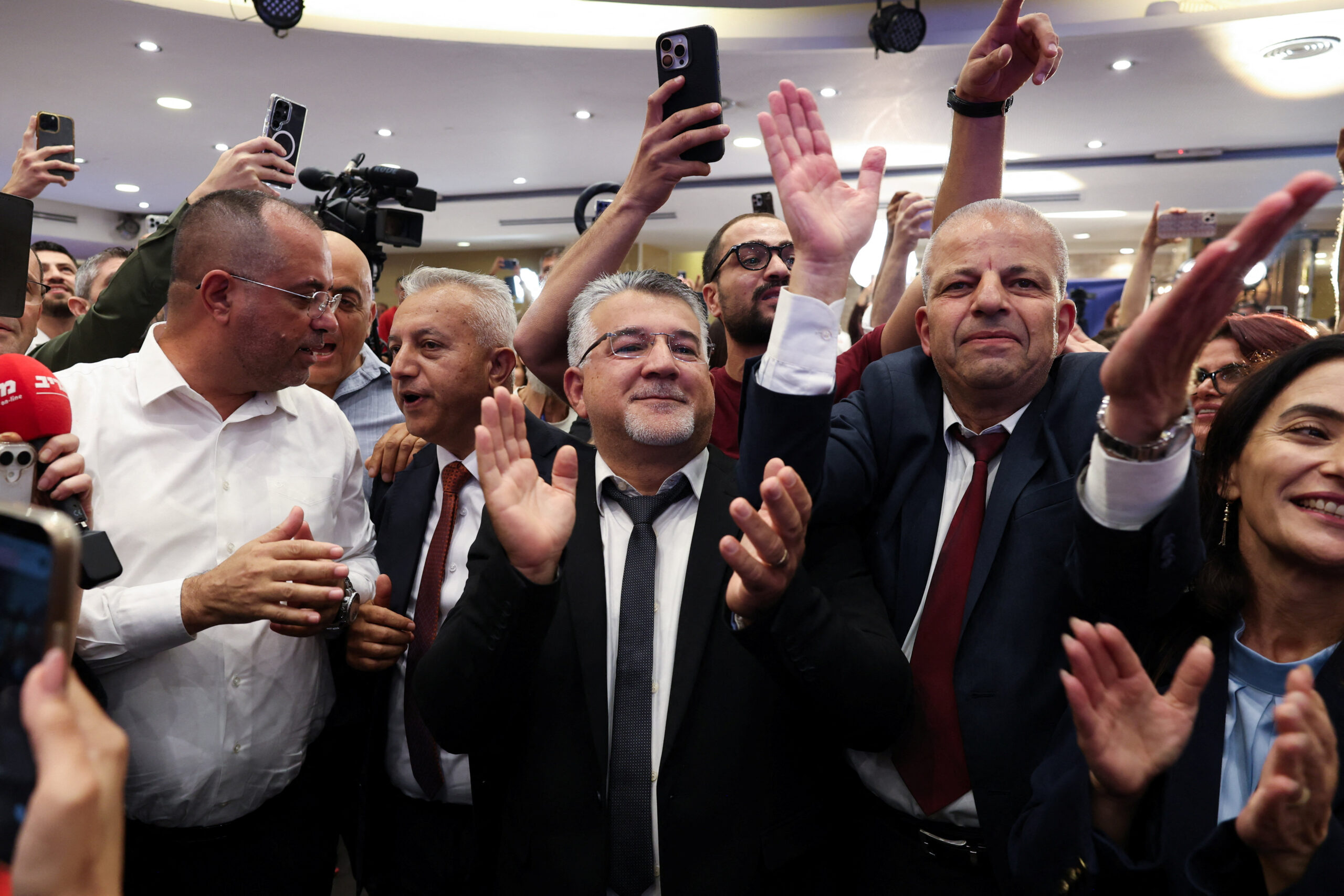
Arab citizens turned out in force to vote on Tuesday, driven by concerns about their safety and hopes of unseating Prime Minister Benjamin Netanyahu. But while exit polls suggested gains for Arab parties, they also pointed to a familiar obstacle: more seats would not necessarily translate into a role in government.
Neither of Israel’s main political blocs was likely to secure a governing majority, and an improved share of the vote could potentially provide Arab parties with greater leverage, if Netanyahu’s opponents were willing to work with them.
TV news station Channel 12 projected 50 seats for Netanyahu’s bloc, 52 for the opposition bloc led by former military chief Gadi Eisenkot, and 18 for Arab parties. Channel 13 predicted 50 seats for Netanyahu’s bloc, 53 for the opposition and 17 for Arab parties.
Sixty-one seats are required for a majority in the 120-member Knesset, Israel’s parliament. Exit polls are not official results, of course, and the balance of power could shift as ballots are counted.

For voters such as Amal, this uncertainty tempered an election day marked by pride, a sense of urgency and reports of long lines at polling stations in Arab communities.
Arab citizens, mostly of Palestinian heritage, account for about 21 percent of Israel’s population of 10 million people, according to Reuters. Turnout among them has traditionally lagged that of Jewish Israelis.
Sally Abed, a leader of the grassroots Standing Together movement, which brings together Arab Palestinian and Jewish Israeli citizens, and a member of Haifa city council, celebrated after casting her ballot with a message posted on social media platform X.
“I voted! As a Palestinian Arab woman and elected public official in Israel — this is an immense and incomprehensible privilege to vote and influence,” she wrote in Hebrew.
“Have a good day sending the fascists home and continuing to build a place where we all have the right to independence, security, and justice.”
The apparent mobilization of Arab voters prompted warnings from Netanyahu and his far-right allies, who urged their supporters to be sure to vote to counter the increased Arab participation. Arab politicians condemned the appeals as racist and inflammatory.
Netanyahu highlighted the queues at polling places in social media posts, including an image he said showed Arab voters. “If we don’t wake up now, we’ll find ourselves with a government of Mansour Abbas and Ahmed Tibi,” he said, referring to two leading Arab politicians.
Turnout reached 55.7 percent in the first nine hours of voting, the fastest pace on record, Reuters reported, citing statistics from the Israeli elections committee. Witnesses told the news agency that cars displaying flags in support of Netanyahu’s Likud party were driving through Jerusalem, broadcasting the Athaan, the Islamic call to prayer, and urging supporters to vote because the “Arabs are voting.”
Abbas, who leads the United Arab List, also known as Ra’am, accused Netanyahu of attempting to frighten greater numbers right-wing voters into turning out.
“Benjamin Netanyahu is lying and inciting against the United Arab List, using it as a scare tactic to mobilize right-wing voters and drive them to the polls,” Abbas said in a video message.
Sami Abu Shehadeh, leader of the Arab Balad party, said images of people lining up to vote should inspire “pride and joy to anyone who believed in democracy.”
Yet the prospect of stronger Arab representation carried with it a political paradox. Mairav Zonszein, a senior Israel-Palestine analyst at the International Crisis Group, said any gains among Arab parties could leave both of the main blocs further from a majority, which would complicate efforts to form a government and increase the pressure on Netanyahu’s opponents to cooperate with him.
“Although some Palestinians in Israel vote for Netanyahu or other right-wing parties, most will vote for one of the two Arab lists: Mansour Abbas’ party or the Joint List,” Zonszein told Arab News. “The more votes the Arab parties receive, the more seats they get.”
Winning those seats, however, was only the first hurdle.
“Much of the opposition would be resistant to forming a coalition with any Arab party, particularly the Joint List, although they might ultimately agree to do so,” she said. An agreement with Ra’am might be more likely, Zonszein added, depending on the final numbers of seats.
That leaves Arab voters hoping for a change of government facing the possibility that electoral gains for Arab parties could contribute to another political deadlock rather than a governing partnership — and if no party is able to assemble a ruling coalition within the time allowed for negotiations, a new election will have to be called.
“In some ways that’s counterintuitive, if you want a new government and want to avoid another election,” Zonszein said. “But it also puts more pressure on the opposition to work with Palestinian Arabs if they want to replace Netanyahu.”

Another uncertainty was whether smaller parties would manage to clear the electoral threshold of 3.25 percent of the national vote that is required to gain a seat in the Knesset, because higher turnout increases the number of votes required to qualify, Zonszein said. Parties that fall short receive no seats, potentially altering the balance between the blocs.
From Amal’s perspective, the calculations about coalitions and thresholds were inseparable from more immediate concerns about safety and representation. She described receiving recorded Arabic-language campaign messages from Jewish politicians promising to tackle crime in Arab communities. Their appeals exposed what she saw as a contradiction: the very parties whose rhetoric left her feeling threatened were now seeking Arab votes in the voters’ own language.
“They’re making promises we wished they had fulfilled when there wasn’t an election,” she told Arab News.
Among younger voters, Amal sensed a desire for something more lasting than mere campaign pledges.
“Young people are longing to see something fair, something with justice in it; something that represents them,” she said.
Whatever the final result when the votes were counted, Amal said she had found meaning in the scenes around her: young people encouraging others to vote; elderly women arriving at polling stations despite their pain; and a blind man accompanied by his wife so that he could vote.
“I am neither pessimistic nor optimistic,” she said of her thoughts about the ultimate outcome, “but I am very happy to see this awakening among our people.”