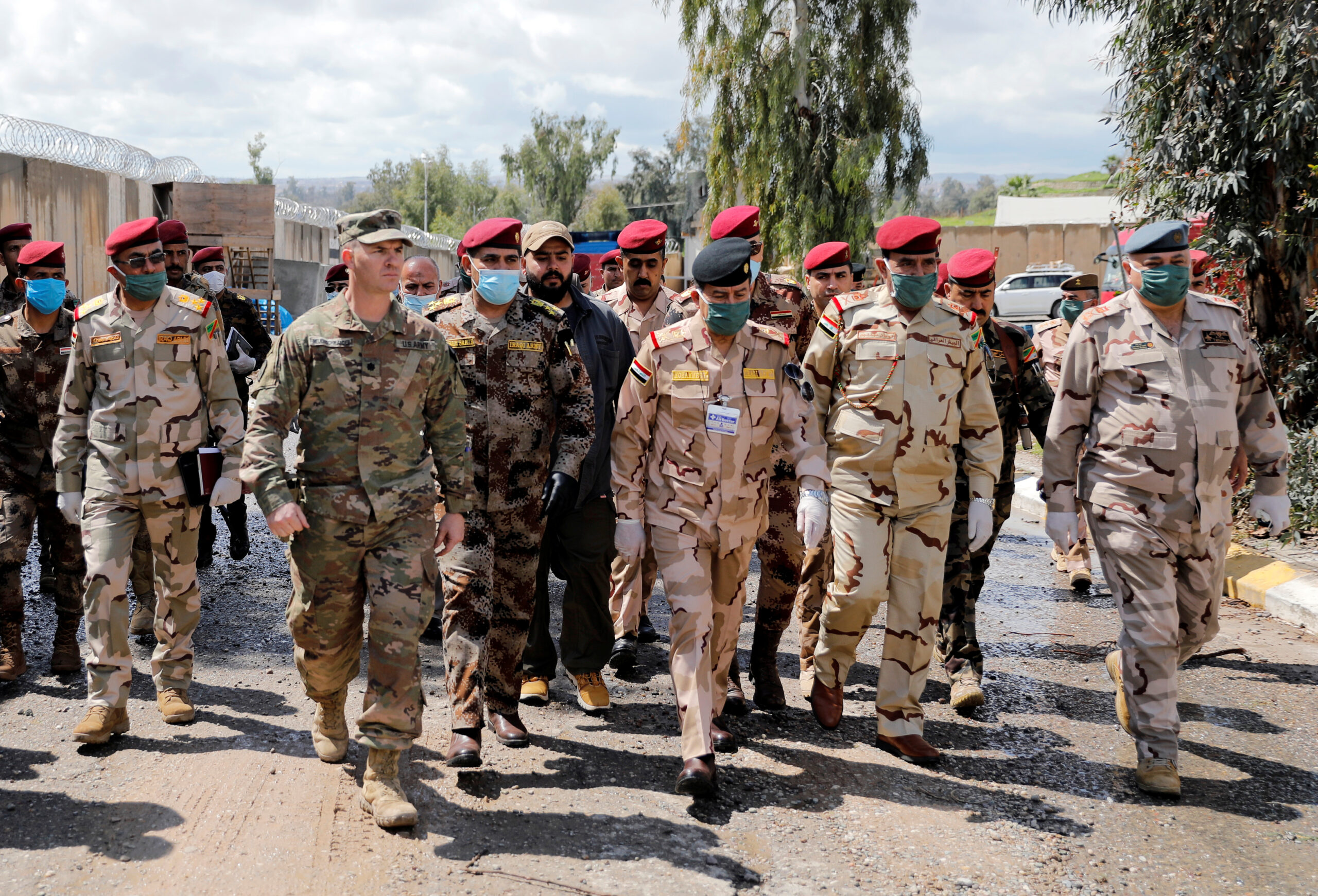
LONDON: When the last US troops leave their remaining bases in Iraq on Sept. 30, Baghdad will assume greater responsibility for a security landscape that remains complicated by two concurrent threats — the remnants of Daesh and powerful armed groups aligned with Iran.
The withdrawal marks the end of the US-led coalition’s military mission against Daesh in Iraq. Most US forces had already left bases elsewhere in the country, with the remaining contingent concentrated in the Kurdistan Region.
The US says Iraqi security forces, including the Kurdish Peshmerga, have developed the capabilities to lead the fight against terrorism. But the end of the military presence also removes some defense capabilities that Iraqi and Kurdish forces have relied upon.
Renad Mansour, deputy director for the Middle East and North Africa Programme and director of the Iraq Initiative at Chatham House, said Iraqi forces had already demonstrated their ability to contain Daesh without direct US military support.
“Iraqi security forces are now broadly capable of containing Daesh without direct US military support,” he told Arab News.
“We have effectively seen this tested since last September, when the Operation Inherent Resolve presence left Baghdad, without a significant deterioration in the counter-Daesh fight.”
There remain weaknesses, particularly around intelligence, surveillance and specialist capabilities, Mansour said. But he argued that Daesh was no longer Iraq’s principal security challenge.

Retired US army Col. Myles B. Caggins III, a senior nonresident fellow at the New Lines Institute and former spokesman for the Global Coalition to Defeat ISIS in Iraq and Syria, similarly said Iraqi and Kurdish forces could prevent Daesh from regaining territory.
“Without direct assistance of the US and Global Coalition, Iraqi Security Forces and Peshmerga are capable of preventing Daesh from mobilizing large groups of fighters and taking over villages,” he told Arab News.
But Caggins said the group remained a threat, pointing to a recent clash between Iraq’s elite Counter Terrorism Service and a small group of suspected terrorists in Kirkuk.
Mutlu Civiroglu, a journalist and analyst specializing in Kurdish affairs, said the ability of Iraqi forces to manage Daesh without US support would be “a big test that is yet to be seen.”
He told Arab News: “The ultimate price of failure could be very costly, and Daesh may return.”
Civiroglu said Washington was “heavily betting on the strengthened capabilities of the central government in Baghdad,” but warned that the approach carried significant risks.
“There are growing fears that Baghdad’s claims of readiness risk repeating the catastrophic mistake of the 2011 US withdrawal, which created the security vacuum that allowed Daesh to rise in the first place,” he said.
Joshua Landis, director of the Center for Middle East Studies at the University of Oklahoma, believes much now hinges on how robust the Iraqi state has become over the past decade.
“The sectarian nature of the Iraqi society and politics guarantees that a disgruntled radical minority may last for some time, but as the central state rebuilds its capabilities, despite its inadequacies and corruption, it will be able to suppress dissidents,” he told Arab News.
“After all, it was the destruction of the central state that led to the spread of Al-Qaeda and Daesh in the first place.”

The concern is not that Daesh is poised to recreate the territorial “caliphate” it controlled at its height. The group was defeated in Iraq in 2017 and in Syria in 2019, and its attacks have fallen sharply.
But its remnants remain active in desert and mountainous areas, while the wider regional environment could provide opportunities for an insurgency that has survived for years.
Civiroglu pointed to another complication: dozens of hardcore Daesh militants who have escaped Syrian prisons in recent months.
The burden is particularly acute because Iraq has also taken responsibility for thousands of suspected Daesh members transferred from detention facilities in Syria. More than 5,700 adult male suspects were transferred to Iraqi custody earlier this year.
That makes secure detention facilities and effective border controls a central part of the post-withdrawal security test.
For Civiroglu, Iraq’s vulnerabilities extend beyond the threat posed by individual Daesh cells. He said the country still faced “a lack of independent air support, poor surveillance over vast desert and mountain hideouts, and weak coordination along porous border areas.”
Mansour acknowledged those weaknesses but argued that the larger challenge lay elsewhere.
“The much bigger concern is the regional war and Iraq’s limited ability to insulate itself from it,” he said.
That shifts the focus from whether Iraqi forces can hunt down Daesh remnants to whether the Iraqi state can control what happens on its territory.

The challenge extends beyond counterterrorism. Federal Iraqi forces and Kurdish security services will need to coordinate across areas where security responsibilities and political authority have often overlapped or remained contested.
Kurdish leaders have repeatedly warned that the US withdrawal could expose the Kurdistan Region to greater risk.
Landis said the implications for Kurdish autonomy could extend beyond immediate military protection.
“Iraq’s Kurds are fearful that American withdrawal will mean the gradual diminishment, if not the end, of their autonomy,” he said.
Caggins highlighted a more immediate concern — the loss of US air-defense and counter-drone capabilities that have helped protect targets in Iraqi Kurdistan.
“America’s air defense, anti-drone technology has prevented Iranian drones from destroying civilian, diplomatic, and military targets in Iraq’s Kurdistan Region and, more broadly, Gulf nations and Jordan,” he said.
The removal of those systems, he added, could increase the vulnerability of the region and its neighbors to Iranian drones.
Caggins said the gap could be partly addressed by allowing the Kurdistan Regional Government and other US partners to purchase anti-drone systems directly.
Civiroglu said the Kurdish leadership had repeatedly sounded the alarm over the issue, warning that leaving the region without adequate protection against drones and missiles “leaves partners vulnerable by design.”

But the broader sovereignty problem is national rather than exclusively Kurdish.
Mansour said the Iraqi government “still cannot exercise full control over its territory or over all the armed groups operating within it.”
He added: “This is complicated by the fragmented nature of the Iraqi state. Many armed groups operate outside the government’s effective command while simultaneously being connected to, or formally embedded within, state institutions.
“That problem exists whether US troops remain in Iraq or not.”
The concern is not confined to Kurdish territory. The withdrawal comes as Iraq faces pressure to bring powerful Iran-backed factions under state control.
Many of these groups are formally incorporated into the Popular Mobilization Forces, which are part of Iraq’s security apparatus. But some of the most powerful factions retain independent chains of command, political influence and ties to Iran.
The government of Prime Minister Ali Al-Zaidi has sought to use the end of the US mission as a moment to push for the regulation or surrender of militia weapons. Yet some of the most powerful factions have rejected disarmament.
Caggins said the groups remained largely outside Baghdad’s effective control.
“Iranian-aligned rogue militia groups operating inside of Iraq remain unchecked and unwilling to fully submit to Baghdad’s authority,” he said.
“Hundreds of times this year, the outlaw groups have attacked targets inside of Iraq’s Kurdistan Region and nations in the Gulf region without much protest from Baghdad or Washington, D.C.”
That leaves Baghdad facing a different kind of security gap — not necessarily the collapse of the state, but the persistence of armed groups capable of acting independently of government decisions.

Landis sees those groups as the most enduring security problem created by the withdrawal, particularly for Washington.
“Iran-backed militias in Iraq will remain a major security risk to Americans and American objectives in the region, especially to its efforts to force the capitulation of the Islamic Republic of Iran,” he said.
Mansour said the withdrawal could alter the arithmetic for those armed groups, but would not resolve the underlying problem.
“A US withdrawal may change the calculations of armed groups and remove one potential source of US-Iran confrontation on Iraqi soil, but it does not resolve the underlying sovereignty problem,” he said.
Civiroglu said the threat from Iran-backed groups was “very high” because they face limited domestic resistance.
“Without US forces acting as a counterweight, these factions can further tighten their grip over Iraq’s state institutions, key borders, and security decisions while steadily sidelining the regular army,” he said.
He also warned that the groups retained the ability to launch drones and rockets across the region whenever tensions between Tehran, Washington and Israel flare up.
In September, Saudi Arabia said drones launched from Iraq struck its East-West oil pipeline, a strategically important route to the Red Sea. Baghdad later confirmed that the drones originated in Iraq and dismissed the military commander overseeing operations in Maysan Province.
The incident underscored the question facing Gulf capitals after the US withdrawal — whether Baghdad can prevent armed groups operating from Iraqi territory from dragging Iraq and its neighbors into wider regional conflicts.

Civiroglu said the withdrawal increased the risk that Iraq could become “an unconstrained launching pad” against its Gulf neighbors.
“Their oil facilities, ports, and critical infrastructure sit within easy range of drone and rocket attacks fired from Iraqi territory without clear fingerprints,” he said.
For Gulf states, the security test therefore extends beyond whether Daesh stages a comeback. They will be watching whether Iraq can prevent attacks launched from its territory, protect neighboring energy infrastructure and maintain intelligence cooperation.
“At the same time, if Baghdad fails to contain the threat and Daesh stages a comeback, that instability will quickly spill across borders and directly jeopardize Gulf security,” Civiroglu said.
Landis said the withdrawal would also force Gulf states to reassess their own security posture.
“US withdrawal means that the Gulf countries must look to a future with diminished US capabilities in the region,” he said. “They will increasingly be left on their own and will have to build up their military forces and pursue diplomacy with their neighbors.”
Mansour concurs.
“For Iraq’s Gulf neighbors, the greater risk therefore comes less from a resurgence of Daesh than from Iraq becoming an arena for the wider regional conflict,” he said.
“As long as Baghdad cannot fully control armed actors or prevent its territory from being used in regional confrontations, escalation between Washington and Tehran can spill across Iraq’s borders and affect the security of the Gulf more broadly.”