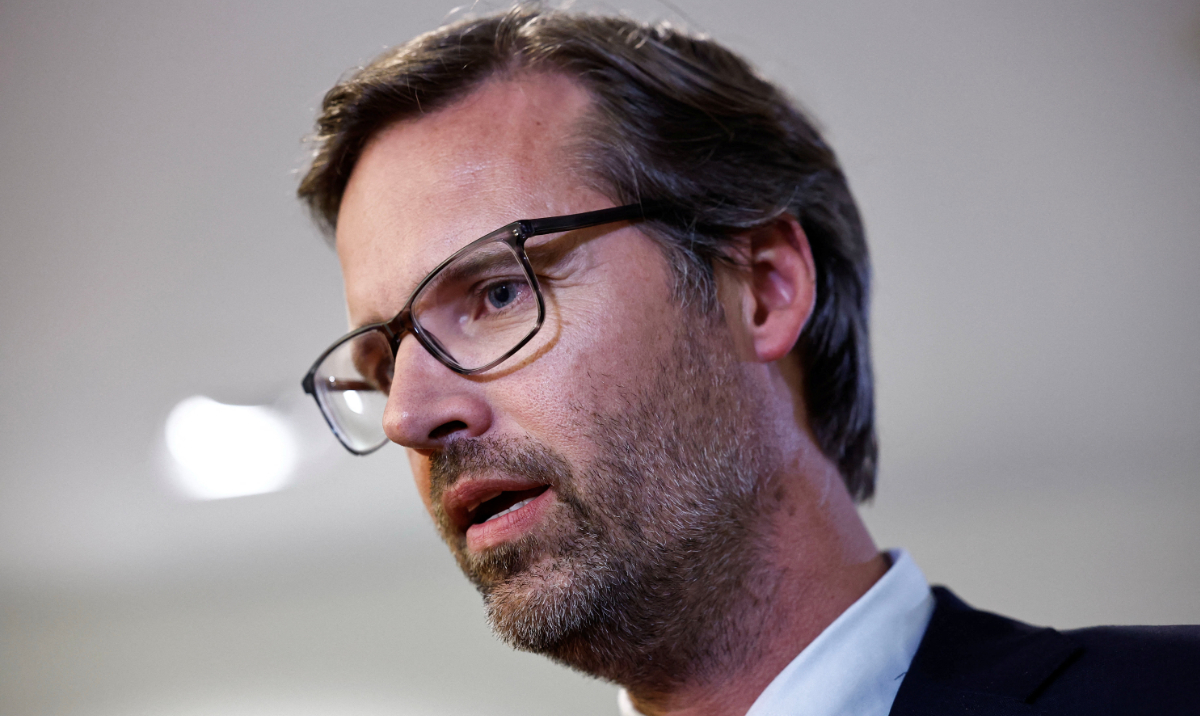

NEW YORK: The Netherlands, long one of Israel’s closest allies in Europe, is building an international coalition to medically evacuate at least 1,000 sick and injured children from Gaza as its relationship with the Israeli government reaches a low point over the war, the Dutch minister for foreign trade and development cooperation told Arab News.
Speaking on the sidelines of the 81st UN General Assembly in New York, Sjoerd Sjoerdsma said the scale of suffering among Gaza’s children left his government with no choice but to act.
“The amount of children in Gaza who are injured or sick is staggering and it’s inhumane,” he added. “It’s unacceptable that aid isn’t reaching these children. That’s why we must bring those children to their treatment.”
He struck the same note at a “Call to Action for Palestinian Children” hosted by the EU, Belgium and Jordan on Wednesday, where he condemned Israel’s restrictions on aid. “We should call it as it is, it’s a disgrace,” he told delegates.
The Dutch cabinet has announced a €12 million ($13.6 million) package for urgent medical care for sick children from Gaza, including the evacuation of 250 seriously ill and injured children to Jordan for treatment.
The Netherlands will work with the World Health Organization, and its €6 million share will fund the evacuations under an initiative launched by Jordan’s King Abdullah II in early 2025 to treat 2,000 children from Gaza.
The need far outstrips the effort. According to WHO, 18,500 patients are awaiting medical evacuation from Gaza, and whether the Dutch-funded transfers go ahead also depends on Israel granting permission.
For many Palestinians, evacuation raises a deeper fear: that those who leave will never be allowed back. “I understand this fear completely, and this is why I’m also here in New York,” Sjoerdsma said.
The aim is to get at least 1,000 children out, ideally by the end of the week, he added, while building “a diplomatic coalition to ensure … that those children don’t only get out for medical treatment, but they can also rejoin their family and friends back home in Gaza.”
The Hague argues that treatment in the region is the more humane option. Sjoerdsma said the choice is simple when for every Gazan child treated in the Netherlands, 40 or 50 can be treated in Jordan.
The Hague is also pressing Israel to reopen the medical corridor to the West Bank, where roughly 90 Gazan patients a day received specialist treatment before October 2023.
Sjoerdsma placed responsibility for the crisis squarely on Israel: “We’ve seen a tremendous catastrophe unfold in Gaza, and this isn’t a natural disaster. This is being done by the Israeli government.”
That conviction, he said, has pushed the Netherlands to take a “frontrunner’s role” within the EU in trying to halt the Israeli government’s actions.
On Tuesday, the Netherlands banned the import, purchase and sale of goods from illegal Israeli settlements.
The Dutch ban goes further than some others, also covering services that facilitate the trade and attempts to circumvent it.
Its reach extends beyond the Dutch market because the Netherlands is a major gateway for goods entering Europe.
More than 10 other countries are now following the Dutch lead, Sjoerdsma said, and The Hague is pushing to freeze the trade part of the EU-Israel Association Agreement.
“Unfortunately, we don’t have a majority here yet,” he added. “We really want to make sure that international law, international humanitarian law and Palestinian lives are put right front and center.”
He and Foreign Minister Tom Berendsen are working “in tandem” to persuade their European counterparts.
“The time for just words is over. We also need actions, and we need actions to ensure that the Israeli government reconsiders its course,” Sjoerdsma said, stressing that the dispute is with the country’s leaders, not its people.
“We’re great friends with the Israeli population. We care for their security, but with their government we have major problems.”
Mending ties, he said, depends on four things. “Israel needs to adhere to international law, to international humanitarian law. It needs to allow humanitarian aid into Gaza unhindered. It needs to cease its settlement activity on the West Bank. And it needs to show a constructive attitude to the two-state solution, to show that a Palestinian state and an Israeli state can exist side by side.”
The Netherlands was not among the Western countries that recognized Palestine around last year’s high-level conference on the two-state solution co-chaired by Saudi Arabia and France.
The Dutch government’s position is that recognition must serve the political process, with the parties negotiating toward a secure Israel and a viable Palestinian state. The question is “hotly debated” in parliament, which remains divided, Sjoerdsma said.
“But where we aren’t divided, neither the cabinet nor the parliament, is that we need to do everything we can to make sure that international law is being restored and that Palestinians are getting the help they need. When lives are on the line, this is what we must do.”
The shift in The Hague has tracked a transformation in Dutch society. An Ipsos I&O survey in September 2025 found that 58 percent of Dutch respondents wanted their government to be more critical of Israel and take more action against it.
The mood has reached cultural life too: Public broadcaster AVROTROS did not take part in or broadcast the 2026 Eurovision Song Contest because of the war in Gaza.
For Sjoerdsma, that shift is the message he is carrying to Israeli officials. “I think it shows a fundamental shift in Dutch public opinion as to our relationship with the Israeli government,” he said.
“This is also what I’m telling our Israeli colleagues: Please help us renew our friendship. Change your course.”