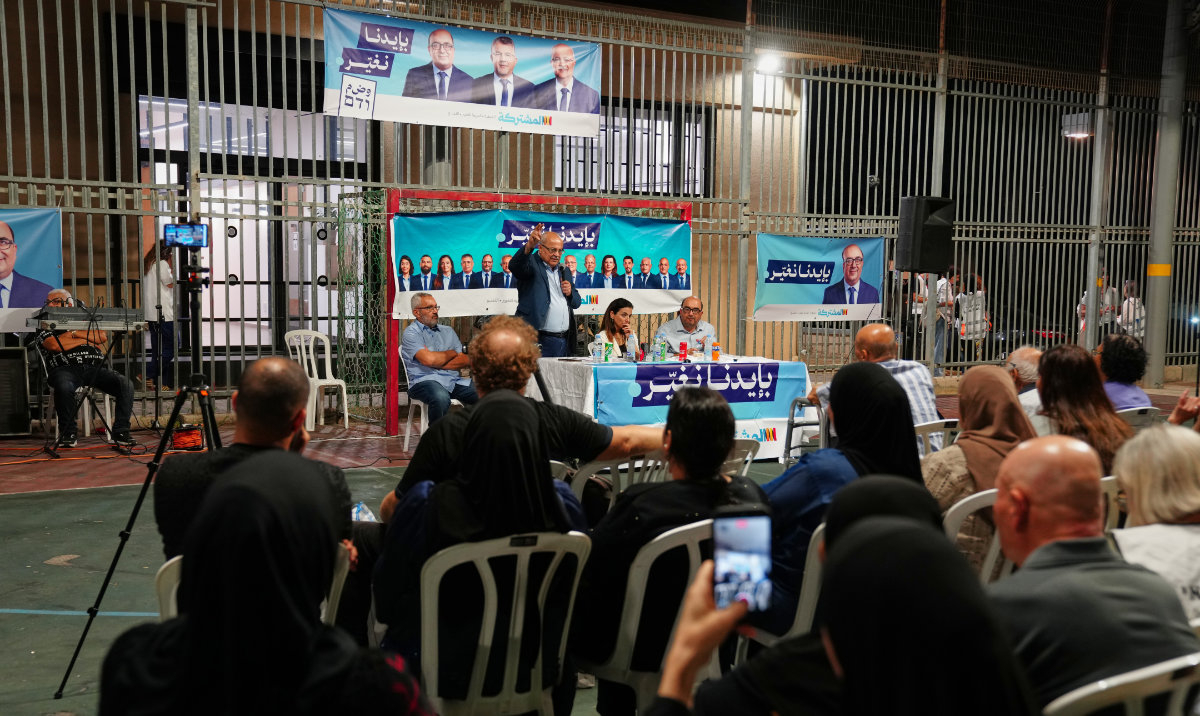

MAJD AL-KRUM, Israel: After boycotting Israeli parliamentary elections his entire life, 55-year-old Said Kabat will head to the polls for the first time on October 27.
For him, the vote is existential — if a right-wing government is returned to power, he fears for the future of Israel’s Arab minority, to which he belongs.
The pharmacist from the Arab village of Majd Al-Krum in northern Israel told AFP he used to boycott elections “all the time.”
“But now, I will go out and vote,” he said, concerned that a low turnout among the Arab population would embolden the far-right elements of the current ruling coalition.
Arab Israelis, also known as Palestinian citizens of Israel, account for about 21 percent of the country’s population.
They are descendants of Palestinians who remained within Israel’s borders after the state’s creation in 1948, and have long complained of discrimination compared with Israel’s Jewish majority.
The close-fought election is sparking calls for a mobilization push among Israel’s Arab population, after their situation worsened under the outgoing government of Prime Minister Benjamin Netanyahu — one of the most right-wing in the country’s history.
Driven by far-right ministers Itamar Ben Gvir and Bezalel Smotrich, settlement construction in the occupied West Bank has soared, and their attention is now turning to predominantly Arab areas inside Israel.
In September, land belonging to Kabat’s family in Majd Al-Krum was the site of a confrontation between residents and Jewish Israelis who came to establish an outpost — a tactic used by West Bank settlers to take control of land.
Israeli police eventually removed the outpost, which had garnered the backing of Smotrich, who held a rally at the site and in August unveiled a plan to “Judaise” Israel’s predominantly Arab regions.
“In light of the events, whether in Majd Al-Krum or other villages, I urge every young person and everyone with a vote to cast it,” Kabat said.
‘Battle for existence’
Turnout among the Arab minority has traditionally been lower than Israel as a whole.
In the last election in November 2022, turnout among Arab and Druze voters was around 53 percent, while the country’s overall figure stood at around 70 percent.
In Majd Al-Krum, activists like 31-year-old Dana Salameh were touring the village to explain the importance of voting.
“Everyone, even those boycotting and those unconvinced about voting, has begun to see the danger very close to them if this government remains in power,” Salameh said.
“They don’t want Arabs in this state at all… whether here or in Gaza or the West Bank,” she added.
On October 27, the Arab vote is expected to be split among four parties running on two lists.
The far-left Joint List brings together three parties, while Raam, or the United Arab List, is more open to negotiating with the right.
Raam became the first Arab party to join an Israeli government in a 2021-2022 coalition, and it could again play a kingmaker role this year.
A recent poll by Israel’s Channel 12 projected that the two lists would garner 13 seats in the next Israeli parliament. They currently have 10 between them.
For Salameh, the poll is evidence of a growing conviction among Israel’s Arab citizens that they are facing “a battle for existence.”
Surging crime levels within the community could also push people toward the ballot box.
Since the start of 2026, at least 175 Arab citizens have been killed in violent crime incidents, according to the Abraham Initiatives coexistence organization.
The violence is predominantly driven by criminal gangs, with Arab Israelis accusing the police — under the ministerial responsibility of Ben Gvir — of lax enforcement.
“The state has completely withdrawn from the scene,” said criminologist Walid Haddad.
‘Change is in our hands’
In Majd Al-Krum, home to about 17,000 people, campaign billboards for the Joint List have popped up bearing the slogan “The change is in our hands.”
Several homes in the village face the threat of demolition, reflecting the reality for Arab localities across the country.
Israeli authorities say the houses were built without permits or on state-owned land, but Palestinians say permits are near impossible to obtain.
In the city of Tayibe in central Israel, around 40 members of the Abu Mtair family face the looming threat of displacement, waiting for a decision on demolition orders that have been temporarily frozen.
“I cannot imagine this right-wing government returning,” said Akram Abu Mtair, 47, urging the city’s residents to vote.
Further south, in the Negev desert, Israeli bulldozers recently demolished around 80 structures housing about 400 people in the Bedouin village of Al-Dahiya.
For Adnan Abu Wadi, who was left homeless with his four children, the demolitions were nothing more than an election stunt.
“People will turn out to vote in large numbers. We will vote as Arabs to change the government and remove the extremists.”