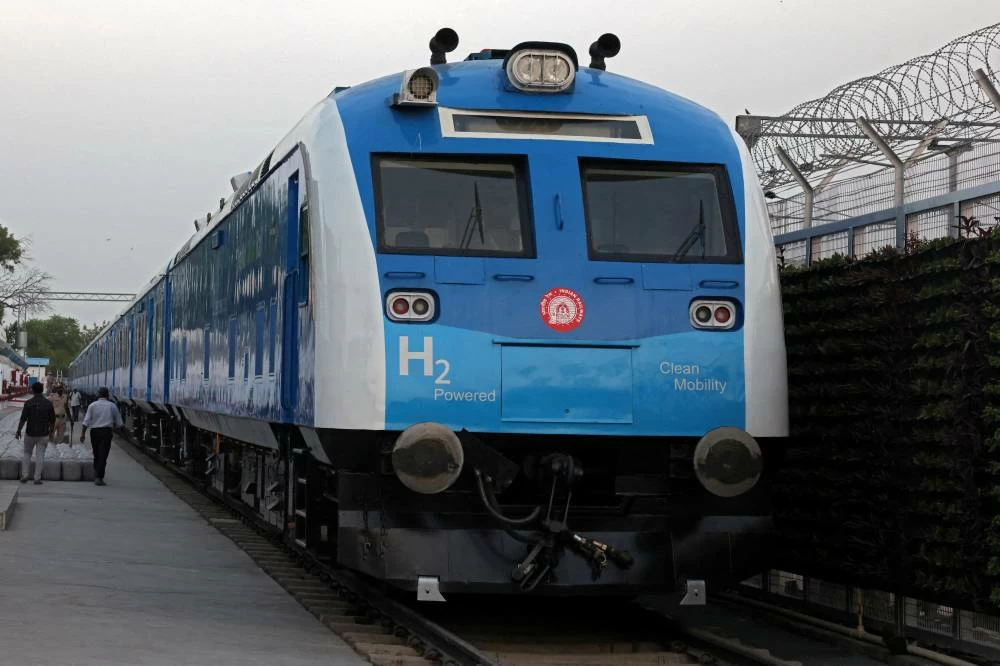
Indian Prime Minister Narendra Modi launched the country’s first hydrogen-powered train on Friday, making it one of a handful of nations to use the zero-emission, clean fuel technology.
India joins a select group of countries, including Germany, Japan, China and the United States, with such trains. They produce only heat and water vapour as by-products, a cleaner alternative to traditional diesel locomotives.
The 10-coach train set, which has a capacity of 2,600 passengers, will run twice a day between the cities of Jind and Sonipat in the northern state of Haryana, bordering the national capital of Delhi.

After flagging the hydrogen train on its 90-km (55-mile) route, Modi said India would continue to find ways to improve efficiency, reduce costs and expand the network.
“The project combines advanced propulsion technology with dedicated hydrogen storage, refuelling and operational infrastructure,” a government statement said on Thursday.
The train set, designed, engineered and built in India, is expected to operate at a maximum speed of 75 km (47 miles) per hour, powered by a 1,200-kilowatt hydrogen fuel cell propulsion system.
India has electrified nearly all of its 70,000-km (43,500-mile) broad-gauge network, one of the world’s largest, in an effort to achieve net zero carbon emissions in its railways by 2030.